## Diagram: Cognitive and Metacognitive Processing Model
### Overview
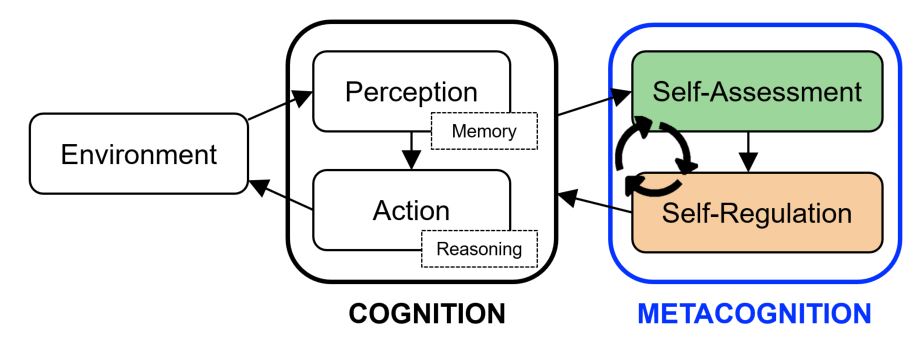
The diagram illustrates a two-stage cognitive framework: **COGNITION** (left) and **METACOGNITION** (right). It depicts the flow of information from the **Environment** through perceptual and action-based processing, followed by self-assessment and self-regulation mechanisms.
### Components/Axes
- **COGNITION** (black-outlined box):
- **Perception**: Receives input from the Environment.
- **Memory**: Linked to Perception (dashed arrow).
- **Action**: Receives input from Perception.
- **Reasoning**: Linked to Action (dashed arrow).
- **METACOGNITION** (blue-outlined box):
- **Self-Assessment**: Receives input from COGNITION (dashed arrow).
- **Self-Regulation**: Receives input from Self-Assessment and feeds back into it (bidirectional dashed arrows).
### Detailed Analysis
- **Environment**: Positioned outside the COGNITION box, it is the source of external stimuli.
- **Perception**: Central to COGNITION, it processes environmental input and connects to Memory (dashed arrow).
- **Memory**: Subordinate to Perception, with no direct external input.
- **Action**: Receives processed information from Perception and connects to Reasoning (dashed arrow).
- **Reasoning**: Subordinate to Action, with no direct external input.
- **Self-Assessment**: Part of METACOGNITION, it evaluates cognitive outputs (dashed arrow from COGNITION).
- **Self-Regulation**: Part of METACOGNITION, it modulates cognitive processes via feedback loops (bidirectional dashed arrows with Self-Assessment).
### Key Observations
1. **Unidirectional Flow in COGNITION**: Information flows from Environment → Perception → Action, with Memory and Reasoning as auxiliary processes.
2. **Bidirectional Feedback in METACOGNITION**: Self-Assessment and Self-Regulation form a closed-loop system, enabling adaptive adjustments.
3. **Dashed Arrows**: Indicate indirect or supportive relationships (e.g., Memory supports Perception but does not drive it).
### Interpretation
This model emphasizes the interplay between **bottom-up processing** (COGNITION) and **top-down regulation** (METACOGNITION). The Environment initiates cognitive activity, which is refined through metacognitive mechanisms like self-assessment and regulation. The dashed arrows suggest that Memory and Reasoning are secondary to Perception and Action but still integral to the system. The bidirectional feedback in METACOGNITION highlights the dynamic nature of self-regulation, where evaluation and adjustment occur iteratively.
No numerical data or trends are present; the diagram focuses on conceptual relationships rather than quantitative analysis.