## Bar Chart: Llama-2-7b-chat-hf Attack Success Rate vs. Ablated Head Numbers
### Overview
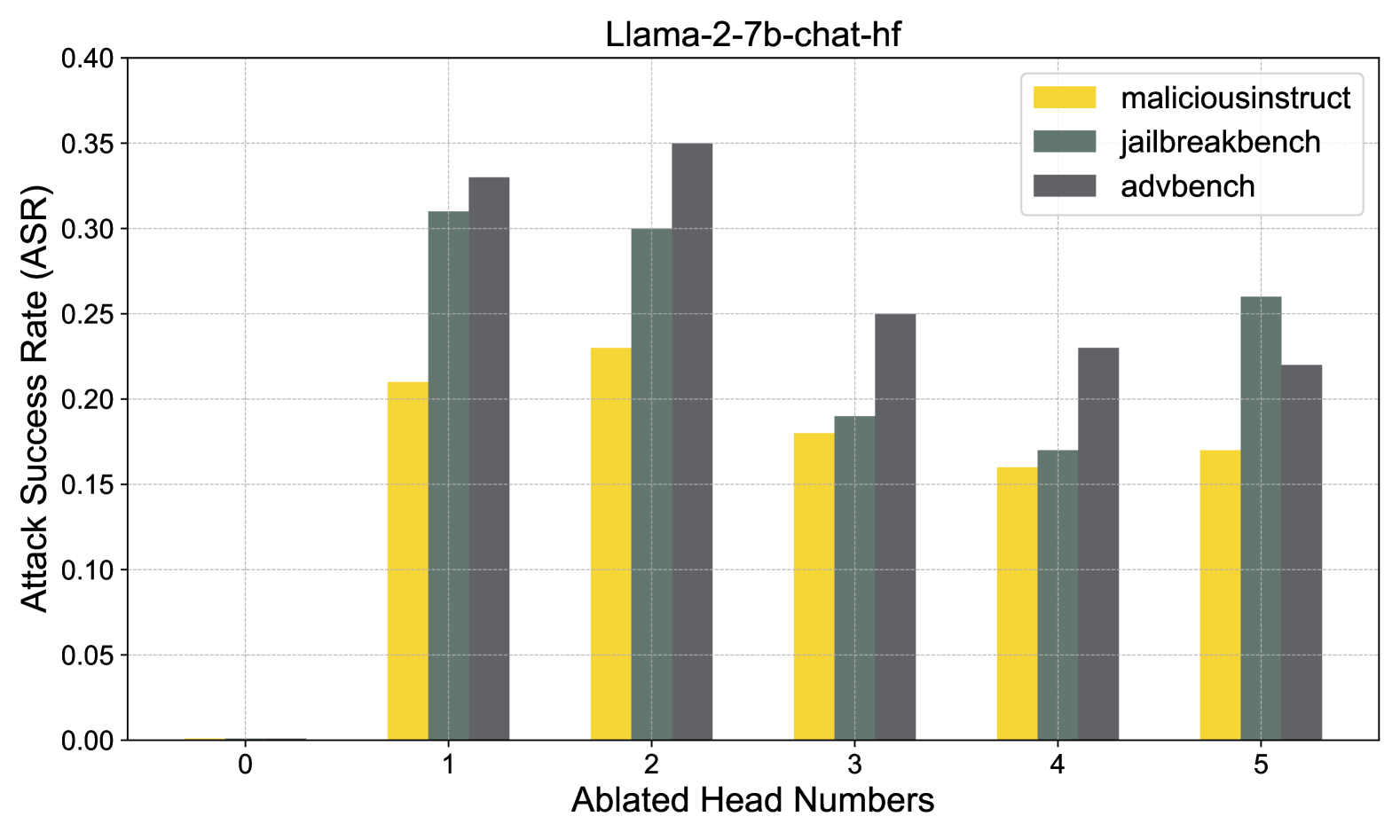
The image is a bar chart comparing the attack success rate (ASR) of the Llama-2-7b-chat-hf model against three different attack methods (maliciousinstruct, jailbreakbench, and advbench) as the number of ablated heads increases from 0 to 5.
### Components/Axes
* **Title:** Llama-2-7b-chat-hf
* **X-axis:** Ablated Head Numbers, with values 0, 1, 2, 3, 4, and 5.
* **Y-axis:** Attack Success Rate (ASR), ranging from 0.00 to 0.40, with increments of 0.05.
* **Legend:** Located in the top-right corner.
* Yellow: maliciousinstruct
* Dark Grey: jailbreakbench
* Grey: advbench
### Detailed Analysis
The chart displays the attack success rate for each attack method at each level of head ablation.
* **Ablated Head Number 0:**
* maliciousinstruct: Approximately 0.00
* jailbreakbench: Approximately 0.00
* advbench: Approximately 0.00
* **Ablated Head Number 1:**
* maliciousinstruct: Approximately 0.21
* jailbreakbench: Approximately 0.31
* advbench: Approximately 0.33
* **Ablated Head Number 2:**
* maliciousinstruct: Approximately 0.23
* jailbreakbench: Approximately 0.30
* advbench: Approximately 0.35
* **Ablated Head Number 3:**
* maliciousinstruct: Approximately 0.18
* jailbreakbench: Approximately 0.19
* advbench: Approximately 0.25
* **Ablated Head Number 4:**
* maliciousinstruct: Approximately 0.16
* jailbreakbench: Approximately 0.17
* advbench: Approximately 0.23
* **Ablated Head Number 5:**
* maliciousinstruct: Approximately 0.17
* jailbreakbench: Approximately 0.26
* advbench: Approximately 0.22
### Key Observations
* When no heads are ablated (0), the attack success rate is near zero for all three methods.
* The attack success rate generally increases when moving from 0 to 1 ablated head.
* The advbench method consistently shows a higher attack success rate than the other two methods for ablated head numbers 1, 2, 3, 4.
* The jailbreakbench method consistently shows a higher attack success rate than the maliciousinstruct method for ablated head numbers 1, 2, 3, 4, 5.
* The attack success rate varies with the number of ablated heads, suggesting that certain heads are more critical for the model's robustness against these attacks.
### Interpretation
The data suggests that ablating heads in the Llama-2-7b-chat-hf model can impact its vulnerability to different types of attacks. The increase in attack success rate when moving from 0 to 1 ablated head indicates that removing even a single head can compromise the model's security. The varying attack success rates across different numbers of ablated heads suggest that some heads are more important for maintaining robustness against specific attack methods. The advbench method appears to be the most effective at exploiting vulnerabilities in the model, followed by jailbreakbench and maliciousinstruct. This information could be valuable for understanding the model's weaknesses and developing strategies to improve its security.