## Bar Chart: MetaQA 1-Hop Hit@1 Scores for Different N and K
### Overview
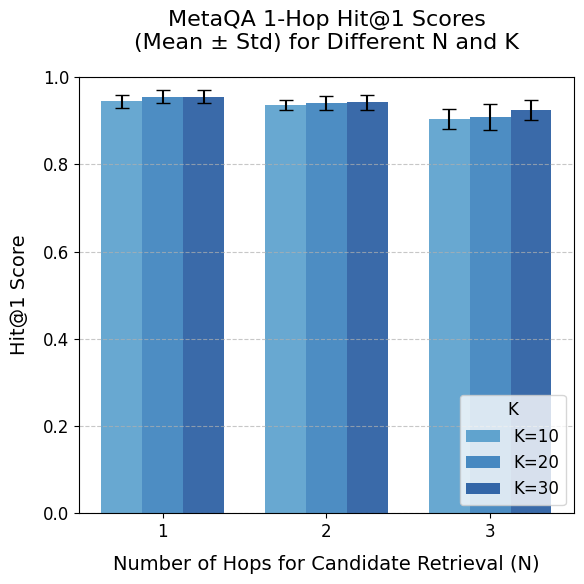
This bar chart displays the MetaQA 1-Hop Hit@1 scores, presented as mean values with standard deviation error bars, for varying numbers of hops (N) in candidate retrieval and different values of K (number of candidates considered). The chart aims to illustrate the performance of a system across different configurations.
### Components/Axes
* **Title:** MetaQA 1-Hop Hit@1 Scores (Mean ± Std) for Different N and K
* **Y-axis Title:** Hit@1 Score
* **Y-axis Scale:** Ranges from 0.0 to 1.0, with major grid lines at 0.0, 0.2, 0.4, 0.6, 0.8, and 1.0.
* **X-axis Title:** Number of Hops for Candidate Retrieval (N)
* **X-axis Markers:** 1, 2, 3
* **Legend:** Located in the bottom-right corner.
* **Title:** K
* **Entries:**
* Light blue: K=10
* Medium blue: K=20
* Dark blue: K=30
### Detailed Analysis or Content Details
The chart presents data for three distinct values of N (1, 2, and 3), and for each N, there are three bars representing different values of K (10, 20, and 30).
**For N=1 (Number of Hops for Candidate Retrieval = 1):**
* **K=10 (Light blue bar):** The mean Hit@1 score is approximately 0.95. The error bar extends slightly above and below this value, indicating a standard deviation of roughly ±0.02.
* **K=20 (Medium blue bar):** The mean Hit@1 score is approximately 0.96. The error bar indicates a standard deviation of roughly ±0.02.
* **K=30 (Dark blue bar):** The mean Hit@1 score is approximately 0.96. The error bar indicates a standard deviation of roughly ±0.02.
**For N=2 (Number of Hops for Candidate Retrieval = 2):**
* **K=10 (Light blue bar):** The mean Hit@1 score is approximately 0.94. The error bar indicates a standard deviation of roughly ±0.02.
* **K=20 (Medium blue bar):** The mean Hit@1 score is approximately 0.95. The error bar indicates a standard deviation of roughly ±0.02.
* **K=30 (Dark blue bar):** The mean Hit@1 score is approximately 0.95. The error bar indicates a standard deviation of roughly ±0.02.
**For N=3 (Number of Hops for Candidate Retrieval = 3):**
* **K=10 (Light blue bar):** The mean Hit@1 score is approximately 0.91. The error bar indicates a standard deviation of roughly ±0.02.
* **K=20 (Medium blue bar):** The mean Hit@1 score is approximately 0.92. The error bar indicates a standard deviation of roughly ±0.02.
* **K=30 (Dark blue bar):** The mean Hit@1 score is approximately 0.93. The error bar indicates a standard deviation of roughly ±0.02.
### Key Observations
* **High Performance:** Across all tested configurations of N and K, the Hit@1 scores are consistently high, generally above 0.90.
* **Impact of N:** There is a slight downward trend in the overall Hit@1 score as the number of hops (N) increases from 1 to 3. The scores are highest for N=1 and lowest for N=3.
* **Impact of K:** The variation in Hit@1 scores due to changes in K (10, 20, 30) is minimal within each N category. For a given N, the scores for K=10, K=20, and K=30 are very close to each other, with only minor differences observed.
* **Standard Deviation:** The standard deviations are relatively small and consistent across all bars, suggesting a stable performance within each configuration.
### Interpretation
The data presented in this bar chart suggests that the MetaQA 1-Hop system achieves a high level of accuracy (Hit@1 score) in retrieving correct answers, even with a limited number of hops for candidate retrieval.
The slight decrease in performance as N increases from 1 to 3 indicates that while more hops might explore a wider search space, they do not necessarily improve the top-1 retrieval accuracy and could potentially introduce noise or irrelevant candidates, leading to a marginal performance drop.
The minimal impact of K on the Hit@1 scores suggests that the system is effective at identifying the correct answer within the top few candidates. Increasing the number of candidates considered (from K=10 to K=30) does not significantly boost the Hit@1 score, implying that the correct answer is likely to be among the first 10 candidates retrieved. This could mean the retrieval mechanism is highly precise, or that beyond a certain point, adding more candidates does not help in finding the correct one at the top position.
In essence, the system demonstrates robust performance, with the number of hops (N) having a more noticeable, albeit small, negative impact on accuracy as it increases, while the number of candidates considered (K) has a negligible effect on the top-1 accuracy. This implies that the retrieval strategy is efficient and effective in placing the correct answer within the top-ranked candidates.