## Diagram: Orchestration Layer
### Overview
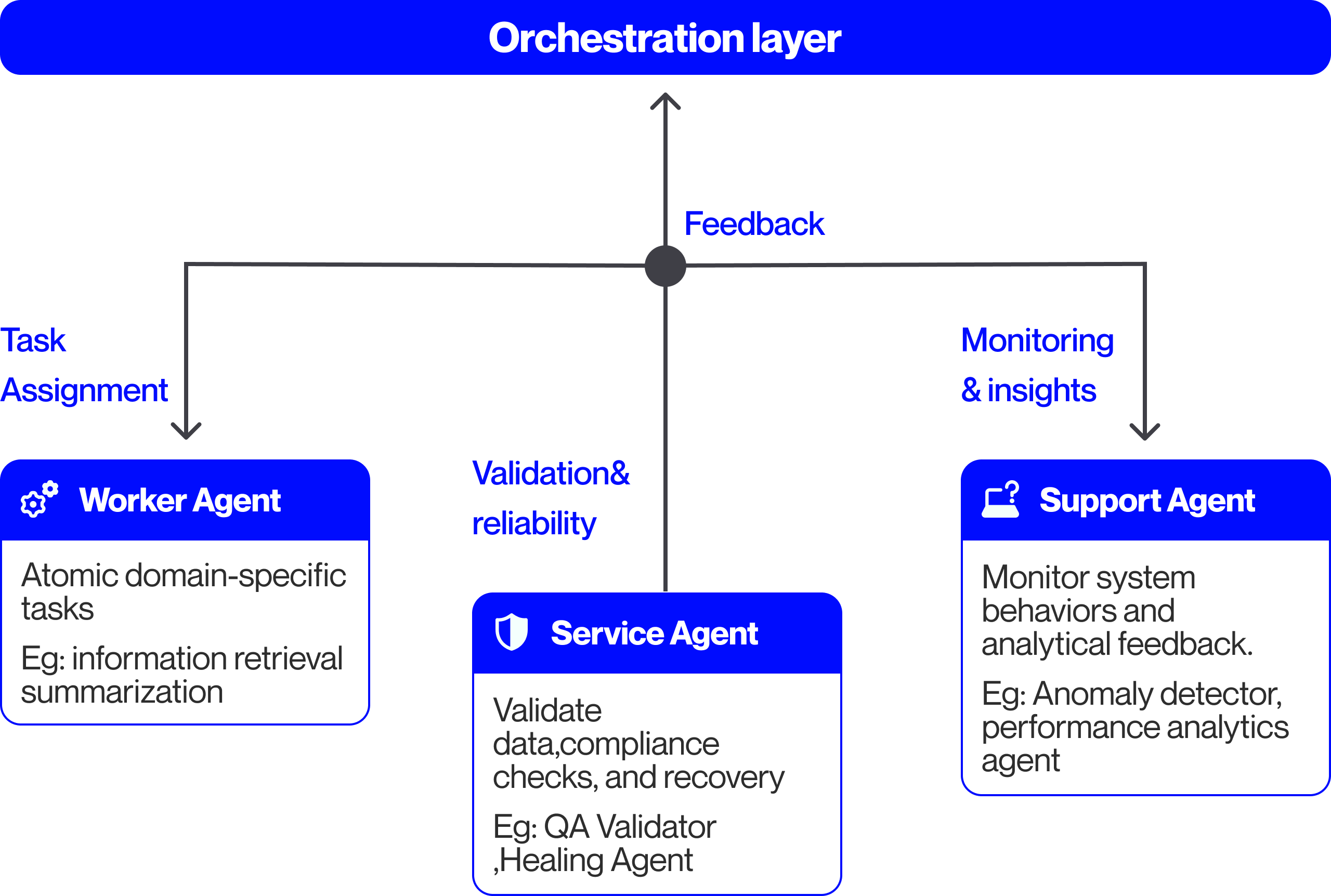
The image is a diagram illustrating an orchestration layer and its interaction with different agents. It shows the flow of tasks, validation, and monitoring between the orchestration layer and worker, service, and support agents.
### Components/Axes
* **Title:** Orchestration layer (located at the top center, inside a blue rounded rectangle)
* **Central Node:** A black circle representing a central point of interaction.
* **Arrows:** Indicate the direction of flow.
* **Labels:**
* Feedback (above the central node, pointing upwards)
* Task Assignment (left of the central node, pointing downwards)
* Validation & reliability (below the central node, pointing downwards)
* Monitoring & insights (right of the central node, pointing downwards)
* **Agent Boxes:** Three blue rounded rectangles representing different agents.
* Worker Agent (bottom-left)
* Service Agent (bottom-center)
* Support Agent (bottom-right)
### Detailed Analysis
* **Orchestration Layer:** The top-level component that orchestrates tasks and receives feedback.
* **Feedback:** An arrow points upwards from the central node to the Orchestration Layer, indicating feedback flow.
* **Task Assignment:** An arrow points downwards from the central node to the Worker Agent, indicating task assignment.
* **Validation & Reliability:** An arrow points downwards from the central node to the Service Agent, indicating validation and reliability processes.
* **Monitoring & Insights:** An arrow points downwards from the central node to the Support Agent, indicating monitoring and insights flow.
* **Worker Agent:**
* Label: Worker Agent (with a gear icon)
* Description: Atomic domain-specific tasks. Eg: information retrieval summarization.
* **Service Agent:**
* Label: Service Agent (with a shield icon)
* Description: Validate data, compliance checks, and recovery. Eg: QA Validator, Healing Agent.
* **Support Agent:**
* Label: Support Agent (with a question mark and monitor icon)
* Description: Monitor system behaviors and analytical feedback. Eg: Anomaly detector, performance analytics agent.
### Key Observations
* The Orchestration Layer is the central point of control.
* The diagram illustrates a cyclical flow: tasks are assigned, validated, monitored, and feedback is provided to the Orchestration Layer.
* Each agent has a specific role: task execution, validation, and monitoring.
### Interpretation
The diagram represents a system architecture where an orchestration layer manages and coordinates the activities of different agents. The flow of information and tasks is clearly defined, with feedback loops ensuring continuous improvement and reliability. The agents perform specialized functions, contributing to the overall system's functionality. The diagram highlights the importance of validation, monitoring, and feedback in maintaining a robust and reliable system.