\n
## Diagram: Agent Orchestration Layer
### Overview
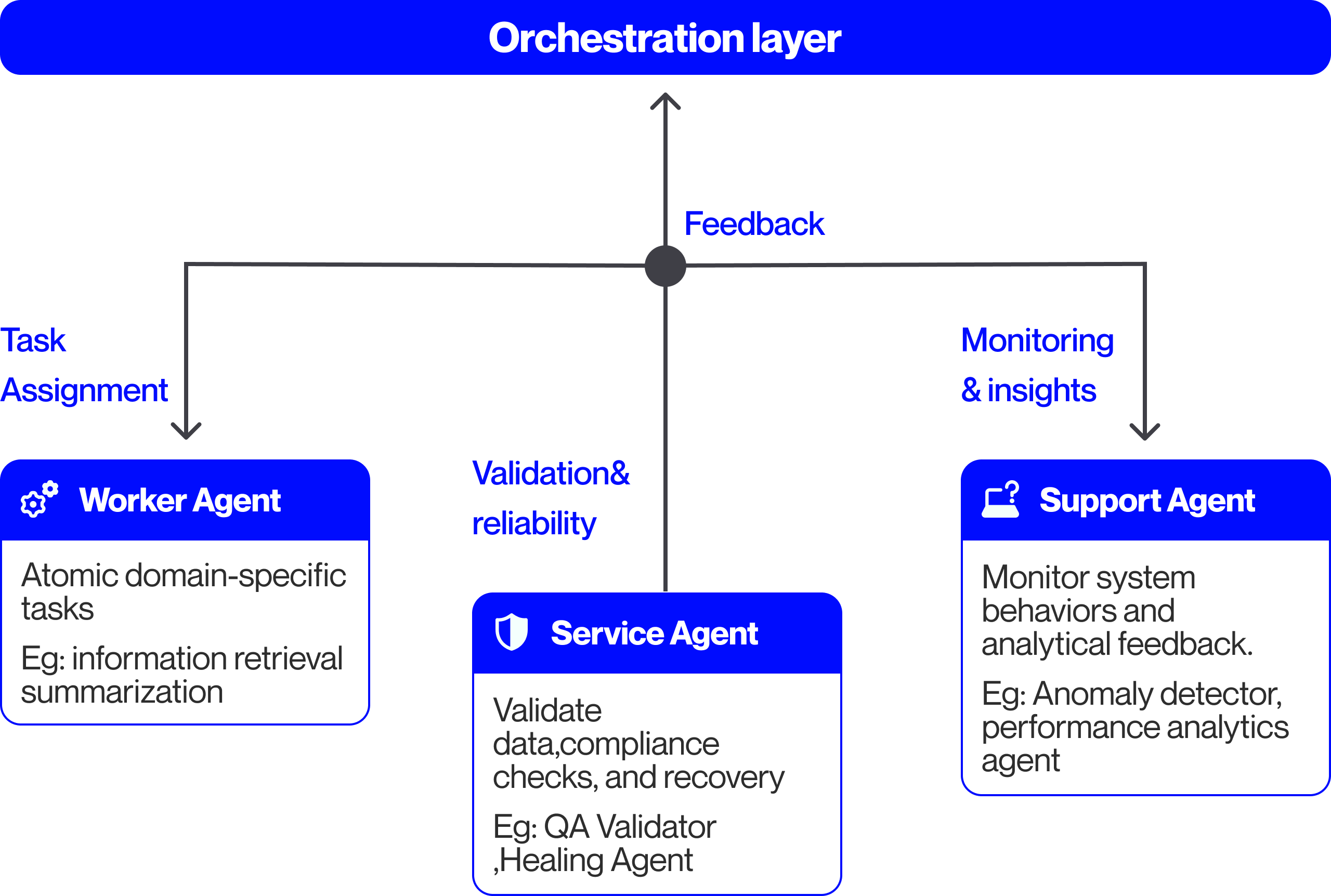
The image is a diagram illustrating an agent orchestration layer, depicting the interaction between different types of agents (Worker, Service, and Support) and an orchestration layer. The diagram shows a flow of tasks and feedback between these components. It's a high-level architectural overview, not a data-rich chart.
### Components/Axes
The diagram consists of four main components:
* **Orchestration Layer:** Located at the top, represented by a light blue rectangle labeled "Orchestration layer".
* **Worker Agent:** Located on the left, represented by a dark blue rectangle labeled "Worker Agent". It includes the text: "Atomic domain-specific tasks. Eg: information retrieval summarization".
* **Service Agent:** Located in the center, represented by a dark blue rectangle labeled "Service Agent". It includes the text: "Validate data, compliance checks, and recovery. Eg: QA Validator ,Healing Agent".
* **Support Agent:** Located on the right, represented by a dark blue rectangle labeled "Support Agent". It includes the text: "Monitor system behaviors and analytical feedback. Eg: Anomaly detector, performance analytics agent".
* **Feedback Loop:** A gray arrow labeled "Feedback" connects the Support Agent and the Orchestration Layer.
* **Task Assignment:** A gray arrow labeled "Task Assignment" connects the Orchestration Layer and the Worker Agent.
* **Validation & Reliability:** A gray label connecting the Worker Agent and the Service Agent.
* **Monitoring & Insights:** A gray label connecting the Service Agent and the Support Agent.
### Detailed Analysis or Content Details
The diagram illustrates a workflow:
1. The Orchestration Layer assigns tasks to the Worker Agent.
2. The Worker Agent performs atomic, domain-specific tasks (e.g., information retrieval, summarization).
3. The output from the Worker Agent is passed to the Service Agent for validation and reliability checks.
4. The Service Agent validates data, performs compliance checks, and handles recovery (e.g., QA validation, healing).
5. The Service Agent provides insights to the Support Agent.
6. The Support Agent monitors system behaviors and provides analytical feedback.
7. The Support Agent sends feedback to the Orchestration Layer, completing the loop.
The diagram does not contain numerical data or precise measurements. It is a conceptual representation of a system architecture.
### Key Observations
The diagram emphasizes a layered approach to agent orchestration, with each agent type having a specific role. The feedback loop suggests a continuous improvement process. The use of icons (gear for Worker Agent, shield for Service Agent, question mark for Support Agent) visually reinforces the function of each agent.
### Interpretation
This diagram represents a system designed for robust and reliable task execution. The orchestration layer acts as a central control point, distributing work and collecting feedback. The separation of concerns into distinct agent types (Worker, Service, Support) promotes modularity and maintainability. The validation and reliability step, handled by the Service Agent, is crucial for ensuring data quality and system stability. The Support Agent's monitoring and analytical feedback provide valuable insights for optimizing the system's performance. The feedback loop indicates a system that learns and adapts over time. The diagram suggests a complex system, likely used in a production environment where reliability and accuracy are paramount.