\n
## Diagram: Multi-Agent Orchestration Architecture
### Overview
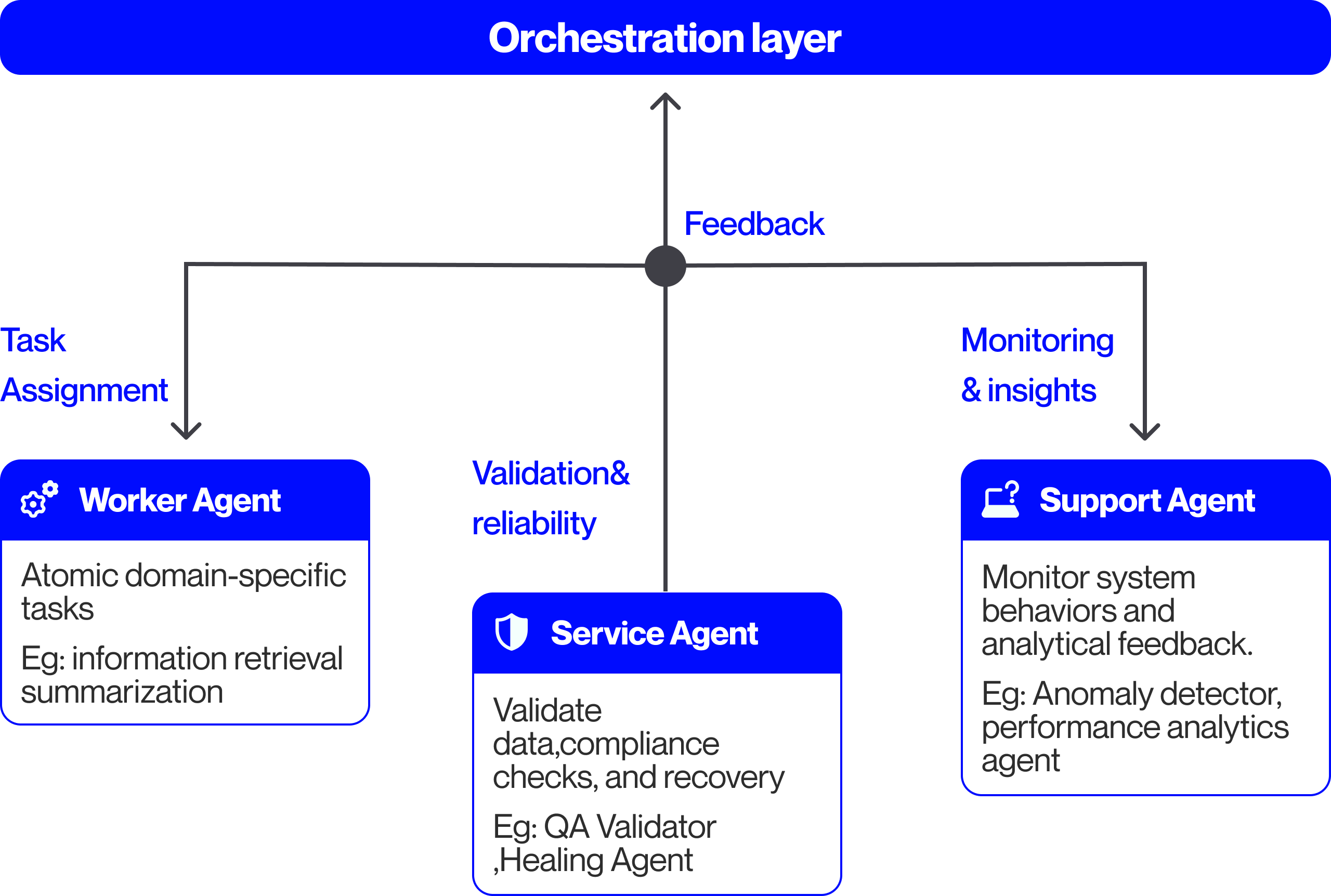
The image is a technical diagram illustrating a hierarchical system architecture centered around an "Orchestration layer." It depicts how this central layer delegates tasks to three specialized agent types and receives feedback from them, forming a closed-loop control system. The design uses a clean, modern aesthetic with blue accent colors for headers and icons against a light gray background.
### Components/Axes
The diagram is structured with a central hub-and-spoke model.
1. **Central Hub (Top Center):**
* **Label:** "Orchestration layer" (white text on a solid blue, rounded rectangle banner spanning the top width).
* **Function:** Acts as the central coordinator and decision-maker.
2. **Communication Node (Center):**
* A solid dark gray circle positioned directly below the "Orchestration layer" banner.
* It serves as the junction point for all communication flows.
3. **Agent Components (Bottom Row, Left to Right):**
* **Worker Agent (Left):**
* **Header:** Blue rounded rectangle with a white gear icon (⚙️) and the text "Worker Agent".
* **Body:** White box with black text: "Atomic domain-specific tasks\nEg: information retrieval summarization".
* **Connection:** A downward-pointing arrow from the central communication node, labeled "Task Assignment" in blue text.
* **Service Agent (Center):**
* **Header:** Blue rounded rectangle with a white shield icon (🛡️) and the text "Service Agent".
* **Body:** White box with black text: "Validate data, compliance checks, and recovery\nEg: QA Validator ,Healing Agent".
* **Connection:** A vertical line connecting it directly to the central communication node, labeled "Validation & reliability" in blue text to its left.
* **Support Agent (Right):**
* **Header:** Blue rounded rectangle with a white icon of a laptop with a question mark (💻❓) and the text "Support Agent".
* **Body:** White box with black text: "Monitor system behaviors and analytical feedback.\nEg: Anomaly detector, performance analytics agent".
* **Connection:** A downward-pointing arrow from the central communication node, labeled "Monitoring & insights" in blue text.
4. **Feedback Loop:**
* A single upward-pointing arrow originates from the central communication node and points to the "Orchestration layer."
* This arrow is labeled "Feedback" in blue text, indicating the flow of information back to the central coordinator.
### Detailed Analysis
The diagram explicitly defines the roles and responsibilities of each agent type through its embedded text:
* **Worker Agent:** Executes discrete, fundamental tasks within a specific domain. Provided examples are "information retrieval" and "summarization."
* **Service Agent:** Focuses on system integrity, performing validation, compliance, and recovery functions. Examples include a "QA Validator" and a "Healing Agent."
* **Support Agent:** Provides oversight and analysis by monitoring system behavior. Examples are an "Anomaly detector" and a "performance analytics agent."
The flow of operations is clearly mapped:
1. The **Orchestration layer** sends directives downward via three channels: "Task Assignment," "Validation & reliability," and "Monitoring & insights."
2. These directives are received by the **Worker Agent**, **Service Agent**, and **Support Agent**, respectively.
3. Information and results from all three agents are aggregated at the central communication node.
4. This aggregated information is sent upward as **Feedback** to the **Orchestration layer**, completing the loop.
### Key Observations
* **Hierarchical Control:** The architecture is strictly top-down for task assignment and bottom-up for feedback, with the Orchestration layer at the apex.
* **Specialization of Labor:** The system is decomposed into three distinct functional categories: execution (Worker), governance (Service), and observation (Support).
* **Closed-Loop System:** The "Feedback" arrow is critical, indicating this is not a fire-and-forget system but one designed for continuous adjustment and learning based on operational data.
* **Self-Healing Implication:** The inclusion of a "Healing Agent" as an example under the Service Agent suggests the architecture is designed for resilience and automated recovery.
### Interpretation
This diagram represents a sophisticated blueprint for a resilient, multi-agent AI or software system. The **Orchestration layer** functions as the "brain," making high-level decisions. The **Worker Agents** are the "hands," performing the actual work. The **Service Agents** act as the "immune system and conscience," ensuring quality, compliance, and integrity. The **Support Agents** serve as the "nervous system and senses," providing the observational data necessary for informed decision-making.
The architecture's core principle is **separation of concerns**, which enhances scalability, maintainability, and reliability. The explicit feedback loop transforms it from a simple command hierarchy into an adaptive system capable of self-optimization. The presence of a "Healing Agent" is particularly notable, moving beyond simple error detection to imply automated remediation—a key characteristic of advanced autonomous systems. This model would be applicable in complex domains like enterprise automation, large-scale AI deployment, or autonomous system management where reliability and continuous operation are paramount.