## Diagram: Orchestration Layer Architecture
### Overview
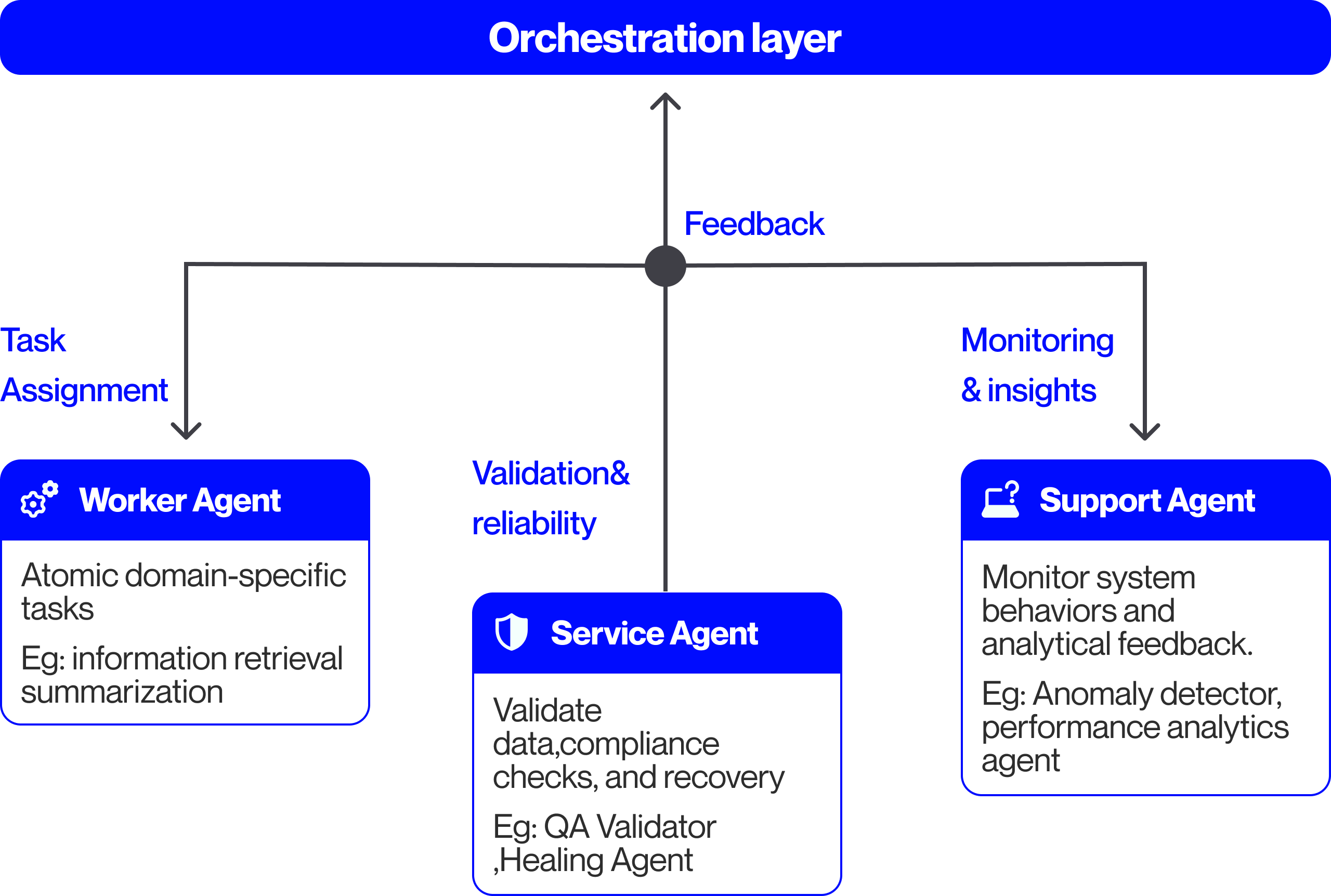
The diagram illustrates a centralized orchestration layer with three core components (Worker Agent, Service Agent, Support Agent) connected through feedback loops. Arrows indicate task flow, validation processes, and monitoring mechanisms.
### Components/Axes
1. **Central Node**:
- Labeled "Feedback" with bidirectional arrows
- Connects all three agent components
2. **Left Branch (Worker Agent)**:
- Icon: Gear (⚙️)
- Title: "Worker Agent"
- Subtext: "Atomic domain-specific tasks"
- Example: "information retrieval summarization"
3. **Center Branch (Service Agent)**:
- Icon: Shield (🛡️)
- Title: "Service Agent"
- Subtext: "Validate data, compliance checks, and recovery"
- Examples: "QA Validator, Healing Agent"
4. **Right Branch (Support Agent)**:
- Icon: Computer with question mark (💻❓)
- Title: "Support Agent"
- Subtext: "Monitor system behaviors and analytical feedback"
- Examples: "Anomaly detector, performance analytics agent"
5. **Vertical Arrows**:
- "Task Assignment" (downward from central node)
- "Validation & reliability" (downward from central node)
- "Monitoring & insights" (downward from central node)
### Detailed Analysis
- **Color Coding**:
- All components use blue header bars with white text
- Worker Agent: Blue gear icon
- Service Agent: Blue shield icon
- Support Agent: Blue computer icon
- **Spatial Relationships**:
- Central "Feedback" node positioned at top center
- Worker Agent box located bottom-left quadrant
- Service Agent box centered at bottom
- Support Agent box positioned bottom-right quadrant
- All arrows originate from central node and terminate at agent boxes
### Key Observations
1. **Feedback Loop**: Central node connects all components through bidirectional arrows, suggesting continuous improvement cycle
2. **Task Flow**:
- Worker Agent receives tasks via "Task Assignment"
- Service Agent handles validation/reliability checks
- Support Agent provides monitoring/insights
3. **Specialization**: Each agent has distinct responsibilities with clear examples provided
4. **Visual Hierarchy**: Central node dominates visually through positioning and bidirectional arrows
### Interpretation
This architecture diagram represents a distributed system orchestration model where:
1. **Worker Agents** handle granular domain-specific operations
2. **Service Agents** ensure data integrity and system recovery
3. **Support Agents** provide real-time monitoring and analytics
4. The central "Feedback" node acts as the nervous system, enabling adaptive learning through continuous validation and performance insights
The bidirectional feedback arrows suggest an iterative improvement process where:
- Worker Agent outputs are validated by Service Agents
- Support Agent monitoring data informs system adjustments
- All components contribute to refining task assignments and reliability protocols
This design emphasizes fault tolerance through Service Agent recovery mechanisms and performance optimization via Support Agent analytics, creating a self-regulating system capable of maintaining operational integrity while adapting to changing conditions.