## Line Graphs: ResNet-50 and ResNet-200 Top-1 Accuracy vs. RandAugment Magnitude
### Overview
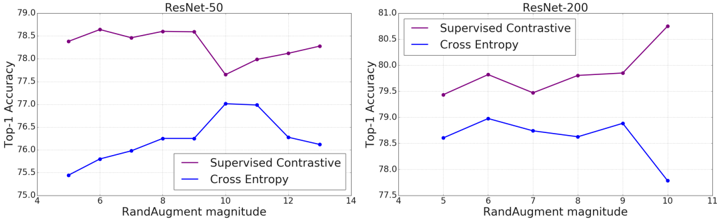
The image contains two line graphs comparing the **Top-1 Accuracy** of two training methods (**Supervised Contrastive** and **Cross Entropy**) across varying **RandAugment magnitudes** for two neural network architectures: **ResNet-50** (left) and **ResNet-200** (right). The graphs highlight how accuracy changes as augmentation strength increases.
---
### Components/Axes
1. **X-Axis (Horizontal)**:
- **Title**: "RandAugment magnitude"
- **Range**:
- ResNet-50: 4 to 14
- ResNet-200: 4 to 11
- **Markers**: Integer values (e.g., 4, 5, ..., 14 for ResNet-50).
2. **Y-Axis (Vertical)**:
- **Title**: "Top-1 Accuracy"
- **Range**:
- ResNet-50: 75.0 to 79.0
- ResNet-200: 77.5 to 81.0
- **Markers**: Incremental values (e.g., 75.0, 75.5, ..., 79.0 for ResNet-50).
3. **Legends**:
- **Position**: Right side of each graph.
- **Labels**:
- **Purple**: "Supervised Contrastive"
- **Blue**: "Cross Entropy"
4. **Graph Titles**:
- Left: "ResNet-50"
- Right: "ResNet-200"
---
### Detailed Analysis
#### ResNet-50 Graph
- **Supervised Contrastive (Purple)**:
- Starts at ~78.5 (x=4), fluctuates between ~77.5–78.5, and ends at ~78.5 (x=14).
- Notable dip to ~77.5 at x=10.
- **Cross Entropy (Blue)**:
- Starts at ~75.5 (x=4), rises to ~77.0 (x=10), then drops to ~76.0 (x=14).
#### ResNet-200 Graph
- **Supervised Contrastive (Purple)**:
- Starts at ~79.5 (x=4), dips to ~79.0 (x=7), then sharply rises to ~80.5 (x=11).
- **Cross Entropy (Blue)**:
- Starts at ~78.5 (x=4), peaks at ~79.0 (x=6), then declines to ~77.5 (x=11).
---
### Key Observations
1. **Supervised Contrastive** consistently outperforms **Cross Entropy** in both architectures, especially at higher RandAugment magnitudes.
2. **ResNet-200** shows a more pronounced accuracy gain for Supervised Contrastive as augmentation increases (e.g., ~79.5 → ~80.5 at x=11).
3. **Cross Entropy** peaks mid-range (x=6–10) but declines sharply at higher magnitudes, suggesting sensitivity to over-augmentation.
4. **ResNet-50** exhibits stability in Supervised Contrastive accuracy despite augmentation, while ResNet-200 shows a steeper upward trend.
---
### Interpretation
- **Robustness of Supervised Contrastive**: The method demonstrates better generalization under stronger augmentation, particularly in deeper networks (ResNet-200). This suggests it mitigates overfitting more effectively than Cross Entropy.
- **Cross Entropy Limitations**: Its decline at higher magnitudes implies it struggles with complex data distributions when combined with aggressive augmentation.
- **Architectural Impact**: ResNet-200’s deeper architecture amplifies the benefits of Supervised Contrastive, highlighting its suitability for large-scale models.
- **Practical Insight**: For tasks requiring strong augmentation (e.g., image classification with diverse datasets), Supervised Contrastive is preferable, especially with deeper networks.