## Scatter Plot: Prompt Distribution Analysis
### Overview
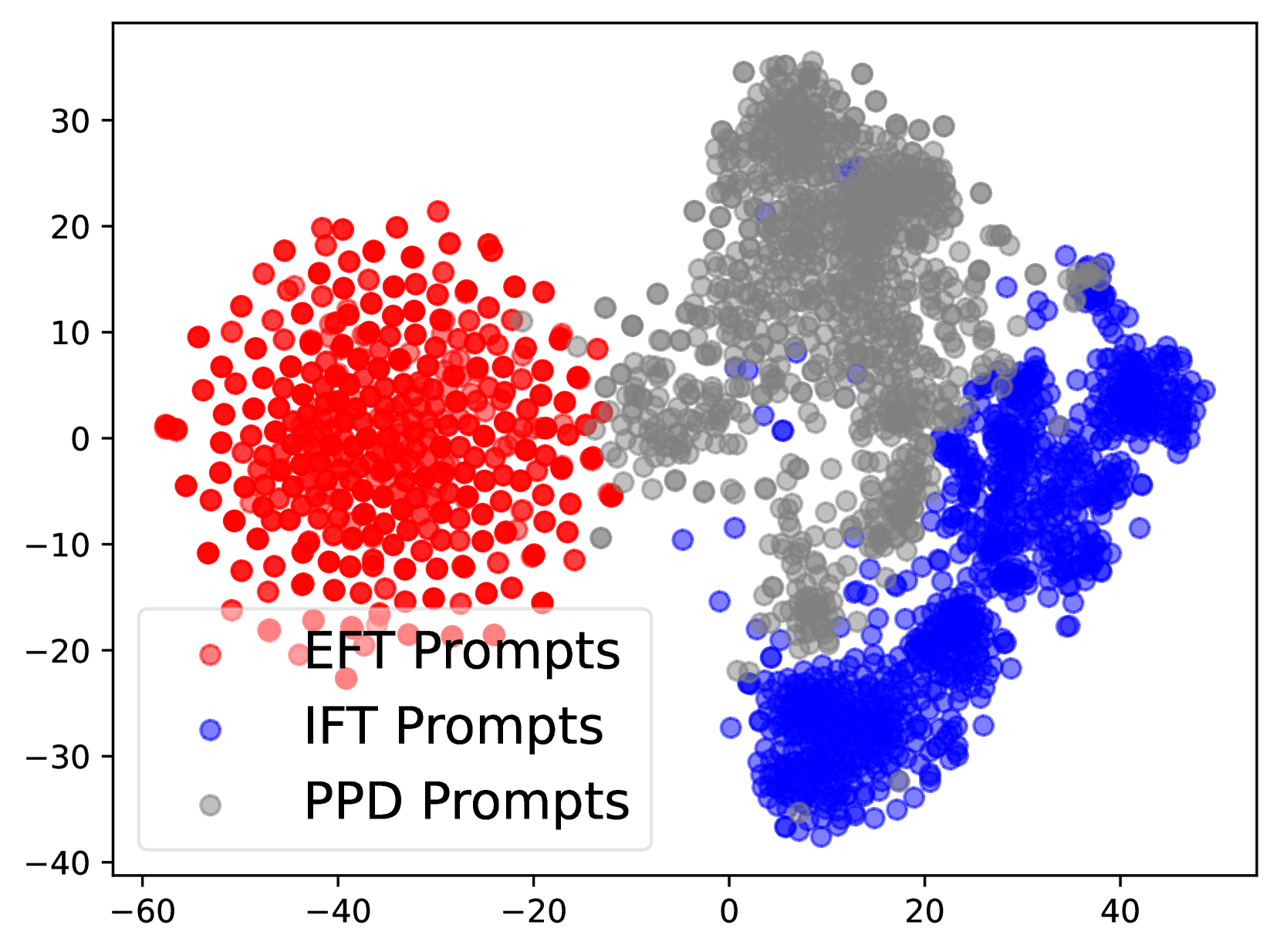
The image is a scatter plot visualizing the distribution of three prompt types (EFT, IFT, PPD) across a 2D coordinate system. Points are color-coded: red for EFT Prompts, blue for IFT Prompts, and gray for PPD Prompts. The plot reveals distinct clustering patterns for each prompt type.
### Components/Axes
- **X-axis**: Labeled "X" with values ranging from -60 to 40 in increments of 20.
- **Y-axis**: Labeled "Y" with values ranging from -40 to 30 in increments of 10.
- **Legend**: Located at the bottom-left corner, mapping colors to prompt types:
- Red: EFT Prompts
- Blue: IFT Prompts
- Gray: PPD Prompts
- **Title**: "Prompt Distribution Analysis" (implied by context, not explicitly labeled).
### Detailed Analysis
1. **EFT Prompts (Red)**:
- Clustered tightly in the **left quadrant** (X: -60 to -20, Y: -10 to 20).
- High density in the center of the cluster (X ≈ -40, Y ≈ 0).
- Approximately 150-200 data points visible.
2. **IFT Prompts (Blue)**:
- Clustered in the **right quadrant** (X: 0 to 40, Y: -30 to 10).
- Concentrated near the origin (X ≈ 10, Y ≈ -10).
- Approximately 120-180 data points visible.
3. **PPD Prompts (Gray)**:
- Spread across the **central region** (X: -20 to 20, Y: -10 to 20).
- Overlaps with both EFT and IFT clusters but forms a distinct gradient.
- Approximately 250-300 data points visible.
### Key Observations
- **Spatial Separation**: EFT and IFT clusters are spatially distinct, while PPD points bridge the gap between them.
- **Density Gradients**: EFT and IFT clusters show higher density near their centers, with sparser points toward the edges.
- **Overlap**: PPD points intermingle with both EFT and IFT clusters, particularly in the central region (X: -10 to 10, Y: -5 to 5).
### Interpretation
The plot suggests that EFT and IFT prompts are categorized into separate regions, possibly reflecting distinct functional or behavioral characteristics. The PPD prompts, however, exhibit hybrid traits, as evidenced by their overlap with both clusters. This could indicate that PPD prompts are transitional or context-dependent, blending features of EFT and IFT. The spatial separation of EFT and IFT might imply mutual exclusivity in their application, while the PPD cluster’s central position could represent a neutral or composite state. Further analysis (e.g., clustering algorithms) would be needed to quantify these relationships.