## Diagram: Neural Network Architecture for Object Detection
### Overview
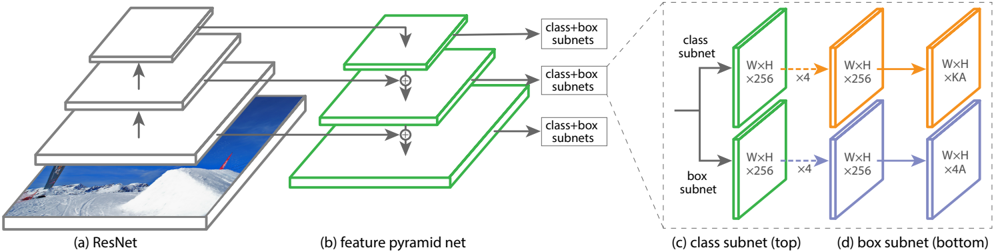
The diagram illustrates a multi-stage neural network architecture for object detection, combining a ResNet backbone, feature pyramid network (FPN), and specialized subnetworks for classification and bounding box prediction. The flow progresses from input image processing through hierarchical feature extraction to specialized prediction tasks.
### Components/Axes
1. **(a) ResNet**:
- Stacked residual blocks with upward arrows indicating residual connections.
- Input: Image (e.g., snowy landscape with ski equipment).
2. **(b) Feature Pyramid Net**:
- Hierarchical feature maps with downward arrows showing multi-scale feature extraction.
- Labels: "class+box subnets" at each pyramid level.
3. **(c) Class Subnetwork (Top)**:
- Green blocks labeled with dimensions: `WxH x 256 → WxH x 256 → WxH x KA`.
- Arrows indicate transformations (e.g., `x4` scaling).
4. **(d) Box Subnetwork (Bottom)**:
- Blue blocks labeled with dimensions: `WxH x 256 → WxH x 256 → WxH x 4A`.
- Arrows show scaling factors (e.g., `x4A`).
### Detailed Analysis
- **ResNet (a)**:
- Input image processed through residual blocks (gray arrows) to generate feature maps.
- **Feature Pyramid Net (b)**:
- Feature maps from ResNet are downsampled/upsampled (green arrows) to create a pyramid of features at different scales.
- Each pyramid level feeds into "class+box subnets" for joint prediction tasks.
- **Class Subnetwork (c)**:
- Processes features for object classification (`WxH x KA` likely represents class-specific feature maps, where `K` = number of classes).
- Scaling factor `x4` suggests upsampling to refine predictions.
- **Box Subnetwork (d)**:
- Handles bounding box regression (`WxH x 4A` likely encodes box coordinates, where `A` = 4 for [x, y, width, height]).
- Scaling factor `x4A` indicates spatial refinement for box localization.
### Key Observations
1. **Multi-Scale Processing**: The FPN enables detection of objects at varying scales by combining features from different ResNet layers.
2. **Specialized Subnetworks**: Separation of class and box prediction tasks allows focused optimization (e.g., class subnetwork prioritizes semantic features, box subnetwork focuses on spatial precision).
3. **Dimensional Consistency**:
- `WxH x 256` likely denotes feature map dimensions (width × height × channels).
- `KA` and `4A` suggest task-specific output dimensions (class logits and box coordinates, respectively).
### Interpretation
This architecture demonstrates a **two-stage object detection pipeline**:
1. **Backbone + FPN**: Extracts rich, multi-scale features from the input image.
2. **Subnetworks**: Specialized networks process these features for classification and regression tasks, improving efficiency and accuracy.
The use of residual connections (ResNet) mitigates vanishing gradients, enabling deeper networks. The FPN's top-down pathway with lateral connections (implied by pyramid structure) enhances feature reuse across scales. The separation of class and box subnetworks may reduce computational redundancy, as each subnetwork focuses on distinct prediction tasks. The scaling factors (`x4`, `x4A`) suggest adaptive feature map adjustments to balance resolution and computational cost.