## Diagram: Knowledge Ingestion and Task Processing
### Overview
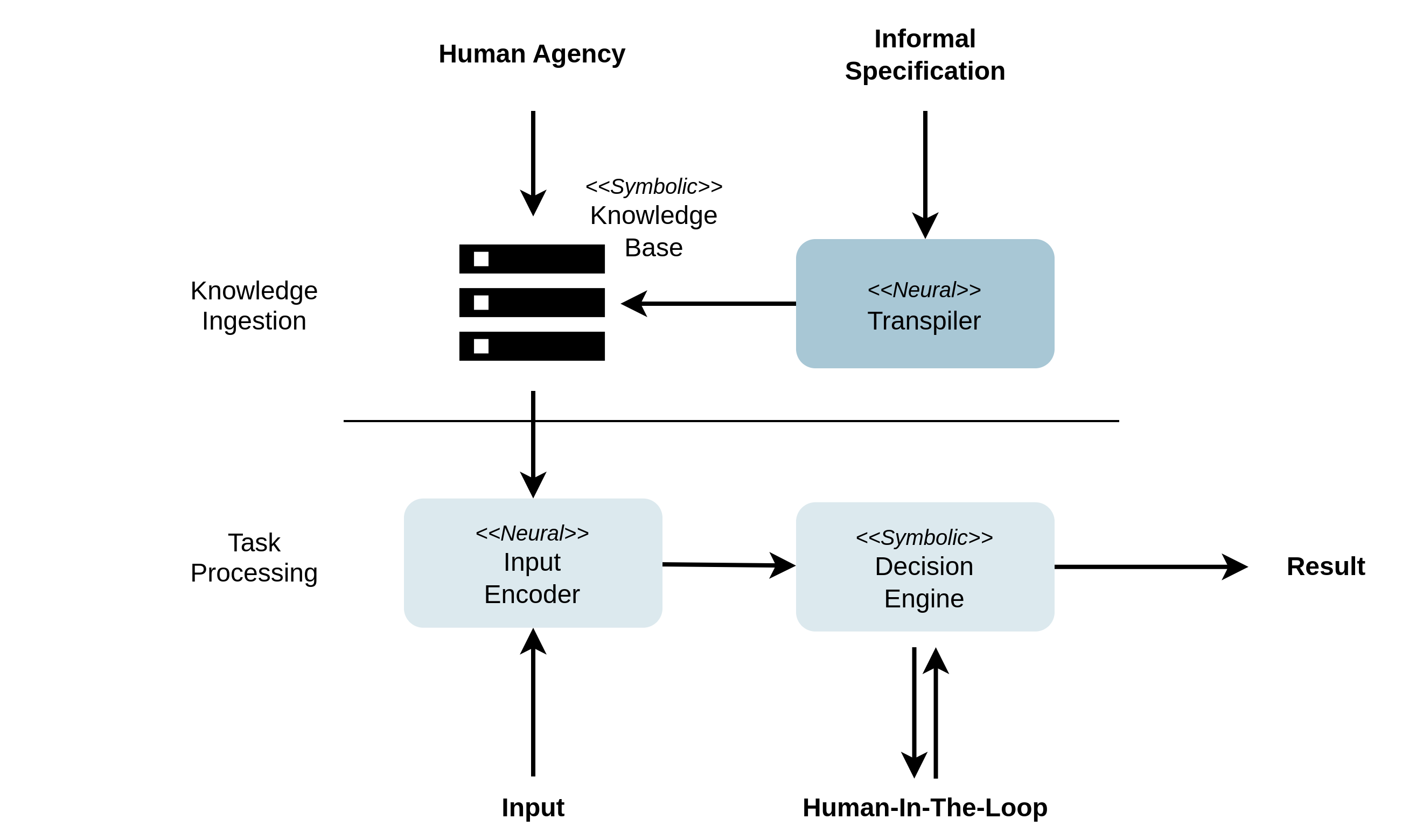
The image is a diagram illustrating a system for knowledge ingestion and task processing, incorporating both symbolic and neural approaches, as well as human interaction. The diagram is divided into two main sections: Knowledge Ingestion and Task Processing. It shows the flow of information from Human Agency and Informal Specification to a Knowledge Base and Transpiler, respectively, and then through an Input Encoder and Decision Engine to produce a Result. Human-In-The-Loop interaction is also depicted.
### Components/Axes
* **Title:** None explicitly provided, but the diagram describes a system for knowledge ingestion and task processing.
* **Sections:**
* Knowledge Ingestion (left side, top)
* Task Processing (left side, bottom)
* **Nodes:**
* Human Agency (top-left)
* Informal Specification (top-right)
* Knowledge Base (top-center, labeled "<<Symbolic>>")
* Transpiler (top-right, labeled "<<Neural>>")
* Input (bottom-left)
* Input Encoder (bottom-center-left, labeled "<<Neural>>")
* Decision Engine (bottom-center-right, labeled "<<Symbolic>>")
* Human-In-The-Loop (bottom-center)
* Result (bottom-right)
* **Arrows:** Arrows indicate the flow of information between the nodes.
* **Labels:** Labels describe the function of each node. The labels "<<Symbolic>>" and "<<Neural>>" indicate the type of processing used in each node.
### Detailed Analysis or ### Content Details
* **Human Agency:** An arrow points from "Human Agency" downwards to the "Knowledge Base".
* **Informal Specification:** An arrow points from "Informal Specification" downwards to the "Transpiler".
* **Knowledge Base:** The "Knowledge Base" is represented by three stacked horizontal bars, each with a small square on the left end. It is labeled "<<Symbolic>> Knowledge Base".
* **Transpiler:** The "Transpiler" is a rounded rectangle labeled "<<Neural>> Transpiler".
* **Input:** An arrow points from "Input" upwards to the "Input Encoder".
* **Input Encoder:** The "Input Encoder" is a rounded rectangle labeled "<<Neural>> Input Encoder".
* **Decision Engine:** The "Decision Engine" is a rounded rectangle labeled "<<Symbolic>> Decision Engine".
* **Human-In-The-Loop:** A bidirectional arrow connects the "Decision Engine" and "Human-In-The-Loop".
* **Result:** An arrow points from the "Decision Engine" to "Result".
* **Flow:**
* Human Agency -> Knowledge Base
* Informal Specification -> Transpiler
* Knowledge Base -> Input Encoder
* Transpiler -> Input Encoder
* Input -> Input Encoder
* Input Encoder -> Decision Engine
* Decision Engine <-> Human-In-The-Loop
* Decision Engine -> Result
### Key Observations
* The diagram distinguishes between symbolic and neural approaches to knowledge processing.
* Human interaction is integrated into the task processing loop.
* The system takes both human agency and informal specifications as input.
### Interpretation
The diagram illustrates a hybrid system that combines symbolic and neural approaches for knowledge ingestion and task processing. Human Agency provides input to a symbolic Knowledge Base, while Informal Specifications are processed by a neural Transpiler. The outputs of both are fed into a neural Input Encoder, which then passes information to a symbolic Decision Engine. The Decision Engine can interact with a human in the loop, allowing for human intervention and guidance. The final output is the Result.
The diagram suggests a system that leverages the strengths of both symbolic and neural approaches, while also incorporating human expertise. The use of a Knowledge Base suggests a system that relies on explicit knowledge representation, while the use of a Transpiler suggests a system that can learn from data. The integration of human interaction allows for the system to adapt to changing circumstances and to incorporate human judgment.