\n
## Diagram: System Architecture for Knowledge-Based AI
### Overview
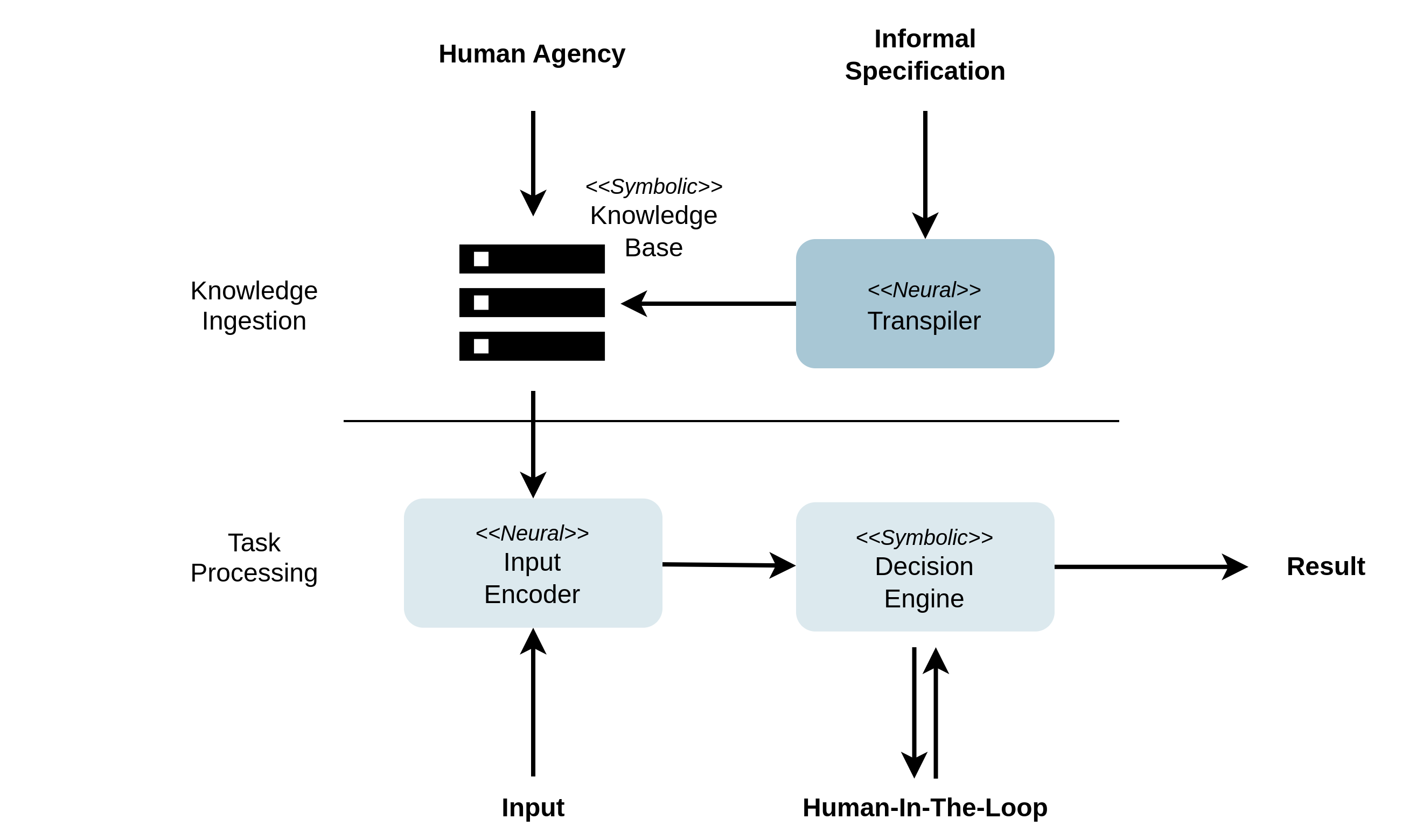
The image depicts a system architecture diagram illustrating the flow of information and processing stages in a knowledge-based AI system. The diagram shows a two-tiered process: Knowledge Ingestion and Task Processing, connected by a central "Transpiler" component. The diagram uses arrows to indicate the direction of information flow and labels to identify the components and inputs/outputs.
### Components/Axes
The diagram consists of the following components:
* **Human Agency:** Input from a human source.
* **Informal Specification:** Input representing an informal description of a task.
* **Knowledge Base:** A symbolic knowledge repository. Labeled as "<<Symbolic>>".
* **Transpiler:** A component that translates between symbolic and neural representations. Labeled as "<<Neural>>".
* **Input Encoder:** A neural network component that encodes input data. Labeled as "<<Neural>>".
* **Decision Engine:** A symbolic component that makes decisions based on encoded input and the knowledge base. Labeled as "<<Symbolic>>".
* **Input:** Data provided to the system for processing.
* **Human-In-The-Loop:** Feedback or intervention from a human operator.
* **Result:** The output of the system.
* **Knowledge Ingestion:** A process that takes Human Agency and Informal Specification as input.
* **Task Processing:** A process that takes Input as input.
### Detailed Analysis or Content Details
The diagram illustrates the following flow:
1. **Knowledge Ingestion:**
* "Human Agency" and "Informal Specification" feed into the "<<Symbolic>> Knowledge Base".
* The Knowledge Base has four rectangular blocks within it, representing stored knowledge.
* The Knowledge Base then feeds into the "<<Neural>> Transpiler".
2. **Task Processing:**
* "Input" feeds into the "<<Neural>> Input Encoder".
* The Input Encoder feeds into the "<<Symbolic>> Decision Engine".
* The Decision Engine receives input from the Transpiler.
* The Decision Engine also has a bi-directional arrow connecting it to "Human-In-The-Loop", indicating feedback or intervention.
* The Decision Engine outputs a "Result".
The arrows indicate a sequential flow of information. The Transpiler acts as a bridge between the symbolic Knowledge Base and the neural Input Encoder/Decision Engine. The Human-In-The-Loop provides a feedback mechanism to the Decision Engine.
### Key Observations
The diagram highlights a hybrid approach to AI, combining symbolic knowledge representation with neural network processing. The Transpiler is a crucial component, enabling the translation between these two paradigms. The Human-In-The-Loop suggests a system designed for iterative refinement and human oversight.
### Interpretation
This diagram represents a system architecture for an AI that leverages both symbolic reasoning and neural network learning. The "Knowledge Ingestion" phase focuses on building a symbolic knowledge base from human input and informal specifications. The "Task Processing" phase utilizes neural networks to encode input and make decisions based on the knowledge base. The Transpiler is the key component that allows these two different approaches to work together. The inclusion of "Human-In-The-Loop" suggests that the system is designed to be interactive and adaptable, allowing human operators to provide feedback and refine the system's behavior. This architecture is likely intended to overcome the limitations of purely symbolic or purely neural approaches, combining the strengths of both. The diagram does not provide any quantitative data or specific details about the algorithms or technologies used, but it clearly outlines the overall system structure and information flow.