## System Architecture Diagram: Hybrid Symbolic-Neural AI Processing Pipeline
### Overview
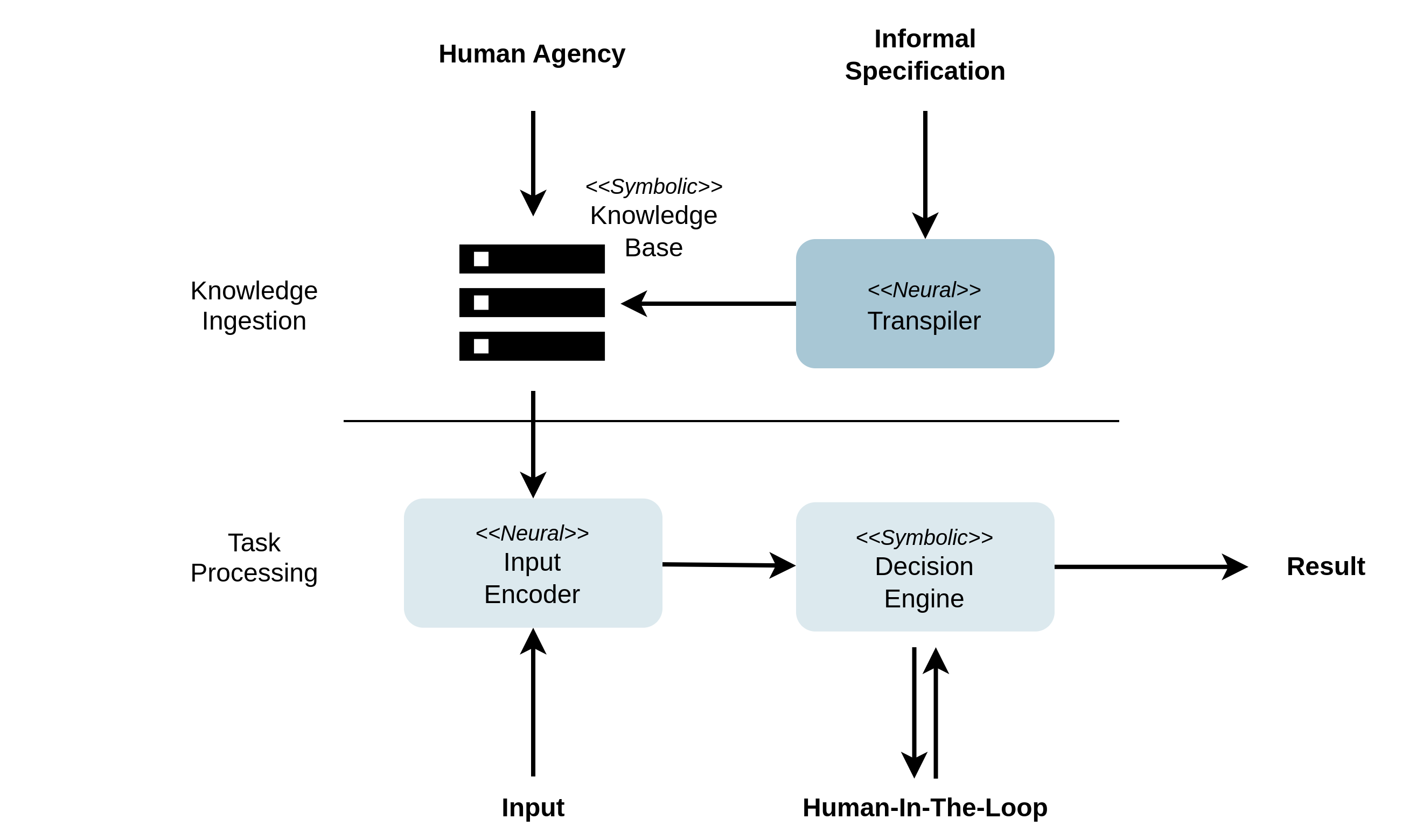
The image is a technical system architecture diagram illustrating a hybrid AI processing pipeline that integrates symbolic and neural components. The diagram is divided into two primary horizontal sections: an upper "Knowledge Ingestion" phase and a lower "Task Processing" phase, separated by a solid horizontal line. The flow of information and control is indicated by directional arrows connecting various labeled components.
### Components/Axes
The diagram contains the following labeled components, organized by their spatial position and functional grouping:
**Upper Section (Knowledge Ingestion):**
* **Top Center-Left:** "Human Agency" (text label with a downward arrow).
* **Top Center-Right:** "Informal Specification" (text label with a downward arrow).
* **Center-Left:** "Knowledge Ingestion" (section label).
* **Center:** `<<Symbolic>> Knowledge Base` (represented by a stack of three black rectangles with white squares on the left side).
* **Center-Right:** `<<Neural>> Transpiler` (represented by a light blue rounded rectangle).
**Lower Section (Task Processing):**
* **Center-Left:** "Task Processing" (section label).
* **Center-Left:** `<<Neural>> Input Encoder` (represented by a light blue rounded rectangle).
* **Center-Right:** `<<Symbolic>> Decision Engine` (represented by a light blue rounded rectangle).
* **Bottom Center-Left:** "Input" (text label with an upward arrow).
* **Bottom Center-Right:** "Human-In-The-Loop" (text label with bidirectional vertical arrows).
* **Far Right:** "Result" (text label with a rightward arrow).
### Detailed Analysis
**Flow and Connections:**
1. **Knowledge Ingestion Phase (Upper Section):**
* "Human Agency" provides input directly to the `<<Symbolic>> Knowledge Base`.
* "Informal Specification" provides input directly to the `<<Neural>> Transpiler`.
* The `<<Neural>> Transpiler` sends output (leftward arrow) to the `<<Symbolic>> Knowledge Base`.
* The `<<Symbolic>> Knowledge Base` sends output (downward arrow, crossing the horizontal divider) to the `<<Neural>> Input Encoder` in the lower section.
2. **Task Processing Phase (Lower Section):**
* An external "Input" feeds into the `<<Neural>> Input Encoder` (upward arrow).
* The `<<Neural>> Input Encoder` processes this input along with knowledge from the Knowledge Base and sends its output (rightward arrow) to the `<<Symbolic>> Decision Engine`.
* The `<<Symbolic>> Decision Engine` has a bidirectional interaction (vertical up/down arrows) with "Human-In-The-Loop".
* The final output from the `<<Symbolic>> Decision Engine` is the "Result" (rightward arrow).
**Component Classification:**
The diagram explicitly classifies components using stereotypes:
* **Symbolic Components:** `<<Symbolic>> Knowledge Base`, `<<Symbolic>> Decision Engine`.
* **Neural Components:** `<<Neural>> Transpiler`, `<<Neural>> Input Encoder`.
### Key Observations
* **Hybrid Architecture:** The system is explicitly designed as a hybrid model, combining symbolic AI (Knowledge Base, Decision Engine) with neural AI (Transpiler, Input Encoder).
* **Human Oversight:** Human involvement is integral at two key points: in the initial knowledge ingestion ("Human Agency") and during task execution ("Human-In-The-Loop"), suggesting a system designed for collaboration and oversight.
* **Knowledge Flow:** There is a clear pipeline where unstructured "Informal Specification" is processed by a neural component (Transpiler) to populate a structured symbolic Knowledge Base, which then informs the neural processing of real-time inputs.
* **Separation of Concerns:** The horizontal line cleanly separates the offline or preparatory "Knowledge Ingestion" phase from the online "Task Processing" phase.
### Interpretation
This diagram represents a sophisticated AI system architecture that seeks to leverage the strengths of both symbolic and neural paradigms. The **symbolic components** (Knowledge Base, Decision Engine) likely handle structured reasoning, logic, and explicit rule-based operations, providing transparency and controllability. The **neural components** (Transpiler, Input Encoder) handle the processing of unstructured, informal data (specifications, raw inputs), converting them into forms the symbolic system can utilize.
The flow suggests a process where human-provided knowledge and specifications are first compiled into a formal knowledge base. During operation, real-time inputs are encoded and then reasoned upon by the decision engine, which remains subject to human intervention. This architecture aims to create a system that is both **knowledge-rich** (from the symbolic side) and **perceptually capable** (from the neural side), with human agency ensuring alignment and safety. The "Human-In-The-Loop" feedback into the Decision Engine is particularly notable, indicating a design for continuous validation, correction, or guidance during the decision-making process.