## Network Diagram: User Interaction Graph
### Overview
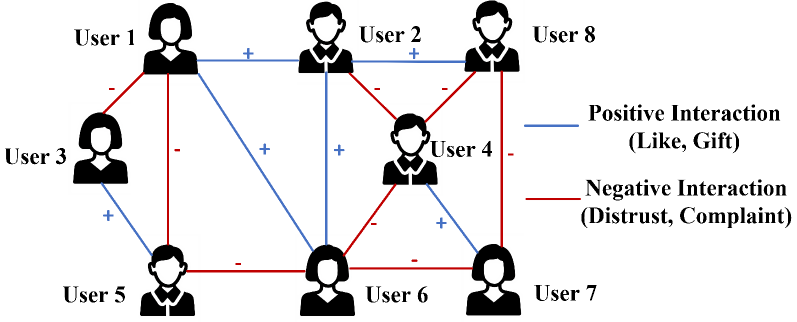
The image displays a directed graph diagram illustrating social interactions among eight users. The diagram uses icons to represent users and colored, labeled lines to represent the nature of interactions between them. The overall structure is a network with nodes (users) and edges (interactions), showing a mix of positive and negative relationships.
### Components/Axes
* **Nodes (Users):** Eight user icons, each labeled with a unique identifier.
* **Top Row (Left to Right):** User 1, User 2, User 8
* **Middle Row (Left to Right):** User 3, User 4
* **Bottom Row (Left to Right):** User 5, User 6, User 7
* **Edges (Interactions):** Lines connecting users, color-coded and marked with a symbol (+ or -).
* **Legend (Located on the right side):**
* **Blue Line:** Labeled "Positive Interaction (Like, Gift)"
* **Red Line:** Labeled "Negative Interaction (Distrust, Complaint)"
### Detailed Analysis
The following is a complete list of all interactions depicted in the diagram, identified by connecting users, line color, and the associated symbol.
**Positive Interactions (Blue Lines with '+'):**
1. User 1 → User 2 (Horizontal line, top)
2. User 1 → User 6 (Diagonal line, top-left to bottom-center)
3. User 2 → User 6 (Vertical line, top-center to bottom-center)
4. User 3 → User 5 (Diagonal line, middle-left to bottom-left)
5. User 4 → User 7 (Diagonal line, middle-right to bottom-right)
**Negative Interactions (Red Lines with '-'):**
1. User 1 → User 3 (Vertical line, top-left to middle-left)
2. User 1 → User 5 (Vertical line, top-left to bottom-left)
3. User 2 → User 4 (Diagonal line, top-center to middle-right)
4. User 2 → User 8 (Horizontal line, top)
5. User 4 → User 6 (Diagonal line, middle-right to bottom-center)
6. User 4 → User 8 (Diagonal line, middle-right to top-right)
7. User 5 → User 6 (Horizontal line, bottom)
8. User 6 → User 7 (Horizontal line, bottom)
9. User 7 → User 8 (Vertical line, bottom-right to top-right)
### Key Observations
* **Central Nodes:** User 2 and User 4 appear to be central hubs. User 2 has the highest number of outgoing connections (4 total: 2 positive, 2 negative). User 4 also has a high degree of connectivity (4 total: 1 positive, 3 negative).
* **Isolated Node:** User 8 is only connected via negative interactions (with User 2, User 4, and User 7) and has no positive incoming or outgoing links shown.
* **Cluster of Positivity:** A positive interaction cluster exists between Users 1, 2, 3, 5, and 6, though it is interspersed with negative links.
* **Prevalence of Negative Links:** Negative interactions (red lines) are more numerous (9 instances) than positive ones (5 instances) in this specific network snapshot.
* **Reciprocity:** No direct reciprocal interactions (e.g., A→B and B→A) are shown. All connections are unidirectional as drawn.
### Interpretation
This diagram models a social or trust network where the quality of relationships is explicitly categorized. The data suggests a complex environment where influence (indicated by high connectivity) does not equate to popularity or trust. For instance, User 2 and User 4 are highly connected but are sources or targets of significant negative sentiment.
The network structure reveals potential fault lines or subgroups. The lack of positive connections to User 8 might indicate an outlier or a user who is distrusted by the central figures (Users 2 and 4). The positive loop involving Users 1, 2, and 6 could represent a core cooperative group, but its integrity is undermined by the negative link from User 1 to User 3 and User 5.
From a Peircean perspective, this diagram is an **icon** (it resembles a network) and an **index** (the lines point to specific relationships). The **symbolic** layer is provided by the legend, which assigns social meaning (like/gift vs. distrust/complaint) to the visual variables (color and sign). The diagram's value lies in making abstract social dynamics concrete and analyzable, highlighting central actors, potential conflicts, and isolated individuals. It serves as a diagnostic tool for understanding group cohesion and identifying users who may require mediation or support.