## Flowchart: Evolution of Diffusion Models (2021-2025)
### Overview
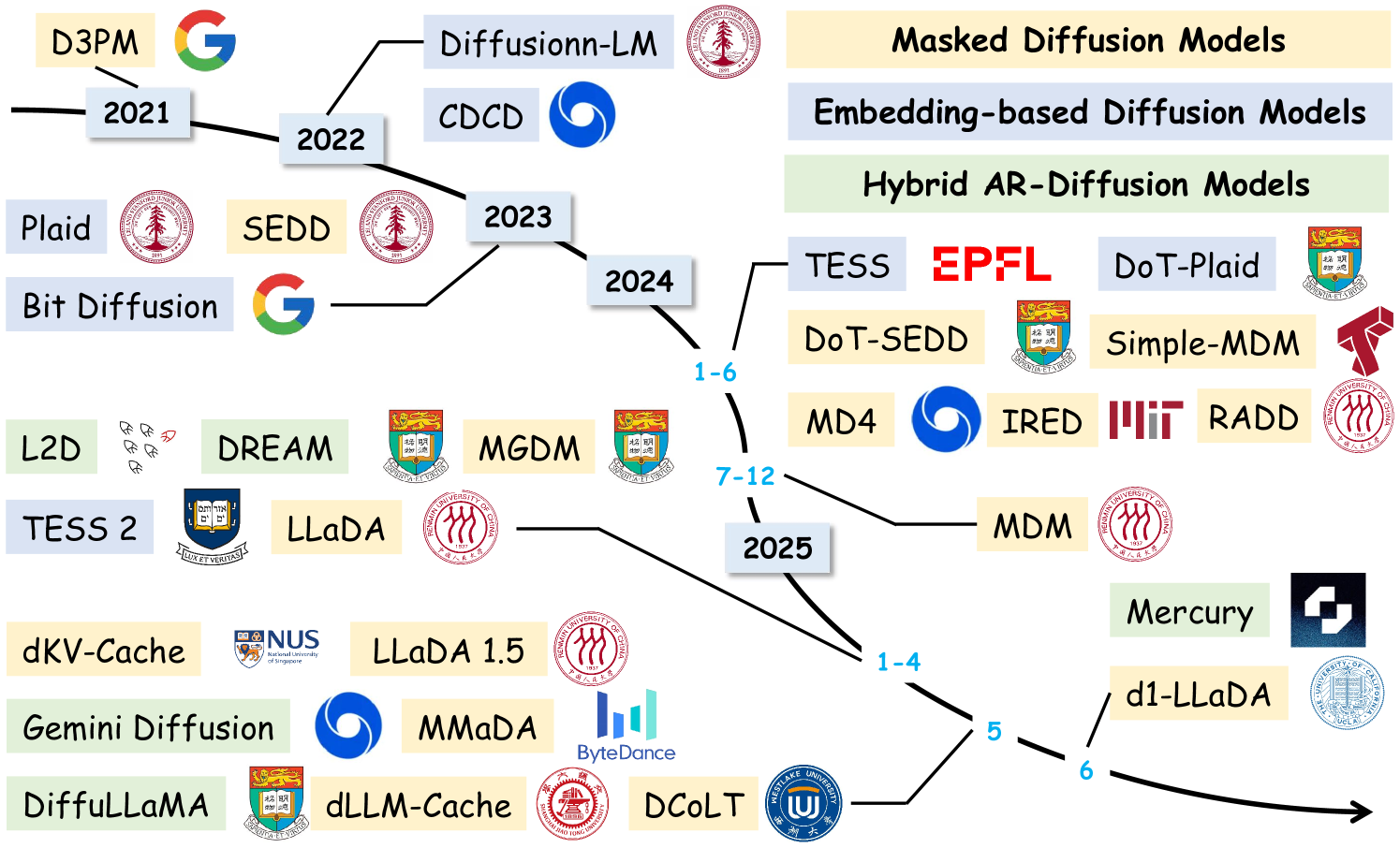
The image is a hierarchical flowchart depicting the development timeline of diffusion models from 2021 to 2025. It categorizes models into three primary groups: **Masked Diffusion Models**, **Embedding-based Diffusion Models**, and **Hybrid AR-Diffusion Models**. Each year (2021-2025) is connected to specific models, with visual links to institutional logos and technical labels.
---
### Components/Axes
#### Left Timeline (Years)
- **Years**: 2021, 2022, 2023, 2024, 2025 (left-aligned, connected by a central vertical line)
- **Model Branches**: Each year branches into 1-6 models (e.g., 2021 → D3PM, Bit Diffusion; 2025 → MDM, d1-LLaDA)
#### Right Categories
1. **Masked Diffusion Models** (yellow background)
- TESS, EPFL, DoT-Plaid, DoT-SEDD, Simple-MDM
2. **Embedding-based Diffusion Models** (blue background)
- MD4, IRED, MiT, RADD
3. **Hybrid AR-Diffusion Models** (green background)
- Mercury, d1-LLaDA
#### Legend
- **Colors**:
- Yellow: Masked Diffusion Models
- Blue: Embedding-based Diffusion Models
- Green: Hybrid AR-Diffusion Models
- **Logos**: Institutional affiliations (e.g., Google, NUS, Westlake University)
---
### Detailed Analysis
#### Yearly Model Breakdown
- **2021**:
- D3PM (Google logo)
- Bit Diffusion (Google logo)
- **2022**:
- Diffusionn-LM (NUS logo)
- CDCD (NUS logo)
- **2023**:
- Plaid (NUS logo)
- SEDD (NUS logo)
- **2024**:
- L2D (NUS logo)
- DREAM (NUS logo)
- MGDM (NUS logo)
- TESS 2 (NUS logo)
- LLaDA (NUS logo)
- **2025**:
- MDM (NUS logo)
- d1-LLaDA (Westlake University logo)
#### Category-Specific Models
- **Masked Diffusion Models** (yellow):
- TESS, EPFL, DoT-Plaid, DoT-SEDD, Simple-MDM
- **Embedding-based Diffusion Models** (blue):
- MD4, IRED, MiT, RADD
- **Hybrid AR-Diffusion Models** (green):
- Mercury, d1-LLaDA
#### Logos and Institutions
- **Google**: D3PM, Bit Diffusion
- **NUS**: Diffusionn-LM, CDCD, Plaid, SEDD, L2D, DREAM, MGDM, TESS 2, LLaDA
- **Westlake University**: d1-LLaDA
---
### Key Observations
1. **Temporal Progression**: Models increase in complexity and diversity from 2021 to 2025.
2. **Institutional Collaboration**: NUS dominates early years (2021-2024), while Westlake University contributes later (2025).
3. **Categorization**: Hybrid AR-Diffusion Models (green) appear exclusively in 2025, suggesting a late-stage innovation.
4. **Model Diversity**: Embedding-based models (blue) show the most variety (4 models in 2025).
---
### Interpretation
The flowchart illustrates a rapid evolution in diffusion model research, with institutions like NUS driving early advancements. The emergence of Hybrid AR-Diffusion Models in 2025 suggests a shift toward integrating augmented reality applications. The dominance of NUS logos indicates concentrated research efforts, while Westlake University’s late entry (d1-LLaDA) highlights emerging players. The categorization reflects technical specialization, with Masked and Embedding-based models forming the foundation before Hybrid AR models emerge as a distinct category.