\n
## Technical Document Extraction: Corsi Board Tapping Game Problem
### Overview
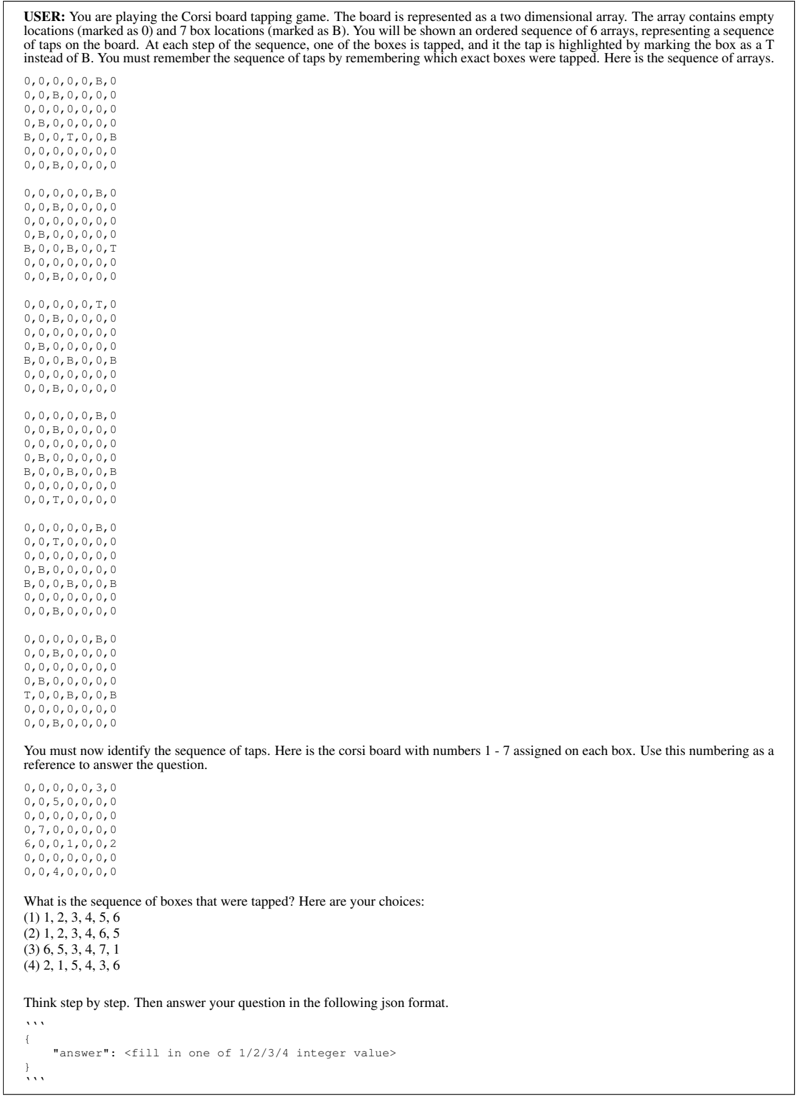
The image presents a cognitive psychology task based on the Corsi block-tapping test. It provides a sequence of six board states (represented as 7x7 arrays) showing a tapping sequence, a numbered reference board, and a multiple-choice question to identify the correct sequence of tapped boxes. The task requires spatial memory and pattern recognition.
### Components/Axes
1. **Game Description Text**: Explains the rules. The board is a 2D array with empty locations (`0`) and 7 box locations (`B`). A sequence of 6 taps is shown, with the tapped box marked as `T` in each step.
2. **Sequence of Arrays**: Six 7x7 grids, each representing a step in the tapping sequence.
3. **Numbered Reference Board**: A 7x7 grid assigning numbers 1-7 to specific box locations for answer mapping.
4. **Question & Multiple Choice**: Asks for the sequence of tapped boxes with four options.
5. **Answer Format Instruction**: Specifies to think step-by-step and output the answer in a JSON format.
### Detailed Analysis
#### 1. Transcription of the Six Sequence Arrays
Each array is a 7x7 grid. Rows are listed top to bottom. `0` = empty, `B` = box location, `T` = tapped box at that step.
**Array 1 (Step 1):**
```
0,0,0,0,0,B,0
0,0,B,0,0,0,0
0,0,0,0,0,0,0
0,B,0,0,0,0,0
B,0,0,T,0,0,B
0,0,0,0,0,0,0
0,0,B,0,0,0,0
```
* **Tapped Box (`T`)**: Located at Row 5, Column 4 (using 1-based indexing from top-left).
**Array 2 (Step 2):**
```
0,0,0,0,0,B,0
0,0,B,0,0,0,0
0,0,0,0,0,0,0
0,B,0,0,0,0,0
B,0,0,B,0,0,T
0,0,0,0,0,0,0
0,0,B,0,0,0,0
```
* **Tapped Box (`T`)**: Located at Row 5, Column 7.
**Array 3 (Step 3):**
```
0,0,0,0,0,T,0
0,0,B,0,0,0,0
0,0,0,0,0,0,0
0,B,0,0,0,0,0
B,0,0,B,0,0,B
0,0,0,0,0,0,0
0,0,B,0,0,0,0
```
* **Tapped Box (`T`)**: Located at Row 1, Column 6.
**Array 4 (Step 4):**
```
0,0,0,0,0,B,0
0,0,B,0,0,0,0
0,0,0,0,0,0,0
0,B,0,0,0,0,0
B,0,0,B,0,0,B
0,0,0,0,0,0,0
0,0,T,0,0,0,0
```
* **Tapped Box (`T`)**: Located at Row 7, Column 3.
**Array 5 (Step 5):**
```
0,0,0,0,0,B,0
0,0,T,0,0,0,0
0,0,0,0,0,0,0
0,B,0,0,0,0,0
B,0,0,B,0,0,B
0,0,0,0,0,0,0
0,0,B,0,0,0,0
```
* **Tapped Box (`T`)**: Located at Row 2, Column 3.
**Array 6 (Step 6):**
```
0,0,0,0,0,B,0
0,0,B,0,0,0,0
0,0,0,0,0,0,0
0,B,0,0,0,0,0
T,0,0,B,0,0,B
0,0,0,0,0,0,0
0,0,B,0,0,0,0
```
* **Tapped Box (`T`)**: Located at Row 5, Column 1.
#### 2. Transcription of the Numbered Reference Board
This grid assigns numbers 1-7 to the box (`B`) locations for mapping the answer.
```
0,0,0,0,0,3,0
0,0,5,0,0,0,0
0,0,0,0,0,0,0
0,7,0,0,0,0,0
6,0,0,1,0,0,2
0,0,0,0,0,0,0
0,0,4,0,0,0,0
```
* **Mapping**:
* Number 1: Row 5, Column 4
* Number 2: Row 5, Column 7
* Number 3: Row 1, Column 6
* Number 4: Row 7, Column 3
* Number 5: Row 2, Column 3
* Number 6: Row 5, Column 1
* Number 7: Row 4, Column 2
#### 3. Transcription of the Question and Choices
**Question:** "What is the sequence of boxes that were tapped? Here are your choices:"
**Choices:**
(1) 1, 2, 3, 4, 5, 6
(2) 1, 2, 3, 4, 6, 5
(3) 6, 5, 3, 4, 7, 1
(4) 2, 1, 5, 4, 3, 6
**Instruction:** "Think step by step. Then answer your question in the following json format."
```json
{
"answer": <fill in one of 1/2/3/4 integer value>
}
```
### Key Observations
1. **Spatial Consistency**: The seven box (`B`) locations remain fixed across all six sequence arrays. Only the `T` (tapped box) marker moves.
2. **Tapping Sequence Path**: The taps do not follow a simple linear path (e.g., 1-2-3-4-5-6). The sequence jumps between non-adjacent boxes.
3. **Potential Ambiguity**: The visual representation requires careful cross-referencing between the `T` position in each array and the corresponding number on the reference board.
### Interpretation
This is a test of spatial working memory. The data demonstrates a specific sequence of spatial locations that must be recalled in order. To solve it, one must:
1. **Isolate the Tapped Box (`T`)** in each of the six sequential arrays.
2. **Map each `T` coordinate** to its assigned number using the provided reference board.
3. **Construct the sequence** of these numbers.
**Step-by-Step Mapping:**
* Step 1 `T` (R5,C4) -> Number **1**
* Step 2 `T` (R5,C7) -> Number **2**
* Step 3 `T` (R1,C6) -> Number **3**
* Step 4 `T` (R7,C3) -> Number **4**
* Step 5 `T` (R2,C3) -> Number **5**
* Step 6 `T` (R5,C1) -> Number **6**
The derived sequence is **1, 2, 3, 4, 5, 6**.
**Conclusion:** The correct multiple-choice option is **(1)**. The underlying cognitive demand is to maintain and update a sequence of spatial locations, a core component of visuospatial memory capacity. The problem is well-structured, with unambiguous mapping once the coordinates are correctly identified.