## Diagram: Neural Network Architecture Block
### Overview
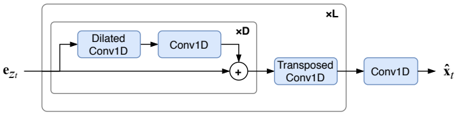
The image displays a block diagram representing a neural network architecture, likely a decoder or generator component used for processing sequential data (such as audio or time-series). The flow moves from left to right, transforming an input signal $e_{Z_t}$ into an output signal $\hat{x}_t$ through a series of convolutional operations, including a residual block structure.
### Components/Axes
* **Input:** $e_{Z_t}$ (located at the far left).
* **Output:** $\hat{x}_t$ (located at the far right).
* **Processing Blocks (Light Blue Rectangles):**
* **Dilated Conv1D:** A convolutional layer with dilation.
* **Conv1D:** A standard 1D convolutional layer.
* **Transposed Conv1D:** A 1D transposed convolutional layer (often used for upsampling).
* **Conv1D:** A final standard 1D convolutional layer.
* **Structural Containers:**
* **xD:** An inner box containing the residual block (Dilated Conv1D and Conv1D). The "xD" label indicates this block is repeated $D$ times.
* **xL:** An outer box containing the "xD" block and the "Transposed Conv1D" layer. The "xL" label indicates this entire structure is repeated $L$ times.
* **Operators:**
* **$\oplus$ (Addition):** A circle containing a plus sign, representing a residual (skip) connection summation.
### Detailed Analysis
The diagram follows a sequential flow from left to right:
1. **Input Stage:** The signal $e_{Z_t}$ enters the system.
2. **Residual Block (Inner 'xD' container):**
* The input signal splits into two paths.
* **Upper Path:** The signal passes through a "Dilated Conv1D" layer, followed by a "Conv1D" layer.
* **Lower Path:** The signal bypasses the convolutional layers (a skip connection).
* **Merge:** The outputs of the upper and lower paths are combined at the addition operator ($\oplus$).
3. **Upsampling/Transformation (Outer 'xL' container):**
* The output from the residual block enters a "Transposed Conv1D" layer.
4. **Final Output Stage:**
* After exiting the "xL" container, the signal passes through a final "Conv1D" layer.
* The process terminates at the output $\hat{x}_t$.
### Key Observations
* **Residual Connection:** The presence of the $\oplus$ operator indicates a residual architecture, which is commonly used to mitigate vanishing gradient problems in deep networks.
* **Dilated Convolution:** The use of "Dilated Conv1D" suggests the model is designed to capture long-range dependencies or a wider receptive field without significantly increasing the number of parameters.
* **Hierarchical Structure:** The nesting of "xD" inside "xL" implies a hierarchical design where a specific residual block is repeated $D$ times, and that entire sequence is then repeated $L$ times, likely to increase the depth and representational capacity of the model.
* **Upsampling:** The "Transposed Conv1D" layer suggests that the model is increasing the temporal resolution of the data as it passes through the "xL" blocks.
### Interpretation
This diagram represents a standard architecture for generative models, such as those used in speech synthesis (e.g., WaveNet-style vocoders) or time-series forecasting.
* **Data Flow:** The architecture takes a latent representation ($e_{Z_t}$) and progressively refines it.
* **Functionality:** The "xD" block acts as a feature extractor that preserves information via the skip connection while learning complex patterns via the dilated convolutions. The "Transposed Conv1D" layer serves to expand the signal, likely increasing the sampling rate or temporal length.
* **Peircean Investigative Note:** The notation "xD" and "xL" are standard shorthand in deep learning literature for "repeat $D$ times" and "repeat $L$ times." This indicates that the diagram is a simplified representation of a much deeper network. The final "Conv1D" layer acts as a projection head, mapping the high-level features learned by the "xL" blocks into the final output space $\hat{x}_t$.