## Diagram: Neural Network Architecture for Sequence Processing
### Overview
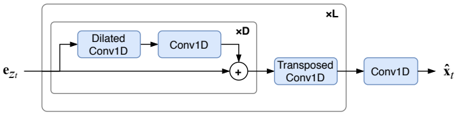
The diagram illustrates a neural network architecture designed for sequence processing, featuring dilated convolutions, residual connections, and transposed convolutions. The flow progresses from an input sequence `e_zt` to a reconstructed/predicted output `x̂_t`, with explicit scaling and transformation steps.
### Components/Axes
- **Input**: `e_zt` (sequence embedding at time step `t`).
- **Blocks**:
1. **Dilated Conv1D**: Expands receptive field for long-range dependencies.
2. **Conv1D**: Standard 1D convolution.
3. **Multiplication by `xD`**: Scaling factor applied to Conv1D output.
4. **Addition (+)**: Residual connection merging paths.
5. **Transposed Conv1D**: Upsampling layer for output reconstruction.
6. **Final Conv1D**: Output refinement.
- **Output**: `x̂_t` (reconstructed/predicted sequence at time step `t`).
### Detailed Analysis
- **Dilated Conv1D**: Input `e_zt` is processed through a dilated convolution with dilation factor `xL`, increasing the receptive field exponentially.
- **Conv1D**: Output of Dilated Conv1D is fed into a standard 1D convolution (`Conv1D`), which applies learned filters.
- **Scaling (`xD`)**: The Conv1D output is multiplied by a scalar `xD`, likely controlling feature magnitude.
- **Residual Connection**: The scaled Conv1D output is added to the original Dilated Conv1D output, enabling gradient flow and mitigating vanishing gradients.
- **Transposed Conv1D**: The residual path is upsampled via transposed convolution, restoring spatial/temporal dimensions.
- **Final Conv1D**: The upsampled output is refined through another `Conv1D` to produce `x̂_t`.
### Key Observations
- **Residual Path**: The addition of the Dilated Conv1D output to the scaled Conv1D output suggests a residual learning mechanism.
- **Dilation Scaling**: The `xL` factor in the Dilated Conv1D indicates adjustable dilation for hierarchical feature extraction.
- **Upsampling**: The Transposed Conv1D implies the architecture handles variable-length sequences or reconstructs higher-resolution outputs.
### Interpretation
This architecture combines dilated convolutions for global context capture with residual connections for stability. The `xD` scaling and `xL` dilation parameters allow flexibility in feature representation. The Transposed Conv1D suggests the model may generate or reconstruct sequences (e.g., time-series prediction, audio generation). The absence of explicit activation functions or normalization layers implies these may be omitted for simplicity or assumed in the Conv1D blocks. The design prioritizes efficient long-range dependency modeling while maintaining computational tractability.