# Technical Document Extraction: Diagram Analysis
## Diagram Labels and Structures
### Row 1
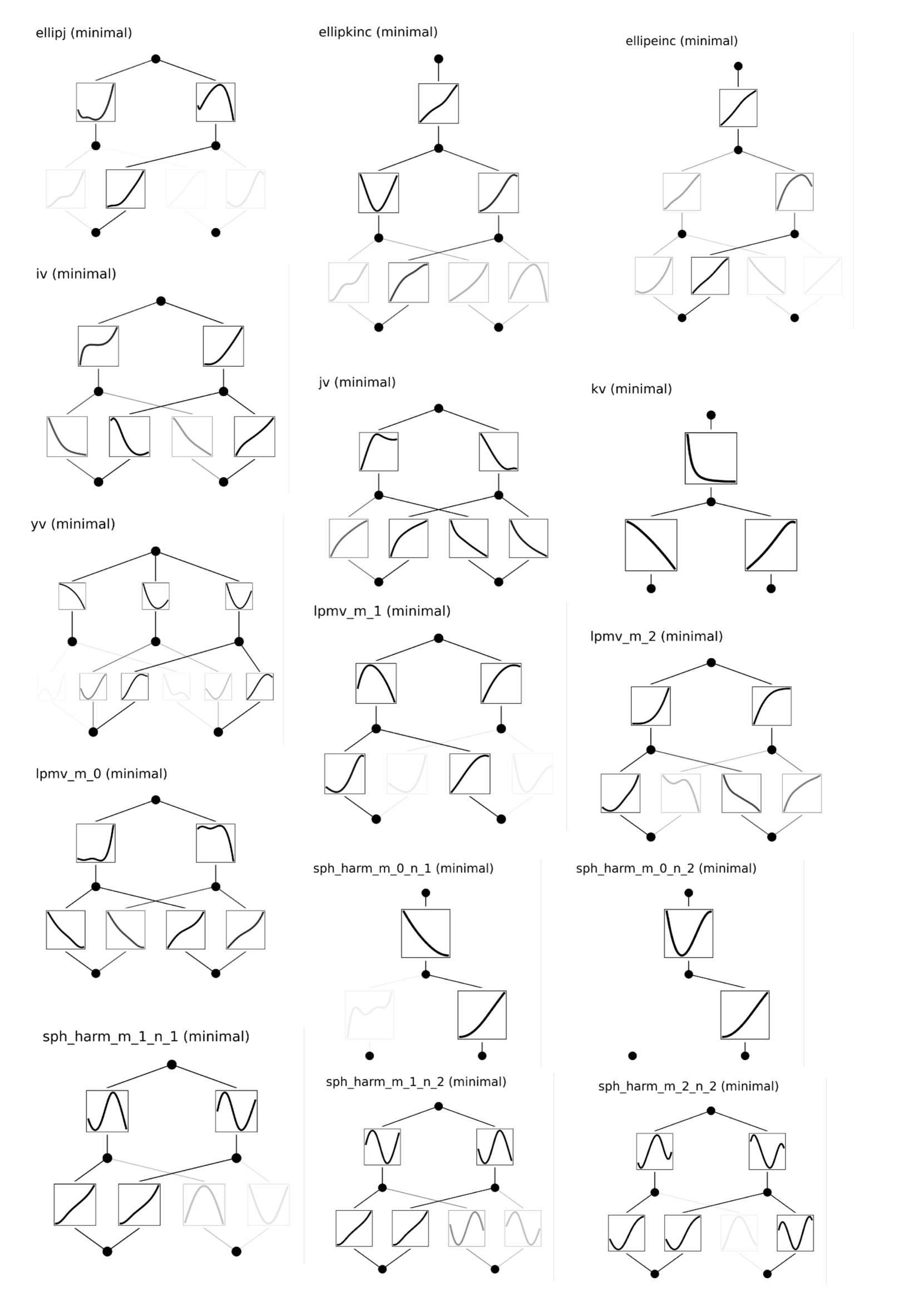
1. **ellipj (minimal)**
- Tree structure with 2 primary branches.
- Root node splits into two nodes, each with two sub-nodes.
- Squares at nodes contain curves (likely function representations).
2. **ellipkinc (minimal)**
- Root node with 3 branches.
- Top branch has 1 sub-node; middle and bottom branches each have 2 sub-nodes.
- Curves in squares suggest varying function behaviors.
3. **ellipeinc (minimal)**
- Root node with 3 branches.
- Top branch has 1 sub-node; middle and bottom branches each have 2 sub-nodes.
- Curves in squares show distinct patterns compared to ellipkinc.
### Row 2
4. **iv (minimal)**
- Balanced binary tree with 2 levels.
- Root splits into two nodes, each with two sub-nodes.
- Curves in squares exhibit smooth transitions.
5. **jv (minimal)**
- Root node with 2 branches.
- Top branch has 1 sub-node; bottom branch has 2 sub-nodes.
- Curves in squares show sharper inflection points.
6. **kv (minimal)**
- Root node with 2 branches.
- Top branch has 1 sub-node; bottom branch has 2 sub-nodes.
- Curves in squares display linear trends.
### Row 3
7. **yv (minimal)**
- Root node with 3 branches.
- Top branch has 1 sub-node; middle and bottom branches each have 2 sub-nodes.
- Curves in squares show oscillatory behavior.
8. **lpmv_m_1 (minimal)**
- Root node with 2 branches.
- Top branch has 3 sub-nodes; bottom branch has 2 sub-nodes.
- Curves in squares indicate polynomial approximations.
9. **lpmv_m_2 (minimal)**
- Root node with 2 branches.
- Top branch has 2 sub-nodes; bottom branch has 3 sub-nodes.
- Curves in squares show higher-degree polynomial fits.
### Row 4
10. **lpmv_m_0 (minimal)**
- Root node with 2 branches.
- Top branch has 1 sub-node; bottom branch has 2 sub-nodes.
- Curves in squares exhibit baseline behavior.
11. **sph_harm_0_n_1 (minimal)**
- Root node with 2 branches.
- Top branch has 1 sub-node; bottom branch has 2 sub-nodes.
- Curves in squares suggest spherical harmonic components.
12. **sph_harm_m_0_n_2 (minimal)**
- Root node with 2 branches.
- Top branch has 1 sub-node; bottom branch has 2 sub-nodes.
- Curves in squares display higher-order spherical harmonics.
### Row 5
13. **sph_harm_m_1_n_1 (minimal)**
- Root node with 2 branches.
- Top branch has 1 sub-node; bottom branch has 2 sub-nodes.
- Curves in squares indicate mixed spherical harmonic terms.
14. **sph_harm_m_1_n_2 (minimal)**
- Root node with 2 branches.
- Top branch has 1 sub-node; bottom branch has 2 sub-nodes.
- Curves in squares show increased complexity in harmonic terms.
15. **sph_harm_m_2_n_2 (minimal)**
- Root node with 2 branches.
- Top branch has 1 sub-node; bottom branch has 2 sub-nodes.
- Curves in squares represent highest-order spherical harmonics in the set.
## Key Observations
- **Label Patterns**:
- Terms like `ellip`, `iv`, `jv`, `kv`, `yv` likely denote elliptic integrals or related functions.
- `lpmv_m_*` and `sph_harm_m_*_n_*` suggest polynomial and spherical harmonic expansions with parameters `m` and `n`.
- "(minimal)" suffix implies base cases or simplified configurations.
- **Tree Structures**:
- Diagrams use hierarchical trees to represent function decomposition or algorithmic steps.
- Nodes with curves may symbolize function evaluations or intermediate results.
- Branch asymmetry (e.g., 1 vs. 2 sub-nodes) could reflect computational efficiency or mathematical constraints.
- **Curve Characteristics**:
- Smooth curves: Likely represent continuous functions (e.g., integrals).
- Sharp inflections: May indicate discontinuities or piecewise definitions.
- Oscillatory patterns: Suggest periodic or wave-like behavior (e.g., spherical harmonics).
## Conclusion
The diagrams encode hierarchical relationships for mathematical functions, with labels indicating specific cases (e.g., minimal configurations). The tree structures and curve patterns provide insights into function behavior, decomposition strategies, or algorithmic flow. No numerical data or legends are present; analysis is based on structural and symbolic cues.