## Diagram: Causal Directed Acyclic Graph (DAG)
### Overview
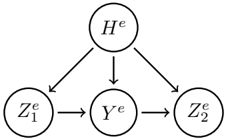
The image displays a directed graph consisting of four nodes (represented by circles) and five directed edges (represented by arrows). The diagram illustrates a causal or directional relationship between four variables: $H^e$, $Z_1^e$, $Y^e$, and $Z_2^e$. The structure suggests a hierarchical system where a top-level variable influences three lower-level variables, which also interact with each other in a sequential chain.
### Components/Axes
* **Nodes (Variables):**
* **$H^e$**: Positioned at the top center.
* **$Z_1^e$**: Positioned at the bottom left.
* **$Y^e$**: Positioned at the bottom center.
* **$Z_2^e$**: Positioned at the bottom right.
* **Edges (Directed Arrows):**
* **From $H^e$:** Three arrows originate from $H^e$, pointing to $Z_1^e$, $Y^e$, and $Z_2^e$ respectively.
* **Horizontal Flow:**
* One arrow points from $Z_1^e$ to $Y^e$.
* One arrow points from $Y^e$ to $Z_2^e$.
### Detailed Analysis
The diagram can be segmented into two distinct layers of influence:
1. **The Confounding Layer (Top-Down):**
* The node $H^e$ acts as a common parent or "confounder" for all other nodes in the system. It exerts a direct influence on $Z_1^e$, $Y^e$, and $Z_2^e$.
2. **The Sequential Layer (Horizontal):**
* There is a causal chain moving from left to right: $Z_1^e \rightarrow Y^e \rightarrow Z_2^e$.
* $Z_1^e$ influences $Y^e$.
* $Y^e$ influences $Z_2^e$.
* Consequently, $Z_1^e$ has an indirect influence on $Z_2^e$ through the mediator $Y^e$.
### Key Observations
* **Common Cause:** $H^e$ is the only node with multiple outgoing edges to the other three nodes, making it the primary source of common variation across the system.
* **Mediated Path:** The relationship between $Z_1^e$ and $Z_2^e$ is mediated by $Y^e$.
* **Notation:** The consistent use of the superscript '$e$' across all variables suggests that these variables are all observed within the same environment, experiment, or specific domain context.
### Interpretation
This diagram is a standard representation used in causal inference, econometrics, and structural equation modeling.
* **Confounding:** The presence of $H^e$ as a parent to $Z_1^e$, $Y^e$, and $Z_2^e$ indicates that any observed correlation between these variables is potentially biased. For example, if one were to analyze the relationship between $Z_1^e$ and $Y^e$, the influence of $H^e$ acts as a "confounder." To isolate the true causal effect of $Z_1^e$ on $Y^e$, one would typically need to "control for" or "condition on" $H^e$.
* **Causal Mechanism:** The chain $Z_1^e \rightarrow Y^e \rightarrow Z_2^e$ represents a structural mechanism. It implies that $Z_1^e$ causes changes in $Y^e$, which subsequently causes changes in $Z_2^e$.
* **Analytical Significance:** This specific configuration is often used to demonstrate selection bias or omitted variable bias. It illustrates that without accounting for $H^e$, the estimated relationship between the variables in the bottom row would be inaccurate due to the shared influence of the top node.