## Diagram: Hierarchical Process Flow
### Overview
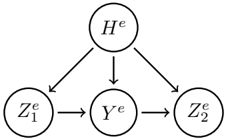
The image depicts a hierarchical process flow diagram with four nodes connected by directional arrows. The structure suggests a sequential or causal relationship between components, with branching pathways and intermediary steps.
### Components/Axes
- **Nodes**:
- `H^e` (top node)
- `Z₁^e` (left node)
- `Y^e` (central node)
- `Z₂^e` (right node)
- **Arrows**:
- `H^e` → `Z₁^e`
- `H^e` → `Z₂^e`
- `Z₁^e` → `Y^e`
- `Y^e` → `Z₂^e`
- **No axes, legends, or numerical scales** are present.
### Detailed Analysis
1. **Primary Pathway**:
- `H^e` directly influences `Z₂^e` (direct arrow).
- `H^e` also influences `Z₁^e`, which then flows to `Y^e`, which finally reaches `Z₂^e` (indirect pathway: `H^e` → `Z₁^e` → `Y^e` → `Z₂^e`).
2. **Key Relationships**:
- `Z₂^e` receives input from both `H^e` (direct) and `Y^e` (indirect via `Z₁^e`).
- `Y^e` acts as a mediator between `Z₁^e` and `Z₂^e`.
### Key Observations
- **Redundancy**: `Z₂^e` has dual input sources (`H^e` and `Y^e`), suggesting potential redundancy or multiple influencing factors.
- **Mediation**: `Y^e` serves as an intermediary, implying a dependency or transformation step between `Z₁^e` and `Z₂^e`.
- **Hierarchy**: `H^e` is the root node, initiating all downstream processes.
### Interpretation
This diagram likely represents a **causal or operational model** where:
- `H^e` is the initiating event or input (e.g., a hypothesis, system state, or trigger).
- `Z₁^e` and `Z₂^e` are outcomes or states influenced by `H^e`.
- `Y^e` represents a secondary process or variable that mediates the relationship between `Z₁^e` and `Z₂^e`.
The dual pathways to `Z₂^e` suggest that its state is determined by both direct and indirect influences from `H^e`. The presence of `Y^e` implies that transformations or intermediate steps are critical to the final outcome (`Z₂^e`). This structure could model systems in fields like systems engineering, biology (e.g., gene regulation), or economics (e.g., supply chain dependencies).