\n
## Diagram: Quadratic Function Piece Identification
### Overview
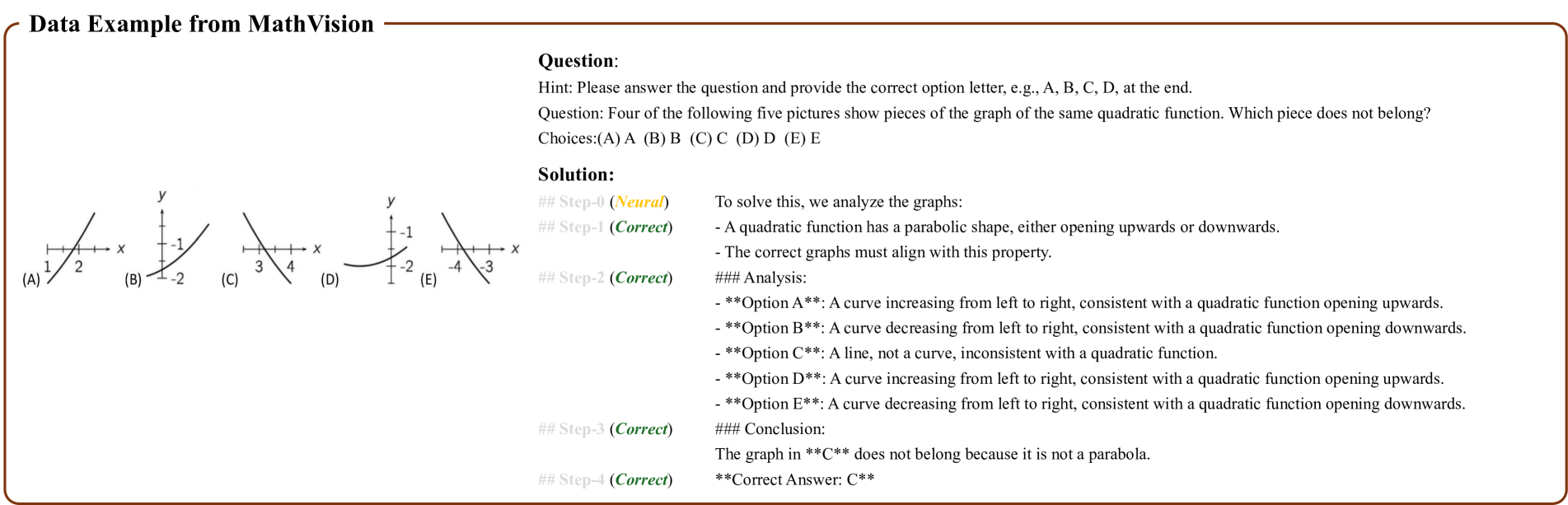
The image presents a mathematical problem involving identifying which of five graph pieces does not belong to the same quadratic function. It includes five small graphs (A-E), a question, answer choices, and a step-by-step solution. The solution explains the properties of quadratic functions and analyzes each graph piece.
### Components/Axes
The image is divided into several sections:
* **Header:** "Data Example from MathVision"
* **Question Section:** Contains the question prompt and answer choices.
* **Graph Section:** Displays five graphs labeled A, B, C, D, and E. Each graph has x and y axes.
* **Solution Section:** Provides a step-by-step solution with annotations.
The graphs have the following axes:
* **x-axis:** Ranges from approximately -2 to 4 for graphs A, B, D, and E. Graph C ranges from -1 to 3.
* **y-axis:** Ranges from approximately -2 to 2 for all graphs.
### Content Details
**Question:**
"Hint: Please answer the question and provide the correct option letter, e.g., A, B, C, D, at the end.
Question: Four of the following five pictures show pieces of the graph of the same quadratic function. Which piece does not belong?
Choices: (A) A (B) B (C) C (D) D (E) E"
**Graphs:**
* **(A):** A parabola opening upwards. The vertex is near (0, -1). The curve increases from left to right.
* **(B):** A parabola opening downwards. The vertex is near (0, 1). The curve decreases from left to right.
* **(C):** A straight line with a negative slope. It passes through approximately (0, 1) and (2, -1).
* **(D):** A parabola opening upwards. The vertex is near (2, -2). The curve increases from left to right.
* **(E):** A parabola opening downwards. The vertex is near (2, 1). The curve decreases from left to right.
**Solution:**
* **Step-0 (Neural):** "To solve this, we analyze the graphs:"
* **Step-1 (Correct):** "- A quadratic function has a parabolic shape, either opening upwards or downwards. - The correct graphs must align with this property."
* **Step-2 (Correct):** "### Analysis:
*Option A**: A curve increasing from left to right, consistent with a quadratic function opening upwards.
*Option B**: A curve decreasing from left to right, consistent with a quadratic function opening downwards.
*Option C**: A line, not a curve, inconsistent with a quadratic function.
*Option D**: A curve increasing from left to right, consistent with a quadratic function opening upwards.
*Option E**: A curve decreasing from left to right, consistent with a quadratic function opening downwards."
* **Step-3 (Correct):** "### Conclusion:
The graph in **C** does not belong because it is not a parabola."
* **Step-4 (Correct):** "**Correct Answer: C**"
### Key Observations
The solution correctly identifies graph C as the outlier because it represents a linear function, not a quadratic function. Graphs A, B, D, and E all exhibit parabolic shapes, consistent with quadratic functions.
### Interpretation
The problem tests the understanding of quadratic functions and their graphical representation. A quadratic function is defined by an equation that results in a parabolic curve when graphed. The key characteristic used to identify the outlier is the shape of the graph. A straight line does not represent a quadratic function. The step-by-step solution effectively breaks down the problem by first stating the defining property of a quadratic function (parabolic shape) and then analyzing each graph piece against that property. The neural network step suggests an automated approach to solving this type of problem. The problem is designed to assess conceptual understanding rather than complex calculations.