## Diagram: MathVision Quadratic Function Analysis
### Overview
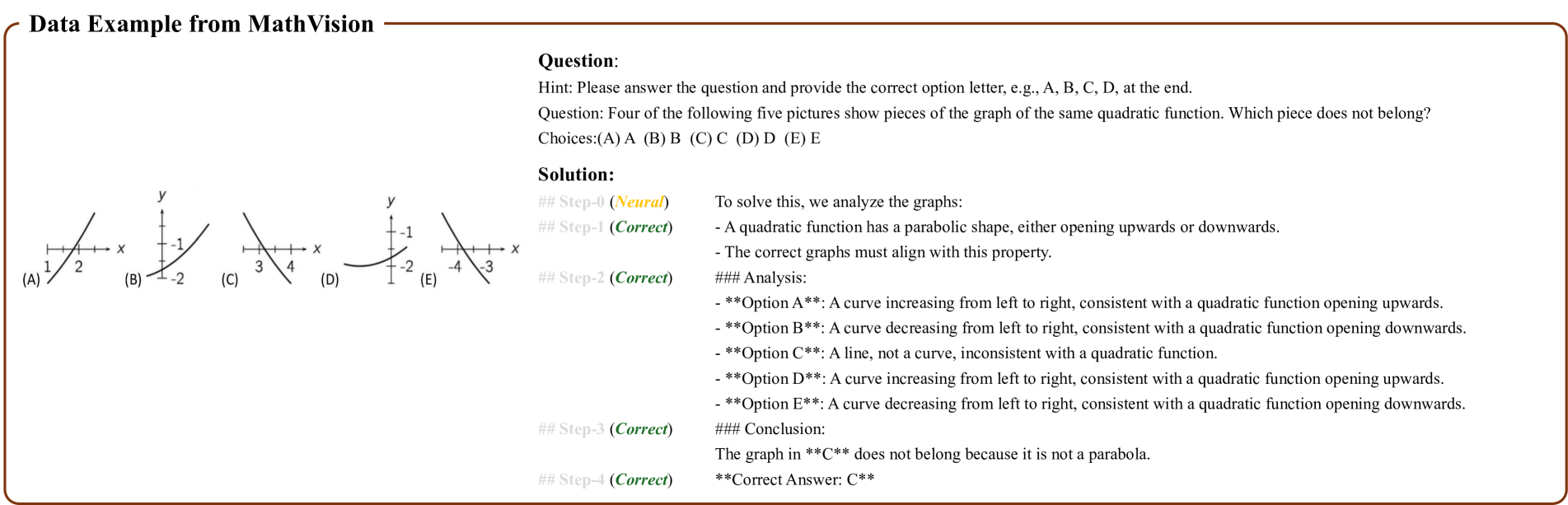
The image presents a mathematical problem from MathVision, asking which of five graphs (A-E) does not belong to the same quadratic function. The solution explains that quadratic functions form parabolas, while one graph is a linear function (a straight line).
### Components/Axes
- **Title**: "Data Example from MathVision" (top-left corner).
- **Question Text**:
- "Four of the following five pictures show pieces of the graph of the same quadratic function. Which piece does not belong?"
- Choices: (A) (B) (C) (D) (E).
- **Graphs (A-E)**:
- All graphs are simple line plots with x and y axes.
- No explicit axis labels, scales, or legends are visible in the graphs themselves.
- **Solution Section**:
- Step 0: "To solve this, we analyze the graphs."
- Step 1: "A quadratic function has a parabolic shape, either opening upwards or downwards."
- Step 2: Analysis of each option:
- **A**: Curve increasing left to right (upward-opening parabola).
- **B**: Curve decreasing left to right (downward-opening parabola).
- **C**: Straight line (not a parabola).
- **D**: Curve increasing left to right (upward-opening parabola).
- **E**: Curve decreasing left to right (downward-opening parabola).
- Step 3: Conclusion: "The graph **C** does not belong because it is not a parabola."
- Step 4: Final answer: **C**.
### Detailed Analysis
- **Graph Shapes**:
- **A, D**: Parabolic curves opening upwards (consistent with quadratic functions).
- **B, E**: Parabolic curves opening downwards (consistent with quadratic functions).
- **C**: Linear function (straight line), inconsistent with quadratic functions.
- **Textual Clues**:
- The solution explicitly states that quadratic functions must be parabolic, ruling out linear functions.
- No numerical data points or axis markers are provided in the graphs.
### Key Observations
1. **Graph C** is the only non-parabolic shape, making it the outlier.
2. All other graphs (A, B, D, E) align with quadratic function properties (parabolic curves).
3. The solution relies on geometric properties rather than numerical data.
### Interpretation
The problem tests recognition of quadratic function characteristics. Quadratic functions are defined by their parabolic shape, which can open upward or downward depending on the coefficient of the squared term. The linear function (Graph C) lacks this curvature, confirming it does not belong to the same family. This highlights the importance of visual pattern recognition in algebraic problem-solving.