## Word Cloud: Academic/Technical Terminology
### Overview
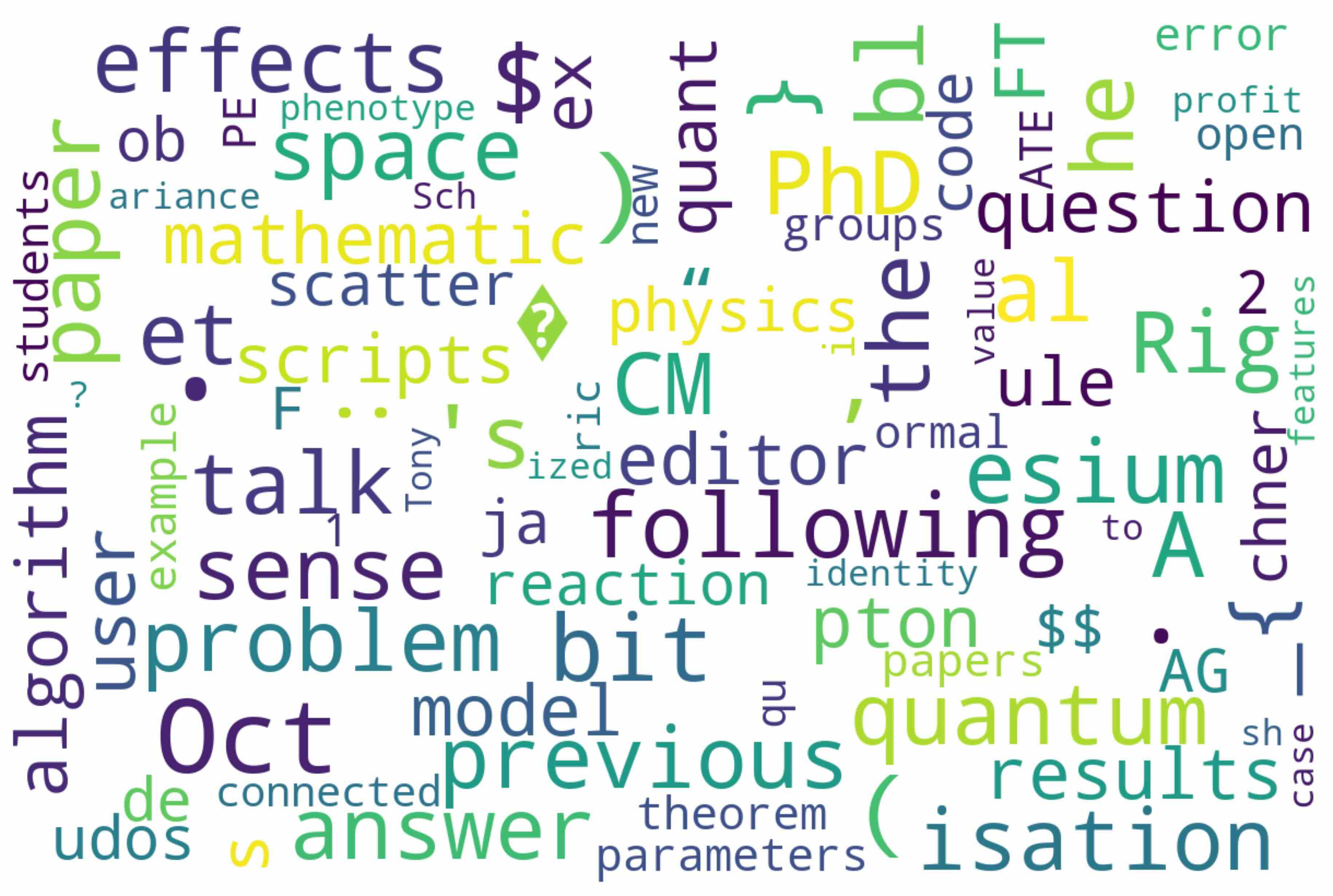
The image is a word cloud visualization. It displays a collection of words and short phrases, primarily in English, with varying font sizes, colors, and orientations. The size of each word typically represents its frequency or importance within an underlying source text, which appears to be from academic, scientific, or technical literature. There is no quantitative data, axis, or legend; the information is purely textual and relational based on visual prominence.
### Components/Axes
* **Type:** Word Cloud.
* **Primary Language:** English.
* **Visual Variables:**
* **Font Size:** Indicates relative frequency/importance. Larger words are more prominent.
* **Color:** Words are rendered in a palette of dark purple, teal/green, and yellow/lime green. Color may be used for aesthetic grouping or to denote different categories from the source, but no legend is provided to define this.
* **Orientation:** Most words are horizontal. A few are rotated vertically (e.g., "algorithm", "students", "paper", "user", "example", "Tony's", "ric", "the", "value", "chmer", "features", "case", "qu", "de", "s").
* **Layout:** Words are densely packed and overlapping in a seemingly random arrangement to fill the rectangular space.
### Detailed Analysis
**Extracted Text (Grouped by approximate visual prominence/color):**
* **Large, Prominent Terms (Likely High Frequency):**
* `effects` (dark purple, top-left)
* `space` (teal, top-center)
* `mathematic` (yellow, upper-center)
* `question` (dark purple, upper-right)
* `the` (dark purple, vertical, center-right)
* `following` (dark purple, center)
* `problem` (teal, lower-left)
* `bit` (teal, center-bottom)
* `Oct` (dark purple, bottom-left)
* `previous` (teal, bottom-center)
* `quantum` (yellow, bottom-right)
* `answer` (teal, bottom)
* `isation` (teal, bottom-right corner)
* **Medium-Sized Terms:**
* `paper` (yellow, vertical, left)
* `et` (dark purple, left)
* `scripts` (yellow, left-center)
* `talk` (dark purple, left-center)
* `sense` (dark purple, left-center)
* `editor` (dark purple, center)
* `esium` (teal, center-right)
* `results` (teal, bottom-right)
* `model` (teal, bottom-center)
* `PhD` (yellow, upper-right)
* `groups` (dark purple, upper-right)
* `physics` (yellow, center)
* `CM` (teal, center)
* `scatter` (dark purple, upper-left)
* `reaction` (teal, center)
* `identity` (teal, center-right)
* `parameters` (dark purple, bottom)
* `theorem` (dark purple, bottom)
* **Smaller Terms and Fragments:**
* `ob`, `ariance`, `Sch`, `phenotype`, `$x`, `ex`, `quant`, `new`, `)`, `{`, `b1`, `code`, `FT`, `ATE`, `he`, `error`, `profit`, `open`, `al`, `value`, `Rig`, `2`, `ule`, `ormal`, `to`, `A`, `chmer`, `features`, `ja`, `Sized`, `ric`, `Tony's`, `F..`, `?`, `example`, `students`, `user`, `algorithm`, `de`, `udos`, `s`, `connected`, `qu`, `ag`, `sh`, `case`, `I`, `{`, `$$`, `pton`, `papers`.
* **Symbols and Punctuation:**
* `$x`, `$$`, `?`, `..`, `'`, `(`, `)`, `{`, `}`, `.`, `,`
### Key Observations
1. **Dominant Themes:** The largest words point to core themes: **problem-solving** (`problem`, `answer`, `question`, `sense`), **academic/research context** (`paper`, `PhD`, `results`, `model`, `theorem`, `parameters`, `editor`), **technical/scientific domains** (`quantum`, `physics`, `mathematic`, `algorithm`, `space`, `effects`), and **process/structure** (`following`, `previous`, `Oct`, `bit`, `isation`).
2. **Color Distribution:** The three-color scheme (dark purple, teal, yellow) is distributed throughout the cloud without an immediately obvious categorical pattern based on word meaning. It may be purely aesthetic or derived from an unstated grouping in the source data.
3. **Textual Nature:** The cloud contains many academic shorthand terms (`et`, `al`, `ob`, `ric`, `qu`), mathematical symbols (`$x`, `$$`), and potential name fragments (`Tony's`, `Sch`, `CM`, `AG`).
4. **No Quantitative Data:** As a word cloud, it conveys relative importance through size but provides no exact counts, frequencies, or statistical measures.
### Interpretation
This word cloud visually summarizes a body of text likely drawn from academic or technical writing, possibly in fields like computational science, physics, or quantitative research. The prominence of "problem," "answer," "question," and "following" suggests a focus on methodology, inquiry, and logical progression. Terms like "quantum," "physics," "mathematic," and "algorithm" indicate a strong scientific and computational foundation. The presence of "PhD," "paper," "editor," and "results" firmly places the context within research and publication.
The cloud effectively highlights the lexicon's core components but abstracts away the specific relationships and narrative. It serves as a thematic fingerprint, showing that the source material is concerned with defining and solving problems using mathematical and computational models within a formal academic framework. The inclusion of fragments and symbols (`$x`, `et`, `al`) reinforces the technical and citation-heavy nature of the original text.