## Word Cloud: Academic and Technical Themes
### Overview
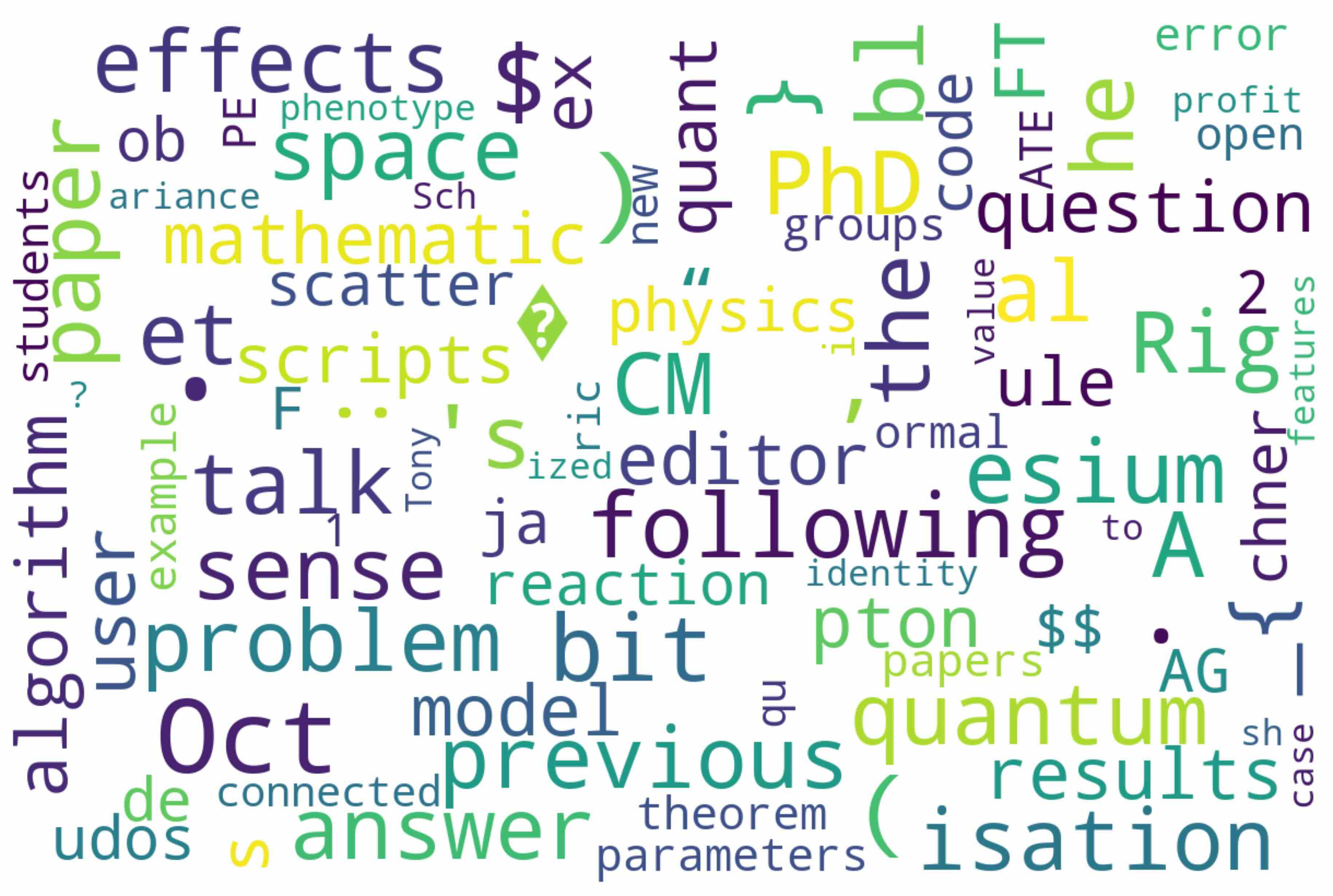
The image is a word cloud composed of technical and academic terminology, with words varying in size and color. No explicit axes, legends, or numerical data are present. The layout is unstructured, with words overlapping and positioned randomly.
### Components/Axes
- **No axes or scales**: The image lacks numerical axes or quantitative markers.
- **Legend**: Absent. Color variations (purple, green, yellow, blue) are present but not explicitly labeled.
- **Text elements**: Words are the sole content, with no additional annotations or labels.
### Detailed Analysis
- **Word sizes**: Larger words (e.g., "quantum," "algorithm," "paper") likely indicate higher frequency or prominence in the source dataset.
- **Color distribution**:
- **Purple**: Dominates the cloud (e.g., "effects," "quantum," "students").
- **Green**: Includes terms like "space," "physics," "results."
- **Yellow**: Words such as "mathematic," "model," "previous."
- **Blue**: Terms like "bit," "connected," "parameters."
- **Notable words**:
- Technical: "quantum," "physics," "algorithm," "code."
- Academic: "paper," "students," "theorem."
- Collaborative: "paper," "editor," "results."
- Miscellaneous: "Oct," "FT," "error," "profit."
### Key Observations
1. **Dominant themes**: Academic research ("quantum," "physics"), technology ("algorithm," "code"), and collaboration ("paper," "students").
2. **Color clustering**: Purple and green dominate, suggesting these categories may represent core themes.
3. **Ambiguity**: No legend or metadata to confirm categories or frequencies. Overlapping words (e.g., "Oct," "FT") reduce readability.
### Interpretation
The word cloud likely visualizes a corpus of academic or technical documents, with larger words reflecting higher occurrence rates. The absence of a legend limits precise categorization, but color coding may imply groupings (e.g., purple for foundational concepts, green for applied fields). Terms like "quantum" and "algorithm" suggest a focus on advanced STEM topics, while "paper" and "students" hint at academic publishing or educational contexts. The lack of structured data prevents quantitative analysis, but the prominence of certain terms underscores their relevance in the source material.