\n
## Diagram: WeMath Data Example - Book Stacking Logic Problem
### Overview
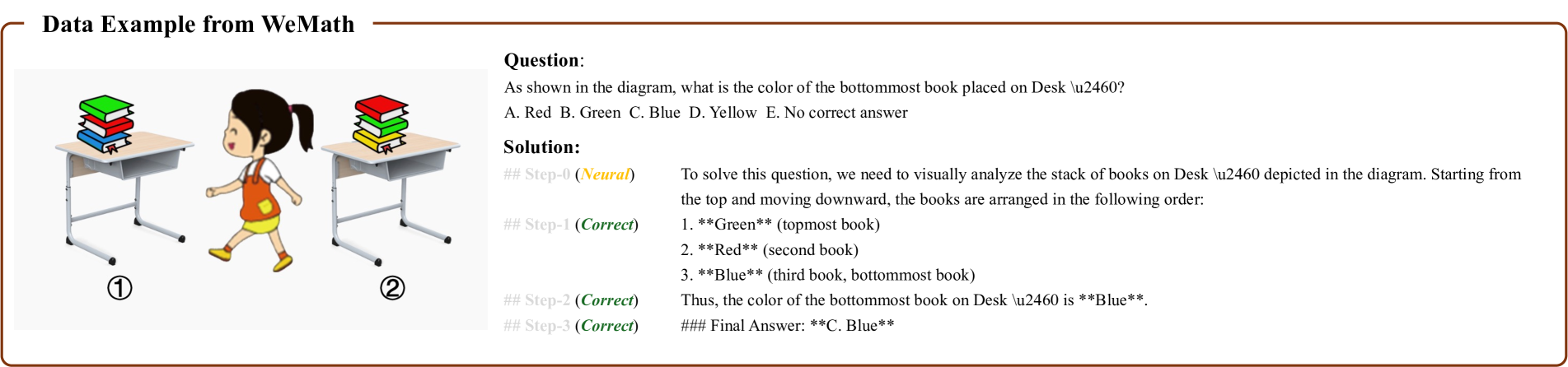
The image is an educational slide or document excerpt titled "Data Example from WeMath". It presents a visual logic puzzle involving the arrangement of colored books on two desks. The layout is divided into two main sections: a diagram on the left and a textual question with a step-by-step solution on the right.
### Components/Axes
**1. Header:**
* **Title:** "Data Example from WeMath" (located at the top-left, underlined with a brown horizontal rule).
**2. Diagram Section (Left Side):**
* **Visual Elements:** Two identical school desks, labeled with circled numbers, and a cartoon girl walking between them.
* **Desk ① (Left):** A stack of three books. From top to bottom: a green book, a red book, and a blue book.
* **Desk ② (Right):** A stack of three books. From top to bottom: a red book, a green book, and a yellow book.
* **Labels:** The desks are labeled with circled numbers: "①" below the left desk and "②" below the right desk.
* **Character:** A girl with brown hair in a ponytail, wearing an orange shirt and yellow shorts, is depicted walking from left to right between the two desks.
**3. Text Section (Right Side):**
* **Question Block:**
* **Label:** "Question:"
* **Text:** "As shown in the diagram, what is the color of the bottommost book placed on Desk \u2460?"
* *Note: "\u2460" is the Unicode character for the circled number 1, corresponding to Desk ① in the diagram.*
* **Multiple Choice Options:**
* A. Red
* B. Green
* C. Blue
* D. Yellow
* E. No correct answer
* **Solution Block:**
* **Label:** "Solution:"
* **Step-0 (Neural):** "To solve this question, we need to visually analyze the stack of books on Desk \u2460 depicted in the diagram. Starting from the top and moving downward, the books are arranged in the following order:"
* **Step-1 (Correct):** A numbered list:
1. "**Green** (topmost book)"
2. "**Red** (second book)"
3. "**Blue** (third book, bottommost book)"
* **Step-2 (Correct):** "Thus, the color of the bottommost book on Desk \u2460 is **Blue**."
* **Step-3 (Correct):** "### Final Answer: **C. Blue**"
### Detailed Analysis
The core task is to identify the color of the bottom book on the desk labeled "①".
* **Visual Data from Diagram for Desk ①:** The stack is clearly depicted with three distinct colored books. The top book is green, the middle book is red, and the bottom book is blue.
* **Textual Solution Logic:** The solution text explicitly walks through the visual analysis, listing the book colors from top to bottom for Desk ①, confirming the bottommost book is blue.
* **Cross-Reference:** The solution's final answer (C. Blue) matches the visual evidence from the diagram for Desk ①. The diagram for Desk ② (with a yellow bottom book) is a distractor and is not referenced in the question or solution.
### Key Observations
1. **Spatial Reasoning:** The problem tests the ability to correctly associate the label "Desk \u2460" (or ①) with the correct visual element in the diagram.
2. **Color Identification:** Requires accurate perception of the colors in the specified stack.
3. **Sequential Order:** The solution methodically lists the order from top to bottom, which is a reliable way to avoid confusion.
4. **Distractor Element:** The presence of a second desk (Desk ②) with a different book order serves as a visual distractor, testing if the solver focuses on the correct labeled item.
### Interpretation
This image is a pedagogical tool designed to teach or assess basic visual analysis and logical deduction skills, likely for a young audience. It demonstrates a clear problem-solving framework:
1. **Identify the Target:** The question specifies "Desk \u2460".
2. **Locate the Target:** Find the corresponding element in the diagram (the left desk labeled ①).
3. **Analyze the Target:** Observe the specific property requested (color of the bottommost book).
4. **Formulate the Answer:** Based on observation, select the matching option.
The inclusion of a "Neural" step and "Correct" steps suggests this might be an example from a dataset or a demonstration of an AI's reasoning process, showing how it breaks down a visual question into logical steps. The structure emphasizes methodical, verifiable reasoning over a simple guess. The clear separation between the visual data and the textual reasoning process makes it an effective example for explaining how to solve such puzzles.