## ASCII Art Diagram: "SPACE TREE"
### Overview
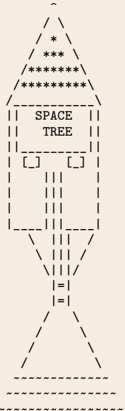
The image is a vertically oriented ASCII art diagram depicting a stylized tree structure. The tree is constructed using standard typographic characters (asterisks, slashes, pipes, brackets, equals signs, and dashes) on a light beige background. The central, defining textual element is the label "SPACE TREE" embedded within the upper portion of the trunk.
### Components/Axes
The diagram is composed of four distinct, stacked sections:
1. **Canopy (Top Section):** A triangular shape representing the tree's foliage.
* Constructed with forward slashes (`/`) and backslashes (`\`) forming the outer edges.
* Filled with asterisks (`*`) arranged in horizontal rows, increasing in number from top to bottom.
* A single asterisk (`*`) sits at the very apex.
2. **Label Section (Upper Trunk):** A rectangular area immediately below the canopy.
* Bordered by vertical pipes (`|`) on the left and right.
* Contains the two-line text label:
* Line 1: `SPACE`
* Line 2: `TREE`
* The text is centered within this bordered section.
3. **Trunk (Middle Section):** A narrow, vertical column extending downward from the label section.
* Bordered by vertical pipes (`|`) on the left and right.
* Contains a central vertical line made of pipe characters (`|`).
* Includes two sets of horizontal brackets (`[ ]`) positioned symmetrically on either side of the central pipe line, suggesting branches or structural supports.
4. **Base (Bottom Section):** A widening, then narrowing, foundation.
* Begins with a series of vertical pipes (`|`) converging inward.
* Transitions to a section using equals signs (`=`) arranged in a small, centered block.
* Ends with a wide, horizontal base made of dashes (`-`).
### Detailed Analysis
* **Text Transcription:** The only standard English words present are "SPACE" and "TREE," located in the upper trunk section.
* **Character Inventory & Spatial Layout:**
* **Top (Canopy):** Apex `*`, followed by rows of `*` (approx. 1, 3, 5, 7, 9, 11, 13, 15 characters wide), framed by `/` and `\`.
* **Upper Middle (Label):** A box defined by `|` on sides and `_` on top/bottom. Inside: `SPACE` above `TREE`.
* **Center (Trunk):** Vertical `|` borders. Central `|` line. Two `[ ]` pairs are placed at the same vertical level, about one-third down the trunk's length.
* **Lower Middle:** The trunk's central `|` line continues, flanked by converging `|` lines.
* **Bottom (Base):** A block of `=` signs (appears as a 3x3 or similar grid). The final base is a long horizontal line of `-` characters.
### Key Observations
1. **Symmetry:** The diagram exhibits near-perfect bilateral symmetry along its vertical central axis.
2. **Hierarchical Construction:** The structure is built from simple, repeating characters to create a complex, recognizable form (a tree).
3. **Label Integration:** The textual label "SPACE TREE" is not an annotation but an integral, framed component of the diagram's structure.
4. **Abstract Representation:** The tree is highly stylized. The canopy is geometric (a triangle), the trunk is a narrow column with abstract bracket "branches," and the base is a formal, stepped foundation.
### Interpretation
This ASCII art diagram is a symbolic or conceptual representation rather than a data-driven chart. The title "SPACE TREE" suggests it may be a metaphorical illustration for a technical concept, such as:
* A **data structure** (e.g., a tree data structure in computer science, where "space" could refer to memory or a namespace).
* A **hierarchical system** in a spatial or astronomical context.
* A **logo or icon** for a project, software tool, or concept related to organized space or hierarchical information.
The design emphasizes order, symmetry, and clear segmentation (canopy, label, trunk, base), which are key attributes of well-organized systems. The use of monospaced ASCII characters implies a context related to computing, programming, or plain-text documentation. The diagram's primary function is to provide a memorable, textual-iconic representation of the "SPACE TREE" concept, prioritizing symbolic clarity over quantitative data.