## Flowchart: Interpretability Approaches
### Overview
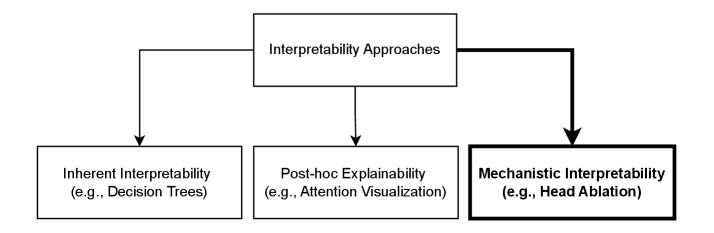
The diagram illustrates a hierarchical structure of interpretability approaches in machine learning, branching from a central node into three distinct categories. Each category includes examples of specific techniques.
### Components/Axes
- **Central Node**: "Interpretability Approaches" (bold, centered at the top).
- **Three Branches**:
1. **Left Branch**: "Inherent Interpretability (e.g., Decision Trees)".
2. **Middle Branch**: "Post-hoc Explainability (e.g., Attention Visualization)".
3. **Right Branch**: "Mechanistic Interpretability (e.g., Head Ablation)".
### Detailed Analysis
- **Inherent Interpretability**:
- Label: "Inherent Interpretability".
- Example: "Decision Trees" (italicized, in parentheses).
- **Post-hoc Explainability**:
- Label: "Post-hoc Explainability".
- Example: "Attention Visualization" (italicized, in parentheses).
- **Mechanistic Interpretability**:
- Label: "Mechanistic Interpretability".
- Example: "Head Ablation" (italicized, in parentheses).
### Key Observations
- The diagram categorizes interpretability methods into three mutually exclusive groups.
- Each category includes a concrete example (e.g., "Decision Trees" for Inherent Interpretability).
- Arrows connect the central node to all three subcategories, emphasizing their relationship to the overarching concept.
### Interpretation
This flowchart highlights the taxonomy of interpretability approaches, distinguishing between:
1. **Inherent Interpretability**: Models designed to be interpretable by design (e.g., Decision Trees).
2. **Post-hoc Explainability**: Techniques applied after model training to explain outputs (e.g., Attention Visualization).
3. **Mechanistic Interpretability**: Methods focused on understanding internal model mechanisms (e.g., Head Ablation).
The structure suggests a progression from broad conceptual categories to specific technical implementations, emphasizing the diversity of strategies for achieving model transparency. The use of examples grounds abstract concepts in real-world applications, aiding practitioners in selecting appropriate methods based on their interpretability needs.