## Line Graphs: Average Probability of Metrics Across Llama and Gemma Layers
### Overview
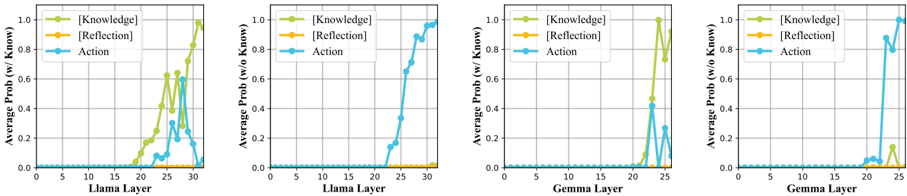
The image contains four line graphs comparing the average probability of three metrics—[Knowledge], [Reflection], and [Action]—across layers of two language models: Llama and Gemma. Each model has two graphs: one with Knowledge included (`w/ Know`) and one without (`w/o Know`). The graphs highlight how metric performance varies with layer depth and the inclusion/exclusion of Knowledge.
---
### Components/Axes
- **X-Axis**:
- Labeled "Llama Layer" (graphs 1–2) or "Gemma Layer" (graphs 3–4).
- Scale: 0 to 30 (discrete increments).
- **Y-Axis**:
- Labeled "Average Prob (w/ Know)" (graphs 1, 3) or "Average Prob (w/o Know)" (graphs 2, 4).
- Scale: 0.0 to 1.0.
- **Legends**:
- Top-left corner of each graph.
- Colors:
- Green: [Knowledge]
- Orange: [Reflection]
- Blue: [Action]
- **Graph Layout**:
- Two graphs per model (Llama left, Gemma right).
- Each graph has three lines (one per metric).
---
### Detailed Analysis
#### Llama Model (Graphs 1–2)
1. **Graph 1 (w/ Know)**:
- **Knowledge** (green): Peaks at ~0.8 at layer 25, then drops to ~0.6 by layer 30.
- **Action** (blue): Peaks at ~0.6 at layer 20, then declines to ~0.2 by layer 30.
- **Reflection** (orange): Remains near 0 throughout.
2. **Graph 2 (w/o Know)**:
- **Action** (blue): Peaks at ~0.8 at layer 25, then drops sharply.
- **Knowledge** (green) and **Reflection** (orange): Flat near 0.
#### Gemma Model (Graphs 3–4)
1. **Graph 3 (w/ Know)**:
- **Knowledge** (green): Peaks at ~0.8 at layer 25, then drops to ~0.6.
- **Action** (blue): Peaks at ~0.6 at layer 20, then declines.
- **Reflection** (orange): Flat near 0.
2. **Graph 4 (w/o Know)**:
- **Action** (blue): Peaks at ~0.8 at layer 25, then drops.
- **Knowledge** (green): Sharp peak at layer 25 (~0.2), then drops.
- **Reflection** (orange): Flat near 0.
---
### Key Observations
1. **Peak Layering**:
- Knowledge and Action metrics peak at different layers (Knowledge at layer 25, Action at layer 20 for Llama; similar for Gemma).
2. **Knowledge Inclusion Impact**:
- Including Knowledge (`w/ Know`) boosts the [Knowledge] metric but suppresses [Action] performance.
- Excluding Knowledge (`w/o Know`) allows [Action] to dominate, with higher peaks.
3. **Model Differences**:
- Llama shows sharper declines post-peak compared to Gemma.
- Gemma’s [Knowledge] metric has a smaller residual peak in `w/o Know` (layer 25, ~0.2).
---
### Interpretation
- **Trade-off Between Metrics**: The inclusion of Knowledge enhances the model’s ability to encode factual or reflective data ([Knowledge]) but may hinder its capacity for dynamic, action-oriented reasoning ([Action]). This suggests a potential architectural conflict between knowledge retention and real-time decision-making.
- **Model-Specific Behavior**: Llama’s steeper post-peak declines imply a more rigid layer hierarchy, while Gemma’s gradual drops suggest more distributed processing.
- **Anomalies**: The residual [Knowledge] peak in Gemma’s `w/o Know` graph (layer 25) hints at residual knowledge leakage even when explicitly excluded, possibly due to shared parameters or cross-layer dependencies.
---
### Spatial Grounding & Trend Verification
- **Legend Placement**: Top-left corner in all graphs, ensuring clarity.
- **Color Consistency**:
- Green ([Knowledge]) matches all green lines.
- Blue ([Action]) matches all blue lines.
- **Trend Logic**:
- Llama’s [Knowledge] in Graph 1 slopes upward to layer 25, then downward—consistent with the described peak.
- Gemma’s [Action] in Graph 4 rises sharply at layer 25, aligning with the annotated peak.
---
### Conclusion
The graphs reveal a critical design consideration: balancing knowledge integration with actionable reasoning. Models optimized for factual accuracy ([Knowledge]) may sacrifice real-time adaptability ([Action]), and vice versa. This trade-off could inform future model architectures aiming for hybrid capabilities.