## Text Analysis: Significance of 'Shraddha'
### Overview
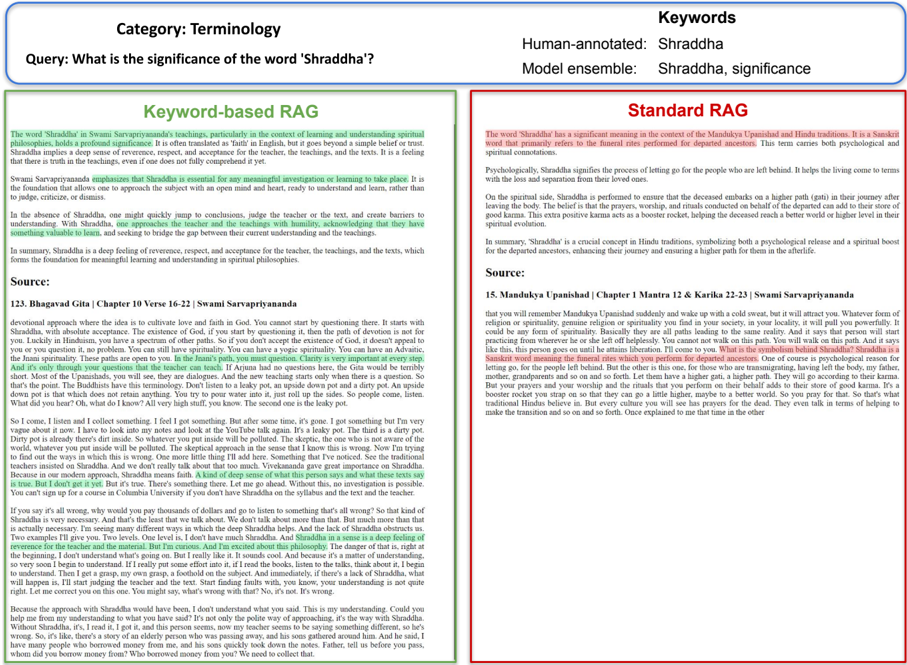
The image presents a comparative analysis of the term 'Shraddha' from two perspectives: a keyword-based approach and a standard reference approach. It includes the definition, context, and source of the term from different texts and viewpoints.
### Components/Axes
* **Category:** Terminology
* **Query:** What is the significance of the word 'Shraddha'?
* **Keywords:**
* Human-annotated: Shraddha
* Model ensemble: Shraddha, significance
* **Sections:**
* Keyword-based RAG (left side, green background)
* Standard RAG (right side, red background)
### Detailed Analysis or ### Content Details
**Keyword-based RAG (Left Side):**
* **Definition and Context:**
* 'Shraddha' in Swami Sarvapriyananda's teachings is significant in learning and understanding spiritual philosophies.
* Translated as 'faith' in English, but goes beyond simple belief or trust.
* Implies reverence, respect, and acceptance for the teacher, teachings, and texts.
* Essential for meaningful investigation or learning.
* Allows approaching the subject with an open mind, rather than to judge or dismiss.
* In its absence, one might jump to conclusions and create barriers to understanding.
* With Shraddha, one approaches with humility, acknowledging the value in teachings.
* **Source:**
* Bhagavad Gita | Chapter 10 Verse 16-22 | Swami Sarvapriyananda
* **Additional Points:**
* Devotional approach cultivates love and faith in God.
* Starts with Shraddha and absolute acceptance.
* If one questions the existence of God, the path of devotion is not for them.
* Hinduism offers a spectrum of other paths.
* Jnani's path requires questioning.
* Clarity is important at every step.
* Teachers can teach through questions.
* Analogy of leaky, upside-down, and dirty pots.
* Traditional teachers insisted on Shraddha.
* Modern approach equates Shraddha with faith.
* Necessary for investigation.
* Necessary to have Shraddha on the syllabus and the text and the teacher.
* Shraddha is necessary to listen to something that's all wrong.
* Shraddha helps in many ways.
* Shraddha is a deep feeling of reverence for the teacher and the material.
* Approach with Shraddha is to seek understanding.
**Standard RAG (Right Side):**
* **Definition and Context:**
* 'Shraddha' has a significant meaning in the context of the Mandukya Upanishad and Hindu traditions.
* Sanskrit word referring to funeral rites for departed ancestors.
* Carries psychological and spiritual connotations.
* Psychologically, signifies letting go for those left behind.
* Helps the living come to terms with loss.
* Spiritually, performed to ensure the deceased embarks on a higher path.
* Prayers, worship, and rituals add to their store of good karma.
* Acts as a booster rocket for spiritual evolution.
* Symbolizes psychological release and spiritual boost for departed ancestors.
* **Source:**
* Mandukya Upanishad | Chapter 1 Mantra 12 & Karika 22-23 | Swami Sarvapriyananda
* **Additional Points:**
* Remember Mandukya Upanishad suddenly and wake up with a cold sweat, but it will attract you.
* Genuine religion or spirituality pulls you powerfully.
* All paths lead to the same reality.
* One will start practicing from wherever they left off.
* Shraddha is a Sanskrit word meaning the funeral rites.
* Psychological reason for letting go.
* For those transmigrating, let them have a higher gati, a higher path.
* Prayers and worship add to their store of good karma.
* Booster rocket to a better world.
* Prayers for the dead.
### Key Observations
* The keyword-based RAG focuses on 'Shraddha' as a foundation for learning and understanding, emphasizing reverence and acceptance.
* The standard RAG focuses on 'Shraddha' as a concept related to funeral rites and the afterlife, emphasizing psychological release and spiritual boost.
* Both approaches acknowledge Swami Sarvapriyananda as a source.
### Interpretation
The image presents two distinct interpretations of 'Shraddha.' The keyword-based approach emphasizes its role in intellectual and spiritual growth, while the standard approach highlights its significance in rituals related to death and the afterlife. The juxtaposition of these perspectives provides a comprehensive understanding of the term's multifaceted nature within Hindu traditions. The keyword-based RAG seems to be more focused on the living and the process of learning, while the standard RAG is focused on the dead and the process of letting go.