## Technical Document Comparison Diagram: Keyword-based RAG vs. Standard RAG
### Overview
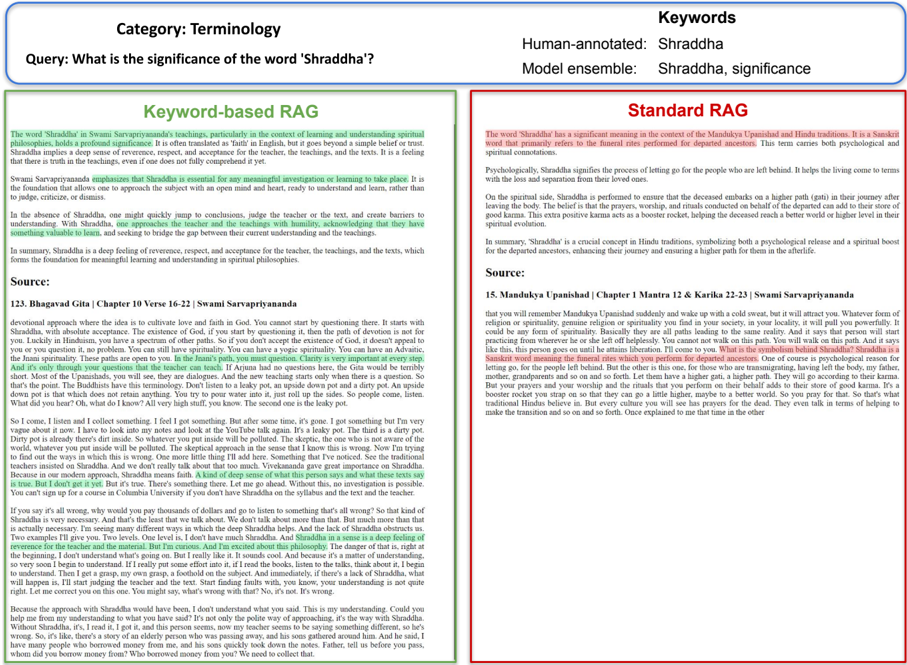
The image is a side-by-side comparison diagram illustrating two different Retrieval-Augmented Generation (RAG) approaches for answering a specific query about the term "Shraddha." The diagram is structured as a technical document with a header, two distinct columns, and embedded text blocks. The left column details a "Keyword-based RAG" response, and the right column details a "Standard RAG" response. The text is in English.
### Components/Axes
The diagram is segmented into three primary regions:
1. **Header (Top Spanning Both Columns):**
* **Category:** Terminology
* **Keywords:**
* Human-annotated: Shraddha
* Model ensemble: Shraddha, significance
* **Query:** "What is the significance of the word 'Shraddha'?"
2. **Left Column - Keyword-based RAG:**
* **Title:** "Keyword-based RAG" (in green text).
* **Content:** A multi-paragraph text block explaining "Shraddha" based on Swami Sarvapriyananda's teachings. Specific phrases are highlighted in green.
* **Source Citation:** "Source: 123. Bhagavad Gita | Chapter 10 Verse 16-22 | Swami Sarvapriyananda"
3. **Right Column - Standard RAG:**
* **Title:** "Standard RAG" (in red text).
* **Content:** A multi-paragraph text block explaining "Shraddha" with a focus on Hindu traditions, Mandukya Upanishad, and Karika. Specific phrases are highlighted in red.
* **Source Citation:** "Source: 15. Mandukya Upanishad | Chapter 1 Mantra 12 & Karika 22-23 | Swami Sarvapriyananda"
### Detailed Analysis / Content Details
**Keyword-based RAG Column (Left):**
* **Core Definition:** "Shraddha" is described as a "deep feeling of reverence, respect, and acceptance for the teacher, the teachings, and the texts."
* **Key Highlighted Phrases (Green):**
* "The word 'Shraddha' in Swami Sarvapriyananda's teachings, particularly in the context of learning and understanding spiritual philosophy, refers to a deep sense of faith, trust, and reverence."
* "Swami Sarvapriyananda emphasizes that Shraddha is essential for any meaningful investigation or learning to take place."
* "In the absence of Shraddha, one might quickly jump to conclusions, judge the teacher or the text, and create barriers to understanding."
* "In summary, Shraddha is a deep feeling of reverence, respect, and acceptance for the teacher, the teachings, and the texts, which forms the foundation for meaningful learning and understanding in spiritual philosophies."
* **Extended Discussion:** The text elaborates on the necessity of Shraddha for learning, using analogies like a student at a university and the story of an elderly person on their deathbed. It contrasts a skeptical approach with one grounded in Shraddha.
**Standard RAG Column (Right):**
* **Core Definition:** "Shraddha" is defined as a "Sanskrit word meaning the funeral rites performed for departed ancestors. This term carries both psychological and spiritual connotations."
* **Key Highlighted Phrases (Red):**
* "The word 'Shraddha' has a significant meaning in the context of the Mandukya Upanishad and Hindu traditions. It is a Sanskrit word meaning the funeral rites performed for departed ancestors."
* "Psychologically, Shraddha signifies the process of letting go for the people who are left behind."
* "On the spiritual side, Shraddha is performed to ensure that the deceased embarks on a higher path (gati) in their journey after death."
* "Sanskrit word meaning the funeral rites which you perform for departed ancestors."
* **Extended Discussion:** The text explains the dual psychological (letting go) and spiritual (ensuring a good afterlife journey) aspects of Shraddha as funeral rites. It discusses the concept of "gati" (path) and the belief that good deeds (karma) of the living aid the deceased.
### Key Observations
1. **Divergent Interpretations:** The two RAG methods retrieve and present fundamentally different interpretations of the same term "Shraddha."
* **Keyword-based RAG** retrieves content focused on the term's meaning in the context of *learning and spiritual philosophy* (faith, reverence for a teacher).
* **Standard RAG** retrieves content focused on the term's meaning in the context of *Hindu ritual practice* (funeral rites for ancestors).
2. **Source Differentiation:** Each response cites a different source lecture by the same speaker (Swami Sarvapriyananda), indicating the RAG systems pulled from different parts of a knowledge base.
3. **Textual Emphasis:** The highlighting (green vs. red) visually reinforces the core definition each system extracted as most relevant to the query.
4. **Structural Consistency:** Both columns follow an identical structure: Title -> Explanatory Text -> Source Citation.
### Interpretation
This diagram serves as a case study demonstrating how different RAG architectures can lead to divergent answers for the same query, even when drawing from the same overall knowledge source (lectures by Swami Sarvapriyananda).
* **What the Data Suggests:** The "Keyword-based RAG" appears to perform a more literal, keyword-focused retrieval, latching onto "Shraddha" and pulling the most direct definition from a philosophical teaching context. The "Standard RAG" seems to perform a more contextual or semantic retrieval, potentially understanding the query's broader scope and retrieving information about the term's ritualistic and traditional significance.
* **Relationship Between Elements:** The header defines the problem (the query and keywords). The two columns present competing solutions. The highlighted text within each column represents the "answer core" each system identified. The sources validate the origin of the information.
* **Notable Anomalies:** The most significant observation is the complete lack of overlap in the primary definition offered. One system defines it as "faith/reverence for learning," the other as "funeral rites." This highlights a potential challenge in RAG systems: ensuring comprehensive and context-aware retrieval when terms have multiple, distinct meanings across different domains (here, philosophy vs. ritual practice). The diagram effectively argues that the choice of RAG method critically shapes the informational output.