## Screenshot: Comparison of Keyword-based RAG and Standard RAG Systems
### Overview
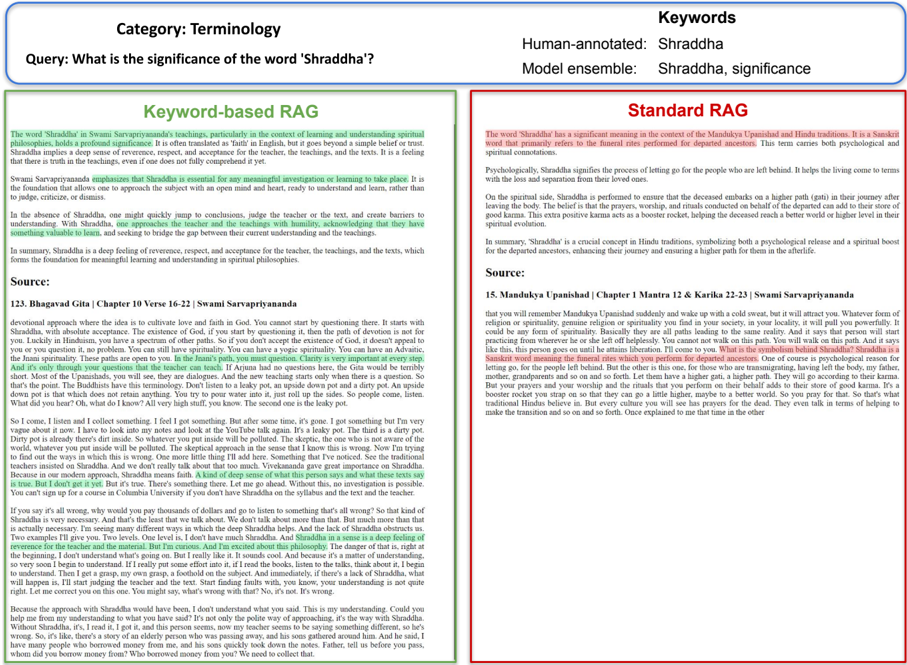
The image compares two approaches to Retrieval-Augmented Generation (RAG) systems: **Keyword-based RAG** (green-highlighted text) and **Standard RAG** (red-highlighted text). Both sections analyze the significance of the Sanskrit term "Shraddha" in Hindu spiritual traditions, with distinct philosophical interpretations and source citations.
---
### Components/Axes
- **Headers**:
- **Category**: Terminology
- **Query**: "What is the significance of the word 'Shraddha'?"
- **Keywords**: Shraddha, significance
- **Sections**:
- **Keyword-based RAG** (left, green-highlighted text)
- **Standard RAG** (right, red-highlighted text)
- **Sources**:
- **Keyword-based RAG**:
- *123. Bhagavad Gita | Chapter 10 Verse 16-22 | Swami Sarvapriyananda*
- **Standard RAG**:
- *15. Mandukya Upanishad | Chapter 1 Mantra 12 & Karika 22-23 | Swami Sarvapriyananda*
---
### Detailed Analysis
#### Keyword-based RAG (Green Highlights)
- **Definition**:
- "Shraddha" is translated as "faith" but emphasizes **reverence, respect, and acceptance** for teachers, teachings, and texts.
- Requires an "open mind and heart" to avoid judgment or dismissal of spiritual concepts.
- **Philosophical Role**:
- Acts as a foundation for meaningful learning by bridging gaps between current understanding and teachings.
- Example: Swami Sarvapriyananda stresses that questioning is essential to cultivate devotion ("bhakti") and spiritual growth.
- **Source Text**:
- Quotes from the *Bhagavad Gita* (Chapter 10, Verses 16-22) highlight the importance of humility and curiosity in spiritual inquiry.
#### Standard RAG (Red Highlights)
- **Definition**:
- Focuses on **ritualistic practices** (e.g., funeral rites for ancestors) and their psychological/spiritual benefits.
- Describes "Shraddha" as a process of **letting go** of grief and separation from loved ones.
- **Psychological/Spiritual Impact**:
- Rituals provide closure for the living and help the deceased transition to a "higher path" (gati) in the afterlife.
- Emphasizes collective karma and the role of rituals in spiritual evolution.
- **Source Text**:
- Quotes from the *Mandukya Upanishad* (Chapter 1, Mantra 12 & Karika 22-23) discuss the symbolism of rituals and their role in liberation (moksha).
---
### Key Observations
1. **Keyword-based RAG** prioritizes **attitudinal readiness** (reverence, humility) as prerequisites for spiritual learning.
2. **Standard RAG** emphasizes **ritualistic action** (e.g., Shraddha ceremonies) as a means of psychological release and spiritual progression.
3. Both systems reference Swami Sarvapriyananda but draw from different texts (*Bhagavad Gita* vs. *Mandukya Upanishad*), reflecting divergent interpretive frameworks.
---
### Interpretation
- **Keyword-based RAG** aligns with Swami Sarvapriyananda’s devotional approach, where faith is a mindset enabling deeper engagement with spiritual teachings. The absence of Shraddha risks superficial understanding or rejection of complex concepts.
- **Standard RAG** reflects a ritual-centric view, where Shraddha ceremonies address grief and facilitate ancestral transitions. This approach ties spiritual practices to tangible outcomes (e.g., karma, gati).
- **Contrast**: The former focuses on **internal attitude** toward learning, while the latter emphasizes **external rituals** for spiritual and psychological well-being. Both, however, agree on Shraddha’s foundational role in Hindu spirituality.
---
### Notes on Language
- All text is in English, with direct references to Sanskrit terms (e.g., "Shraddha," "gati," "karma") and their contextual meanings.
- No non-English text is present beyond source citations.