\n
## Diagram: Network Visualization
### Overview
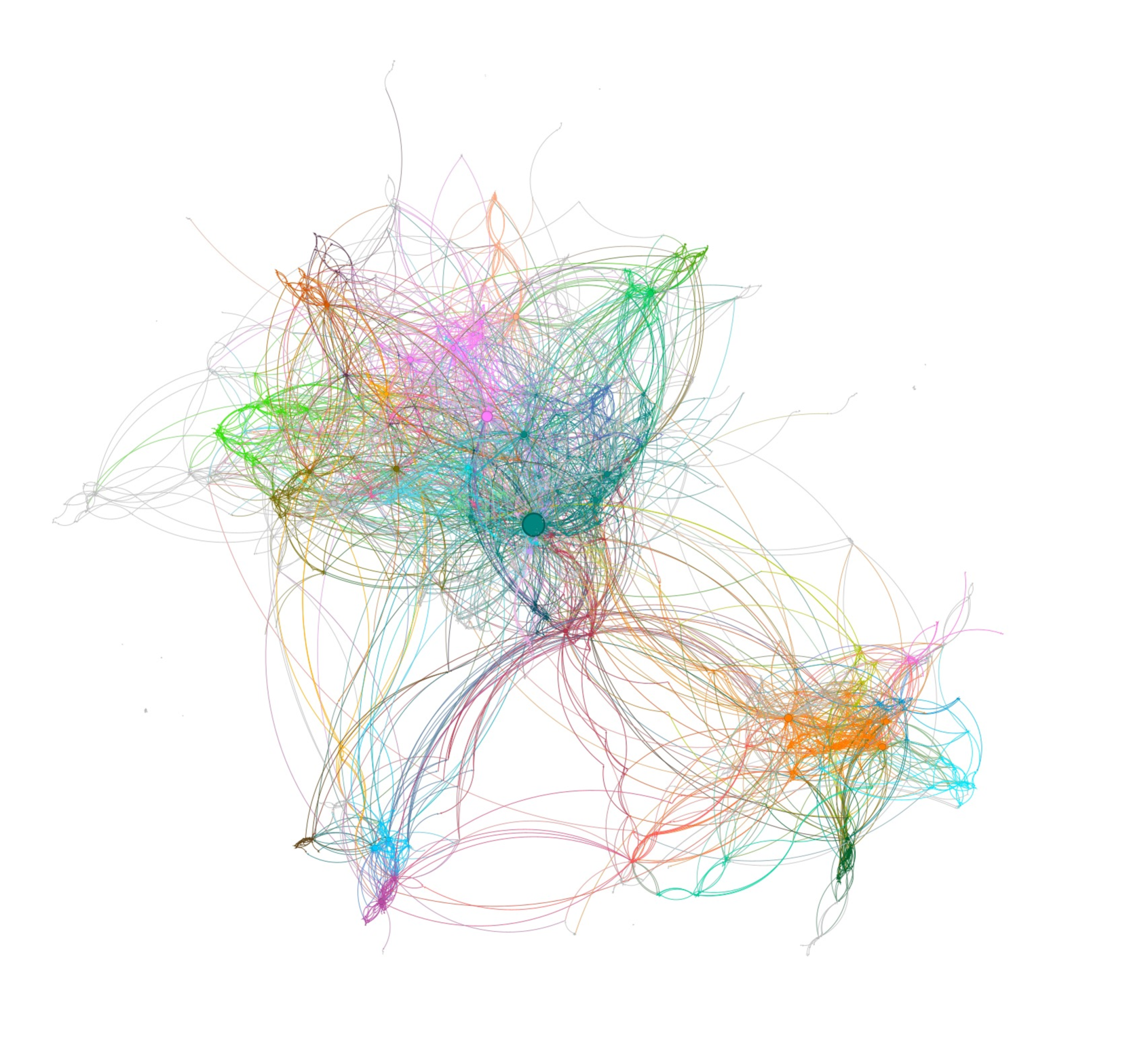
The image presents a complex network visualization composed of numerous interconnected lines and nodes. The lines, varying in color, represent connections between nodes, which appear as points where lines converge. The overall structure resembles a highly interconnected web, with a central cluster and several radiating branches. There are no explicit labels, axes, or legends present within the image itself. The diagram appears to be a visual representation of relationships or flows within a system, but the specific nature of these relationships is not defined.
### Components/Axes
There are no explicit axes or labeled components. The diagram consists solely of:
* **Nodes:** Points where lines intersect, representing entities or elements within the network.
* **Edges/Connections:** Lines connecting the nodes, representing relationships or flows between them.
* **Colors:** The lines are colored in a variety of hues, including green, blue, purple, orange, red, and gray. These colors likely represent different categories or types of connections, but without a legend, their meaning is unknown.
* **Central Node:** A larger, teal-colored node located approximately in the center of the diagram. This node appears to be a central hub, with a high degree of connectivity.
### Detailed Analysis / Content Details
Due to the lack of labels and a legend, precise data extraction is impossible. However, we can describe the visual characteristics:
* **Density:** The central region of the diagram is significantly denser than the peripheral regions, indicating a higher concentration of connections and nodes in the center.
* **Color Distribution:**
* **Green Lines:** Predominantly located in the upper-left quadrant, forming a dense cluster.
* **Blue Lines:** Radiate from the central node towards the bottom-left quadrant.
* **Purple Lines:** Concentrated in the upper-center and upper-right quadrants, with a more dispersed pattern.
* **Orange Lines:** Primarily found in the bottom-right quadrant, forming a distinct cluster.
* **Red Lines:** Scattered throughout the diagram, with a moderate density.
* **Gray Lines:** Appear to be the most numerous, forming a background network connecting various parts of the diagram.
* **Line Length:** Line lengths vary considerably, suggesting different distances or strengths of connections.
* **Node Degree:** The central teal node has a very high degree (number of connections), while other nodes have varying degrees.
### Key Observations
* The central teal node acts as a major hub, connecting many different parts of the network.
* The network appears to be non-uniform, with distinct clusters of nodes and connections in different regions.
* The color variations suggest that different types of relationships or flows exist within the network.
* The diagram lacks any quantitative information, making it difficult to assess the strength or importance of individual connections.
### Interpretation
This diagram likely represents a complex system with numerous interconnected components. The central node could represent a key entity or process, while the surrounding nodes represent related entities or processes. The different colors could indicate different types of relationships, such as information flow, resource allocation, or dependencies.
The high density of connections in the central region suggests that this is where the most activity or interaction occurs. The distinct clusters in different quadrants could represent different sub-systems or groups within the larger network.
Without further information, it is difficult to determine the specific meaning of the diagram. However, it provides a visual representation of the complexity and interconnectedness of the system. The absence of labels and a legend limits the interpretability of the diagram, making it more of a qualitative visualization than a quantitative analysis. It is possible that the diagram is intended to highlight the overall structure of the network rather than to provide specific data points.
The diagram could be used to illustrate concepts in network theory, social network analysis, or systems biology. It could also be used to visualize data from a variety of other domains, such as transportation networks, communication networks, or financial networks.