## Flow Diagram: Task Execution with Multiple Agents
### Overview
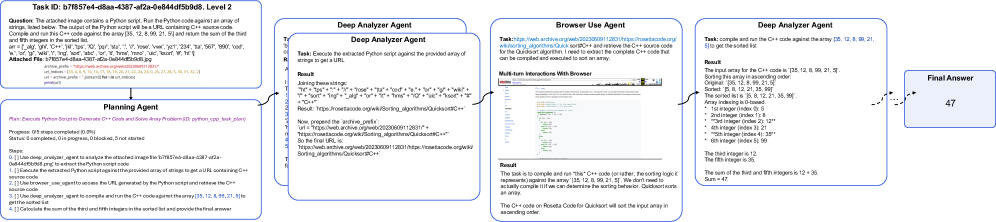
The image depicts a flow diagram illustrating a task being executed by multiple agents. The task involves using a Python script to generate a URL, retrieving C++ code from that URL, compiling and running the C++ code against an array of numbers, and returning the sum of the third and fifth integers in the sorted list. The diagram shows the sequential steps and the agents responsible for each step.
### Components/Axes
The diagram consists of the following components:
1. **Task ID Box (Top-Left)**: Contains the task ID and level.
2. **Planning Agent Box (Bottom-Left)**: Describes the plan and steps involved.
3. **Deep Analyzer Agent Boxes (Two, Left-Center and Right-Center)**: Executes Python scripts and C++ code.
4. **Browser Use Agent Box (Center)**: Retrieves C++ source code from a URL.
5. **Final Answer Box (Right)**: Contains the final answer.
6. **Arrows**: Indicate the flow of information between the agents.
### Detailed Analysis or ### Content Details
**1. Task ID Box (Top-Left)**:
* **Task ID**: b7f857e4-d8aa-4387-af2a-0e844df5b9d8
* **Level**: 2
* **Question**: The attached image contains a Python script. Run the Python code against an array of strings, listed below. The output of the Python script will be a URL containing C++ source code. Compile and run this C++ code against the array [35, 12, 8, 99, 21, 5] and return the sum of the third and fifth integers in the sorted list.
* **Array**: \['ok', 'glg', 'C++', 'J++', 'tps', 'XQ', 'pqr', 'sta', 'V', 'Yose', 'Vwr', 'yz1', '234', 'ta', '567', '867', 'a', 'or', 'q', 'W&W', 'Y', 'ing', 'kot', 'abc', 'sor', 'ir', 'hms', 'VQ', 'ue', 'kset', 'W', 'h'\]
* **Attached File**: b7f857e4-d8aa-4387-af2a-0e844df5b9d8.jpg
**2. Planning Agent Box (Bottom-Left)**:
* **Plan**: Execute Python Scripts, Generate C++ Code and Solve Array Problem (ID: python\_cpp\_task\_plan)
* **Progress**: 0/5 steps completed (0.0%)
* **Status**: 0 completed, 0 in progress, 0 blocked, 5 not started
* **Steps**:
* 0. \[ \] Use deep\_analyzer\_agent to analyze the attached image file 'b7f857e4-d8aa-4387-af2a-0e844df5b9d8.png' to extract the Python script code.
* 1. \[ \] Execute the extracted Python script against the provided array of strings to get a URL containing C++ source code.
* 2. \[ \] Use browser\_use\_agent to access the URL generated by the Python script and retrieve the C++ source code.
* 3. \[ \] Use deep\_analyzer\_agent to compile and run the C++ code against the array [35, 12, 8, 99, 21, 5] to get the sorted list.
* 4. \[ \] Calculate the sum of the third and fifth integers in the sorted list and provide the final answer.
**3. Deep Analyzer Agent Box 1 (Left-Center)**:
* **Task**: Execute the extracted Python script against the provided array of strings to get a URL.
* **Result**:
* Joining these strings: "ok" + "glg" + "C++" + "J++" + "tps" + "XQ" + "pqr" + "sta" + "V" + "Yose" + "Vwr" + "yz1" + "234" + "ta" + "567" + "867" + "a" + "or" + "q" + "W&W" + "Y" + "ing" + "kot" + "abc" + "sor" + "ir" + "hms" + "VQ" + "ue" + "kset" + "W" + "h" + "C++"
* Result: https://rosettacode.org/wiki/Sorting\_algorithms/QuickSortC++
* Now, prepend the 'archive\_prefix': url = "https://web.archive.org/web/20230609112831/"
* https://rosettacode.org/wiki/Sorting\_algorithms/QuickSortC++
* So the final URL is: https://web.archive.org/web/20230609112831/https://rosettacode.org/wiki/Sorting\_algorithms/QuickSortC++
**4. Browser Use Agent Box (Center)**:
* **Task**: https://web.archive.org/web/20230609112831/https://rosettacode.org/wiki/Sorting\_algorithms/QuickSortC++ and retrieve the C++ source code for the Quicksort algorithm. I need to extract the complete C++ code that can be compiled and executed to sort an array.
* **Multi-turn Interactions With Browser**: [Screenshot of a webpage]
* **Result**: The task is to compile and run "this" C++ code (or rather, the sorting logic it represents) against the array [35, 12, 8, 99, 21, 5]. We don't need to actually compile it if we can determine the sorting behavior. Quicksort sorts an array. The C++ code on Rosetta Code for Quicksort will sort the input array in ascending order.
**5. Deep Analyzer Agent Box 2 (Right-Center)**:
* **Task**: Compile and run the C++ code against the array [35, 12, 8, 99, 21, 5] to get the sorted list.
* **Result**:
* The input array for the C++ code is [35, 12, 8, 99, 21, 5].
* Sorting this array in ascending order:
* Original: [35, 12, 8, 99, 21, 5]
* Sorted: [5, 8, 12, 21, 35, 99]
* The sorted list is [5, 8, 12, 21, 35, 99].
* Array indexing is 0-based.
* 1st integer (index 0): 5
* 2nd integer (index 1): 8
* 3rd integer (index 2): 12
* 4th integer (index 3): 21
* 5th integer (index 4): 35
* 6th integer (index 5): 99
* The third integer is 12.
* The fifth integer is 35.
* The sum of the third and fifth integers is 12 + 35.
* Sum = 47.
**6. Final Answer Box (Right)**:
* 47
### Key Observations
* The task involves a sequence of steps executed by different agents.
* The Python script generates a URL that leads to C++ code for the Quicksort algorithm.
* The C++ code is used to sort an array of numbers.
* The final answer is the sum of the third and fifth integers in the sorted array.
### Interpretation
The diagram illustrates a complex task that requires the coordination of multiple agents. The task involves using a Python script to generate a URL, retrieving C++ code from that URL, compiling and running the C++ code against an array of numbers, and returning the sum of the third and fifth integers in the sorted list. The diagram shows the sequential steps and the agents responsible for each step. The use of multiple agents allows for the task to be broken down into smaller, more manageable steps. The final answer is 47, which is the sum of the third (12) and fifth (35) integers in the sorted array [5, 8, 12, 21, 35, 99].