\n
## Diagram: Multi-Agent System Workflow
### Overview
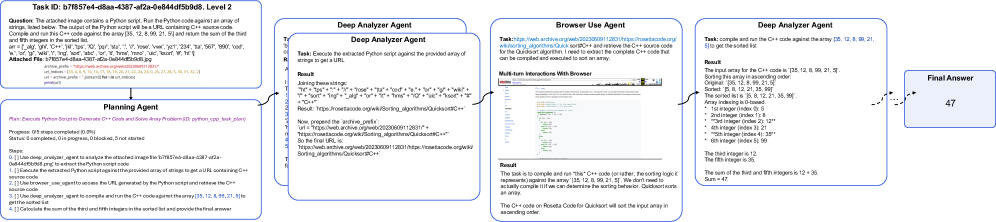
The image depicts a workflow diagram illustrating a multi-agent system designed to solve a coding problem. The system consists of three primary agents: a Planning Agent, a Deep Analyzer Agent (appearing twice), and a Browser Use Agent. The workflow involves generating Python code, analyzing it, potentially using a browser to find solutions, and finally, compiling the code to C++. The diagram shows the tasks, inputs, and outputs of each agent, along with the flow of information between them. A "Final Answer" box is present at the far right, with the number "47" inside.
### Components/Axes
The diagram is structured into four main rectangular blocks, each representing an agent or the final answer. Each block contains text describing the agent's task, input, and output. Arrows indicate the flow of information between the agents. The diagram also includes a "Task ID" at the top-left: `ID: B7857f4-0b0a-4387-a12a-0a44d50b86`.
### Detailed Analysis or Content Details
**1. Planning Agent (Leftmost Block)**
* **Task:** Plan Python Generative Code Details & Array Problem (20 step plan, system prompt)
* **Input:**
* `Step 0/9` (appears multiple times, indicating progress)
* `Steps:` followed by a list of numbered steps.
* `1. [Loop setup]: create an array to store the results.`
* `2. [Loop setup]: create an array to store the results.`
* `3. [Loop setup]: create an array to store the results.`
* `4. [Loop setup]: create an array to store the results.`
* `5. [Loop setup]: create an array to store the results.`
* `6. [Loop setup]: create an array to store the results.`
* `7. [Loop setup]: create an array to store the results.`
* `8. [Loop setup]: create an array to store the results.`
* `9. [Loop setup]: create an array to store the results.`
* `10. [Loop setup]: create an array to store the results.`
* `11. [Loop setup]: create an array to store the results.`
* `12. [Loop setup]: create an array to store the results.`
* `13. [Loop setup]: create an array to store the results.`
* `14. [Loop setup]: create an array to store the results.`
* `15. [Loop setup]: create an array to store the results.`
* `16. [Loop setup]: create an array to store the results.`
* `17. [Loop setup]: create an array to store the results.`
* `18. [Loop setup]: create an array to store the results.`
* `19. [Loop setup]: create an array to store the results.`
* `20. [Loop setup]: create an array to store the results.`
* **Output:** Python code (details not fully visible, but includes `array_length = 12`)
**2. Deep Analyzer Agent (First Instance - Center-Left Block)**
* **Task:** Deep Analyzer Agent: Analyze the Python code against the provided array strings to get a URL.
* **Result:**
* `Java things = "my"`
* `Java things = "my"`
* `Java things = "my"`
* `Java things = "my"`
* `Java things = "my"`
* `URL: https://stackoverflow.com/questions/4488005/sorting-algorithm-quick-sort-and-retrieve-the-c-code-note-the-quickest-algorithm-i-need-to-the-complete-c-code-that`
* **Note:** The repeated "Java things = "my"" is likely an artifact or placeholder.
**3. Browser Use Agent (Center Block)**
* **Task:** Browser Use Agent: Execute the extracted Python against the provided URL strings to get a URL.
* **Content:** A screenshot of a webpage (likely Stack Overflow) with code snippets. The code appears to be a QuickSort implementation.
* **Note:** The text below the screenshot reads: "To complete and parse that URL, you must clarify the specific algorithm you are looking for. The current URL is not sufficiently specific to return a compilable C++ code."
* **Result:** `https://www.geeksforgeeks.org/quick-sort/`
**4. Deep Analyzer Agent (Second Instance - Center-Right Block)**
* **Task:** Deep Analyzer Agent: Compile code and use the C++ code generated from the array (12, 3, 5, 7, 4, 8, 9, 2, 1, 6, 10, 11).
* **Result:**
* `The array sorted is: [2, 3, 4, 5, 6, 7, 8, 9, 10, 11, 12, 1]`
* `Array remaining is: 0-based`
* `1st Integer (index 0): 12`
* `2nd Integer (index 1): 3`
* `3rd Integer (index 2): 5`
* `4th Integer (index 3): 7`
* `5th Integer (index 4): 4`
* `6th Integer (index 5): 8`
* `7th Integer (index 6): 9`
* `8th Integer (index 7): 2`
* `9th Integer (index 8): 1`
* `10th Integer (index 9): 6`
* `11th Integer (index 10): 10`
* `12th Integer (index 11): 11`
* `Sum of the 12th and 11th integers is: 21`
**5. Final Answer (Far-Right Block)**
* Contains the number "47".
### Key Observations
* The system attempts to solve an array problem, likely sorting.
* The Planning Agent generates a series of steps, all of which are identical ("Loop setup"). This suggests a potential issue or placeholder in the planning process.
* The Deep Analyzer Agent uses a URL to find relevant code (initially Stack Overflow, then GeeksforGeeks).
* The final Deep Analyzer Agent compiles the code and provides the sorted array, along with individual element values and a sum.
* The sorted array is not in ascending order.
* The "Final Answer" of "47" is not directly related to the array problem and its purpose is unclear.
### Interpretation
The diagram illustrates a complex workflow for automated code generation and problem-solving. The system leverages multiple agents to plan, analyze, search for solutions, and compile code. However, the repeated "Loop setup" steps in the Planning Agent and the unsorted array in the final result suggest potential flaws in the system's logic or implementation. The system appears to be attempting to implement a sorting algorithm (QuickSort), but the final result is incorrect. The inclusion of the "Final Answer" box with the number "47" is ambiguous and requires further context. The system demonstrates a proof-of-concept for a multi-agent coding system, but requires refinement to achieve accurate and reliable results. The reliance on external resources (Stack Overflow, GeeksforGeeks) highlights the importance of information retrieval in automated code generation. The system's ability to extract and utilize code snippets from these resources is a key strength.