## Process Flow Diagram: Centralized Exploration and Distributed Consensus Phases
### Overview
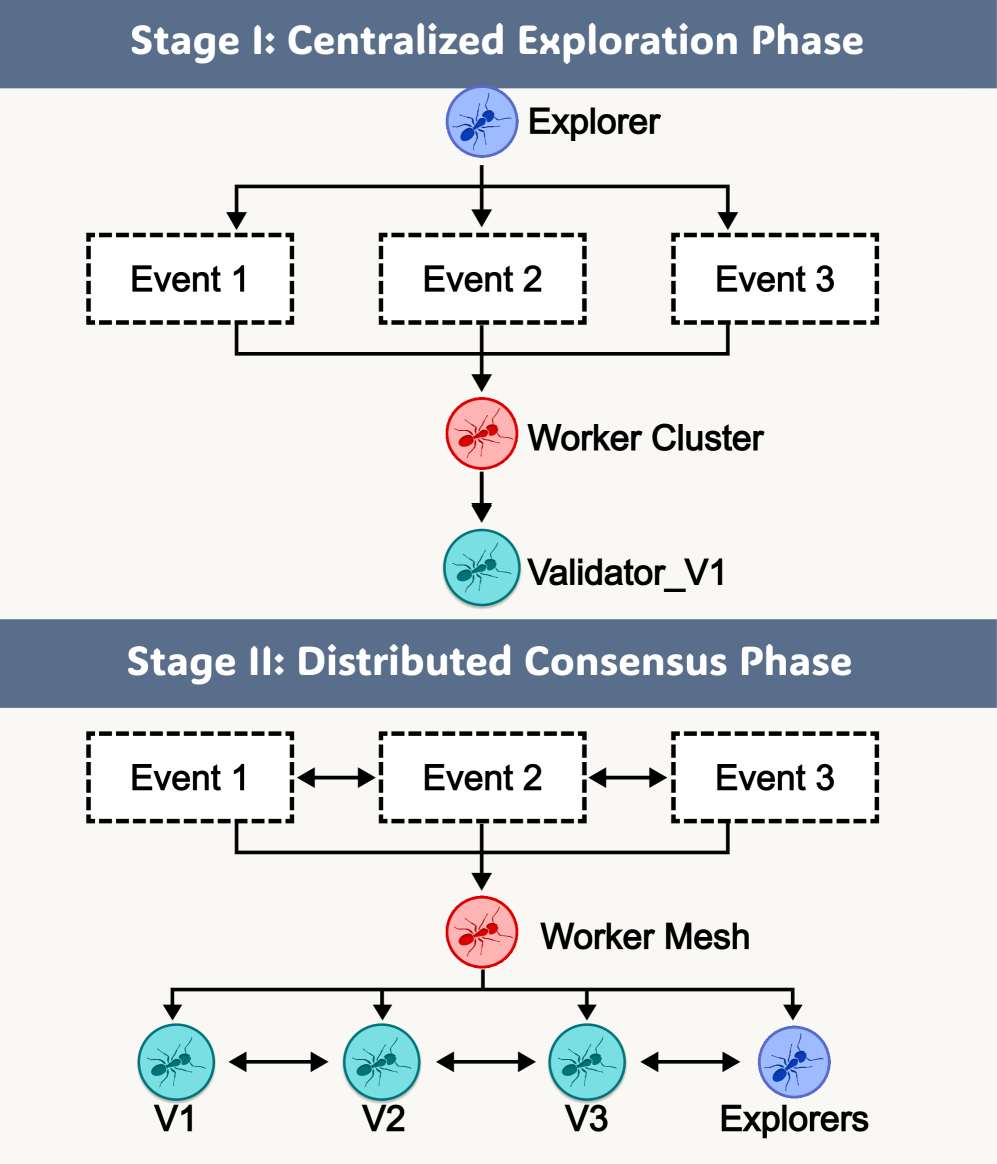
The image is a process flow diagram illustrating two stages: Stage I, a Centralized Exploration Phase, and Stage II, a Distributed Consensus Phase. Each stage involves different components and interactions, represented by labeled shapes and arrows. The diagram uses ant-like figures to represent different roles or entities within the process.
### Components/Axes
**Stage I: Centralized Exploration Phase** (Located in the top half of the image)
* **Title:** Stage I: Centralized Exploration Phase (Dark blue rectangle at the top)
* **Explorer:** A blue ant-like figure at the top, representing the initial explorer.
* **Events:** Three events labeled "Event 1", "Event 2", and "Event 3", represented by dashed rectangles.
* **Worker Cluster:** A red ant-like figure, representing the worker cluster.
* **Validator_V1:** A teal ant-like figure, representing the validator.
**Stage II: Distributed Consensus Phase** (Located in the bottom half of the image)
* **Title:** Stage II: Distributed Consensus Phase (Dark blue rectangle)
* **Events:** Three events labeled "Event 1", "Event 2", and "Event 3", represented by dashed rectangles. These events are interconnected with bidirectional arrows.
* **Worker Mesh:** A red ant-like figure, representing the worker mesh.
* **V1, V2, V3:** Three teal ant-like figures, representing validators.
* **Explorers:** A blue ant-like figure, representing the explorer.
### Detailed Analysis
**Stage I: Centralized Exploration Phase**
* The "Explorer" initiates the process.
* The "Explorer" leads to three parallel "Events": "Event 1", "Event 2", and "Event 3".
* All three "Events" converge to the "Worker Cluster".
* The "Worker Cluster" leads to "Validator_V1".
**Stage II: Distributed Consensus Phase**
* The "Events" ("Event 1", "Event 2", "Event 3") are interconnected with bidirectional arrows, indicating communication and consensus-building.
* All three "Events" converge to the "Worker Mesh".
* The "Worker Mesh" leads to three validators "V1", "V2", and "V3", and an "Explorer".
* "V1", "V2", "V3", and "Explorers" are interconnected with bidirectional arrows.
### Key Observations
* The diagram clearly distinguishes between a centralized exploration phase and a distributed consensus phase.
* The use of different colors (blue and red) for the ant-like figures likely indicates different roles or responsibilities.
* The bidirectional arrows in Stage II suggest a more collaborative and iterative process compared to the linear flow in Stage I.
### Interpretation
The diagram illustrates a two-stage process, likely representing a workflow or system architecture. Stage I focuses on initial exploration and data gathering, with a centralized "Explorer" initiating the process and events converging to a "Worker Cluster" and then a single "Validator". Stage II shifts to a distributed model, where events are interconnected, and a "Worker Mesh" distributes tasks to multiple validators ("V1", "V2", "V3") and another "Explorer", suggesting a consensus-building mechanism. The transition from a single validator to multiple validators indicates a move towards a more robust and decentralized validation process. The bidirectional arrows in Stage II emphasize the importance of communication and feedback loops in achieving consensus.