\n
## Diagram: Two-Stage Process Flow - Centralized Exploration & Distributed Consensus
### Overview
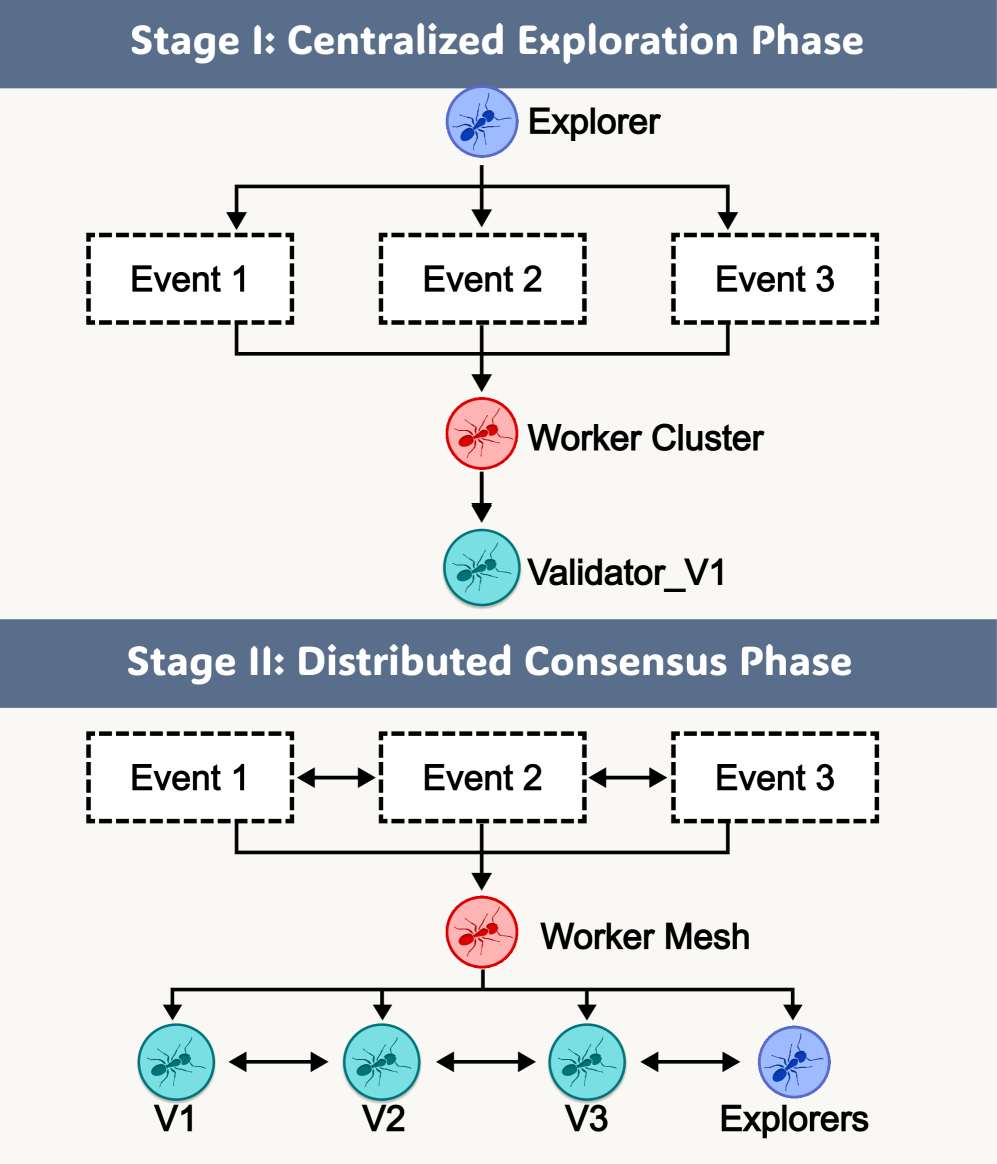
The image depicts a two-stage process flow diagram illustrating a system with a "Centralized Exploration Phase" followed by a "Distributed Consensus Phase". The diagram uses boxes to represent events, circles to represent actors (Explorer, Worker Cluster/Mesh, Validator_V1, V1, V2, V3), and arrows to indicate the flow of information or actions. The diagram is divided into two distinct sections, one for each stage, separated by a horizontal line.
### Components/Axes
The diagram consists of the following components:
* **Stage I: Centralized Exploration Phase:** This section is visually distinguished by a light blue background.
* **Stage II: Distributed Consensus Phase:** This section is visually distinguished by a light red background.
* **Actors:**
* Explorer (represented by a blue circle with a stylized insect-like design)
* Worker Cluster (represented by a red circle with a stylized insect-like design)
* Validator\_V1 (represented by a teal circle with a stylized insect-like design)
* V1, V2, V3 (represented by teal circles with a stylized insect-like design)
* **Events:** Event 1, Event 2, Event 3 (represented by dashed-border rectangles)
* **Arrows:** Indicate the direction of flow between actors and events.
### Detailed Analysis or Content Details
**Stage I: Centralized Exploration Phase**
* The "Explorer" actor (top-center) initiates the process.
* Arrows flow from the "Explorer" to three separate "Event" boxes: "Event 1" (top-left), "Event 2" (top-center), and "Event 3" (top-right).
* Arrows then flow from each "Event" box to a single "Worker Cluster" actor (center).
* Finally, an arrow flows from the "Worker Cluster" to a "Validator\_V1" actor (bottom-center).
**Stage II: Distributed Consensus Phase**
* The "Event 1", "Event 2", and "Event 3" boxes are arranged horizontally (bottom-left, bottom-center, bottom-right).
* Bidirectional arrows connect "Event 1" and "Event 2", "Event 2" and "Event 3".
* Arrows flow from each "Event" box to a "Worker Mesh" actor (center).
* Bidirectional arrows connect the "Worker Mesh" to three "Validator" actors: "V1" (bottom-left), "V2" (bottom-center), and "V3" (bottom-right).
* A final arrow flows from the "Worker Mesh" to an "Explorer" actor (bottom-right).
### Key Observations
* The first stage is a linear, centralized process, with a single "Explorer" and "Worker Cluster" controlling the flow.
* The second stage is a distributed, consensus-based process, with multiple "Validators" (V1, V2, V3) and a "Worker Mesh" interacting with each other and the "Explorer".
* The bidirectional arrows in Stage II suggest a collaborative or iterative process.
* The use of dashed boxes for "Events" suggests they are temporary or intermediate states.
### Interpretation
This diagram illustrates a system that employs a two-phase approach to data processing or decision-making. The first phase, "Centralized Exploration," likely involves an initial investigation or gathering of information by an "Explorer," which is then processed by a "Worker Cluster" and validated by "Validator\_V1". This phase is characterized by a clear hierarchy and a single point of validation.
The second phase, "Distributed Consensus," shifts to a more collaborative and decentralized model. The "Events" are now interconnected, suggesting that information is shared and refined among them. The "Worker Mesh" facilitates communication between multiple "Validators" (V1, V2, V3) and the "Explorer," enabling a consensus-based decision or outcome. The bidirectional arrows indicate that the validators are not simply receiving information but are actively participating in the process, potentially providing feedback or contributing to the final result.
The transition from a centralized to a distributed approach suggests a need for increased robustness, scalability, or trust. The distributed consensus phase may be designed to mitigate the risks associated with a single point of failure or to ensure that decisions are made based on a broader range of perspectives. The diagram highlights a system designed for both exploration and validation, culminating in a consensus-driven outcome. The insect-like design of the actors may be a stylistic choice, but could also hint at a swarm intelligence or distributed computing paradigm.