\n
## Diagram: Two-Phase Distributed System Architecture
### Overview
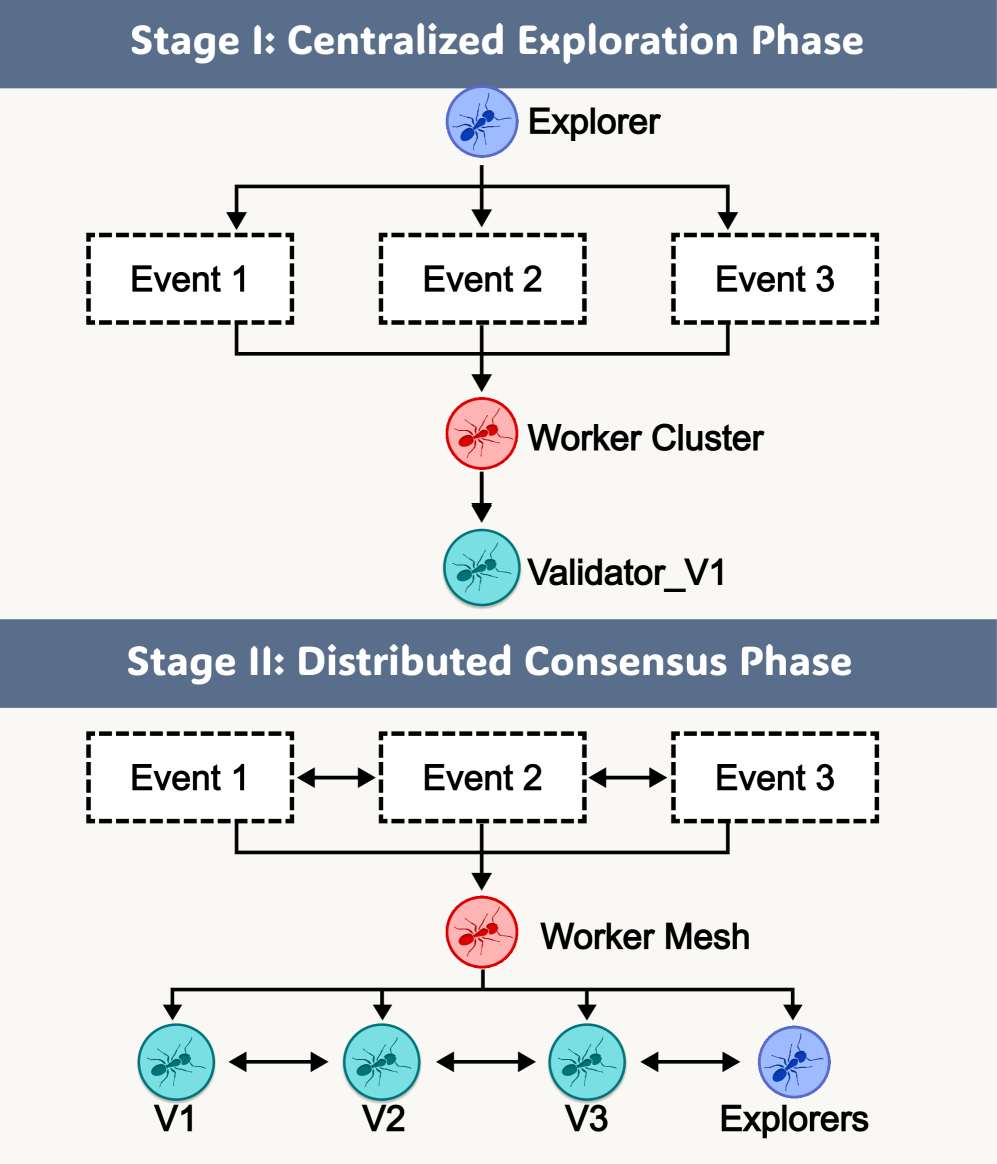
The image is a technical diagram illustrating a two-stage process for a distributed system, likely related to event processing, consensus, or blockchain validation. The architecture uses ant-themed icons to represent different roles. The diagram is split horizontally into two distinct phases: a centralized exploration phase (Stage I) and a distributed consensus phase (Stage II).
### Components/Axes
The diagram is organized into two main sections, each with a title bar.
**Stage I: Centralized Exploration Phase** (Top Section)
* **Title Bar:** A dark blue-grey bar at the top with white text: "Stage I: Centralized Exploration Phase".
* **Components (Top to Bottom):**
1. **Explorer:** A blue circle containing an ant icon, labeled "Explorer". Positioned at the top-center.
2. **Events:** Three dashed-line rectangles in a row, labeled "Event 1", "Event 2", and "Event 3". Arrows point down from the "Explorer" to each event box.
3. **Worker Cluster:** A red circle containing an ant icon, labeled "Worker Cluster". Arrows from all three event boxes converge and point down to this component.
4. **Validator_V1:** A teal circle containing an ant icon, labeled "Validator_V1". An arrow points down from the "Worker Cluster" to this component.
**Stage II: Distributed Consensus Phase** (Bottom Section)
* **Title Bar:** A dark blue-grey bar with white text: "Stage II: Distributed Consensus Phase".
* **Components (Top to Bottom):**
1. **Events:** The same three dashed-line rectangles ("Event 1", "Event 2", "Event 3") are present. They are now connected by double-headed horizontal arrows, indicating peer-to-peer communication.
2. **Worker Mesh:** A red circle containing an ant icon, labeled "Worker Mesh". Arrows from all three event boxes converge and point down to this component.
3. **Validator/Explorer Layer:** A row of four circles at the bottom:
* Three teal circles with ant icons, labeled "V1", "V2", and "V3" from left to right.
* One blue circle with an ant icon, labeled "Explorers" on the far right.
4. **Connections:** Arrows point down from the "Worker Mesh" to each of the four circles (V1, V2, V3, Explorers). Furthermore, double-headed horizontal arrows connect V1 to V2, V2 to V3, and V3 to the Explorers circle, indicating a mesh network.
### Detailed Analysis
The diagram contrasts two architectural patterns for processing events.
**Stage I (Centralized Exploration):**
* **Flow:** Unidirectional and hierarchical. `Explorer -> Events -> Worker Cluster -> Validator_V1`.
* **Structure:** A single "Explorer" initiates or discovers events. These events are processed by a centralized "Worker Cluster". The output or proof is then sent to a single validator ("Validator_V1"). This represents a bottleneck or single point of trust/failure.
**Stage II (Distributed Consensus):**
* **Flow:** Multi-directional and peer-to-peer. `Events <-> Events`, `Events -> Worker Mesh -> {V1, V2, V3, Explorers}`, and `{V1 <-> V2 <-> V3 <-> Explorers}`.
* **Structure:** The events themselves are interconnected, suggesting they are aware of each other. The "Worker Mesh" replaces the "Cluster," implying a distributed processing layer. The output is distributed to multiple validators (V1, V2, V3) and back to the "Explorers" pool. The validators and explorers form a communication mesh, enabling consensus through peer validation.
**Iconography:**
* **Blue Ant (Explorer):** Represents discovery or initiation.
* **Red Ant (Worker Cluster/Mesh):** Represents processing or computation.
* **Teal Ant (Validator_V1, V1, V2, V3):** Represents verification or consensus.
### Key Observations
1. **Architectural Shift:** The core transformation is from a centralized, linear pipeline (Stage I) to a decentralized, networked mesh (Stage II).
2. **Role Evolution:** The single "Validator_V1" in Stage I expands into a network of validators ("V1", "V2", "V3") in Stage II. The "Explorer" role also transitions from a single initiator to a pool ("Explorers") that participates in the consensus mesh.
3. **Communication Pattern:** Stage I uses one-way arrows. Stage II introduces double-headed arrows between events and between validators/explorers, emphasizing bidirectional communication and consensus.
4. **Component Naming:** The change from "Worker **Cluster**" to "Worker **Mesh**" is significant, highlighting the shift from a grouped but potentially centralized unit to a fully distributed network.
### Interpretation
This diagram visually argues for the benefits of a distributed consensus model over a centralized exploration model. It demonstrates how a system can evolve to eliminate single points of failure and trust.
* **Stage I** represents a traditional or initial setup where a central authority (Explorer) and processing unit (Worker Cluster) handle tasks, with results verified by a single entity. This is efficient but vulnerable.
* **Stage II** represents a mature, resilient system. By distributing the worker function ("Mesh") and, crucially, distributing the validation role across multiple independent nodes (V1, V2, V3) that communicate with each other, the system achieves **decentralized trust**. The inclusion of "Explorers" in the final mesh suggests that initiators also become verifiers, closing the loop and enhancing security.
The underlying message is that for robust, trustless systems—common in blockchain, distributed databases, or swarm intelligence—a move from centralized control to a peer-to-peer consensus architecture is essential. The ant metaphor reinforces concepts of collective, decentralized intelligence where simple individual agents (ants) create a complex, resilient system.