## Diagram: ZIPn Transformation
### Overview
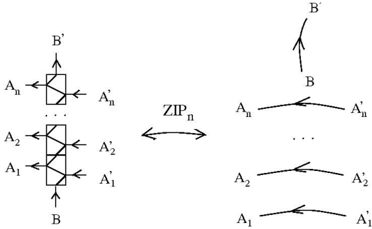
The image presents a diagram illustrating a transformation labeled "ZIPn". It shows a series of stacked rectangular blocks on the left, transforming into a series of curved lines on the right. Arrows indicate the direction of flow or transformation.
### Components/Axes
* **Left Side:**
* A vertical stack of rectangular blocks.
* Each block has inputs labeled A₁, A₂, ... Aₙ on the left side.
* Each block has outputs labeled A'₁, A'₂, ... A'ₙ on the right side.
* The bottom block has an input labeled B.
* The top block has an output labeled B'.
* Ellipsis (...) indicate continuation of the pattern.
* **Center:**
* The label "ZIPn" with a double-headed arrow indicating a reversible transformation.
* **Right Side:**
* A series of curved lines, each corresponding to an Aᵢ input/output pair.
* Inputs labeled A₁, A₂, ... Aₙ on the left side.
* Outputs labeled A'₁, A'₂, ... A'ₙ on the right side.
* Arrows on the curved lines indicate direction from Aᵢ to A'ᵢ.
* An input labeled B, connected to an output labeled B' via a curved line with an upward-pointing arrow.
* Ellipsis (...) indicate continuation of the pattern.
### Detailed Analysis
* **Left Side:** The stacked blocks suggest a sequential process or a series of identical operations. The inputs Aᵢ and output A'ᵢ are associated with each block.
* **Center:** The "ZIPn" label indicates the name of the transformation. The double-headed arrow suggests that the transformation is reversible.
* **Right Side:** The curved lines represent the transformed state of the inputs Aᵢ. The arrow directions indicate the flow from input to output. The B to B' transformation is separate from the Aᵢ transformations.
### Key Observations
* The transformation "ZIPn" appears to relate a stacked, block-based representation to a series of curved lines.
* The Aᵢ inputs and outputs are transformed individually.
* The B input and B' output are transformed separately from the Aᵢ inputs and outputs.
### Interpretation
The diagram illustrates a transformation, "ZIPn", that converts a series of stacked blocks into a series of curved lines. The transformation appears to act on each Aᵢ input independently, while also transforming a separate input B. The reversible nature of the transformation suggests that it is possible to convert between the stacked block representation and the curved line representation. The diagram could represent a mathematical operation, a data processing algorithm, or a physical process.