\n
## Diagram: Aletheia Problem-Solving Flowchart
### Overview
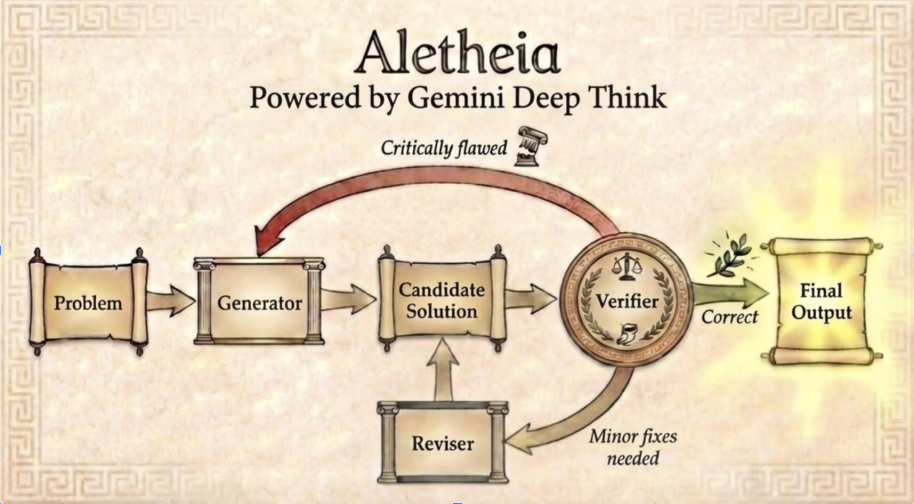
The image is a flowchart diagram illustrating a cyclical, iterative problem-solving process named "Aletheia." The system is explicitly labeled as "Powered by Gemini Deep Think." The diagram uses a classical, scroll-and-pillar aesthetic with a parchment-like background and a Greek key border. It depicts a workflow that generates, verifies, and refines solutions to a problem.
### Components/Axes
The diagram consists of six primary components connected by directional arrows. Each component is represented by a stylized icon with a text label.
**Components (in left-to-right flow order):**
1. **Problem**: Represented by a rolled parchment scroll on the far left.
2. **Generator**: Represented by a classical pillar structure.
3. **Candidate Solution**: Represented by a rolled parchment scroll.
4. **Verifier**: Represented by a circular medallion containing the scales of justice and a quill pen. This is the central decision node.
5. **Final Output**: Represented by a rolled parchment scroll on the far right, glowing with a yellow aura.
6. **Reviser**: Represented by a classical pillar structure located below the main flow.
**Connectors and Conditional Paths:**
* **Problem → Generator**: A straight, right-pointing arrow.
* **Generator → Candidate Solution**: A straight, right-pointing arrow.
* **Candidate Solution → Verifier**: A straight, right-pointing arrow.
* **Verifier → Final Output**: A right-pointing arrow labeled **"Correct"**. This path is accompanied by an icon of an olive branch.
* **Verifier → Reviser**: A downward-curving arrow labeled **"Minor fixes needed"**.
* **Reviser → Candidate Solution**: An upward-pointing arrow.
* **Verifier → Generator**: A large, red, upward-curving arrow that loops back to the Generator. This path is labeled **"Critically flawed"** and is accompanied by an icon of a broken column.
### Detailed Analysis
The process flow is as follows:
1. A **Problem** is input into the system.
2. The **Generator** creates an initial **Candidate Solution**.
3. This solution is passed to the **Verifier** for evaluation.
4. The Verifier assesses the solution and routes it based on one of three outcomes:
* **Outcome 1 (Success):** If the solution is deemed **"Correct"**, it proceeds to become the **Final Output**.
* **Outcome 2 (Minor Revision):** If the solution requires **"Minor fixes needed"**, it is sent to the **Reviser**. The Reviser modifies the solution and sends it back to the Candidate Solution stage for re-verification.
* **Outcome 3 (Major Failure):** If the solution is **"Critically flawed"**, the process loops all the way back to the **Generator** to create a new candidate solution from scratch.
### Key Observations
* **Cyclical and Iterative:** The core of the process is a feedback loop. Solutions are not accepted on the first pass unless perfect; they are refined or regenerated based on verification.
* **Tiered Error Handling:** The system distinguishes between minor errors (handled by the Reviser) and fundamental flaws (requiring a complete restart at the Generator). This suggests an efficiency optimization.
* **Central Authority of the Verifier:** The Verifier, symbolized by the scales of justice, is the sole decision-making component that determines the path of the workflow.
* **Visual Metaphors:** The classical imagery (scrolls, pillars, scales, olive branch, broken column) reinforces themes of truth (Aletheia is Greek for "truth"), wisdom, and structured process.
### Interpretation
This diagram represents a sophisticated, self-correcting AI or algorithmic pipeline for generating solutions. The "Powered by Gemini Deep Think" label indicates it is a conceptual model for how a large language model or reasoning engine might structure its problem-solving to ensure accuracy and reliability.
The process embodies a **Peircean investigative cycle** of hypothesis (Generator), testing (Verifier), and refinement (Reviser). The "Critically flawed" loop back to the Generator is particularly significant; it shows the system is designed to recognize when a line of reasoning is fundamentally unsalvageable and must be abandoned, preventing wasted effort on minor fixes. This mimics human expert reasoning, where one might discard a flawed approach entirely rather than patch it.
The **olive branch** symbol for "Correct" is a nuanced touch, suggesting that a correct solution brings peace or resolution to the problem. The **broken column** for "Critically flawed" implies structural failure. The entire system is geared towards moving from the uncertainty of a "Problem" to the illuminated clarity of a "Final Output," with the Verifier acting as the gatekeeper of truth.