\n
## Diagram: Early-stopping Drafting and Dynamic Verification
### Overview
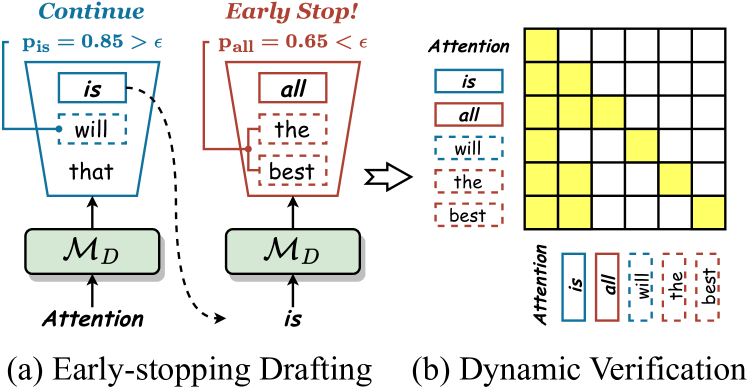
The image presents a diagram illustrating two stages of a process: "Early-stopping Drafting" (a) and "Dynamic Verification" (b). The diagram depicts a sequence of operations involving text processing, attention mechanisms, and decision-making based on probability thresholds. It appears to be a visual representation of a method for generating text, potentially within a machine learning context.
### Components/Axes
The diagram consists of two main sections, labeled (a) and (b). Each section contains visual elements representing text blocks, attention mechanisms, and a decision-making process.
* **Section (a): Early-stopping Drafting**
* Text Blocks: "is", "will", "that" (orange boxes), "all", "the", "best" (red boxes).
* Model: `M_D` (green rectangle)
* Attention: Indicated by arrows and the label "Attention".
* Probability Thresholds: `P_is = 0.85 > ε` (blue), `P_all = 0.65 < ε` (red). `ε` is a threshold value.
* Arrows: Representing flow and connections between components. A dashed arrow indicates a "Continue" path, while a solid arrow indicates an "Early Stop!" path.
* **Section (b): Dynamic Verification**
* Text Blocks: "is", "all", "will", "the", "best" (blue boxes with dashed outlines).
* Model: `M_D` (green rectangle)
* Attention: Indicated by arrows and the label "Attention".
* Attention Matrix: A grid of yellow squares representing an attention matrix.
### Detailed Analysis or Content Details
**Section (a): Early-stopping Drafting**
* The process begins with the model `M_D` receiving "Attention" input.
* The model generates the sequence "is", "will", "that".
* A probability `P_is` is calculated for "is", with a value of 0.85. This value is compared to a threshold `ε`. Since 0.85 > `ε`, the process continues.
* The model then generates the sequence "all", "the", "best".
* A probability `P_all` is calculated for "all", with a value of 0.65. This value is compared to the same threshold `ε`. Since 0.65 < `ε`, the process stops ("Early Stop!").
* The dashed arrow indicates the continuation path, while the solid arrow indicates the early stopping path.
**Section (b): Dynamic Verification**
* The model `M_D` receives "Attention" input and generates the sequence "is", "all", "will", "the", "best".
* The attention matrix is a 6x6 grid of yellow squares. The rows correspond to the words "is", "all", "will", "the", "best", and the columns likely represent the same words, indicating the attention weights between them.
* The text blocks are enclosed in dashed blue boxes.
### Key Observations
* The diagram illustrates a dynamic process where text generation can be stopped early based on a probability threshold.
* The attention mechanism plays a crucial role in both stages of the process.
* The attention matrix in Section (b) provides a visual representation of the relationships between different words in the generated sequence.
* The threshold `ε` is a key parameter that controls the trade-off between generation length and quality.
### Interpretation
The diagram depicts a method for efficient text generation that combines drafting and verification stages. The "Early-stopping Drafting" stage aims to quickly generate a draft sequence, while the "Dynamic Verification" stage refines the sequence and ensures its quality. The probability thresholds and attention mechanisms are used to make informed decisions about when to continue or stop the generation process.
The use of different colors (orange, red, blue) to highlight the text blocks likely indicates different stages or roles in the generation process. The attention matrix in Section (b) suggests that the model is able to focus on the most relevant parts of the generated sequence.
The diagram suggests a system that balances exploration (generating new text) with exploitation (verifying and refining existing text). The threshold `ε` allows for tuning the system's behavior based on the desired trade-off between these two objectives. The overall goal appears to be to generate high-quality text efficiently by stopping the generation process when the probability of generating meaningful content falls below a certain level.