## Probability Density Chart: Posterior Density for Toxicity Probability
### Overview
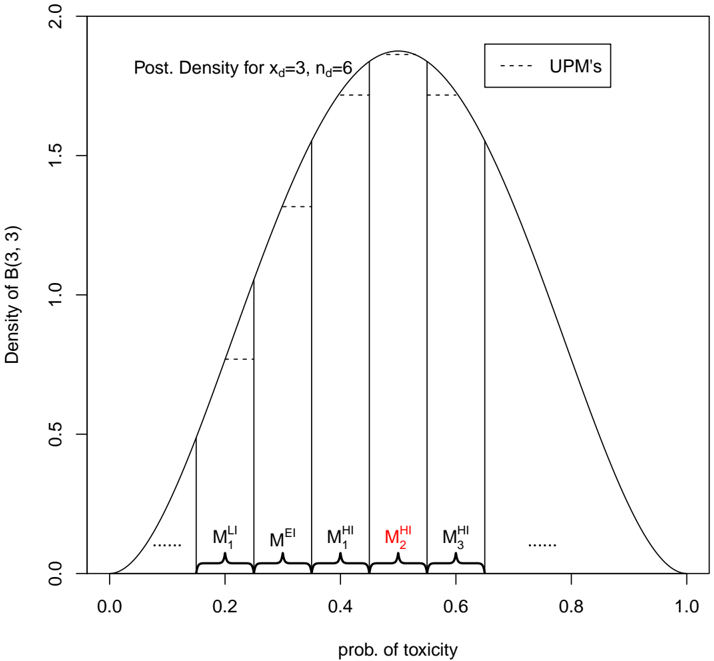
The image is a probability density chart showing the posterior density of a Beta distribution B(3, 3) representing the probability of toxicity. The x-axis represents the probability of toxicity, ranging from 0.0 to 1.0. The y-axis represents the density of the Beta distribution, ranging from 0.0 to 2.0. The chart also displays Uniform Prior Mass (UPM) intervals along the x-axis, marked by vertical lines and dashed horizontal lines indicating the density within each interval.
### Components/Axes
* **Title:** Post. Density for x<sub>d</sub>=3, n<sub>d</sub>=6
* **Y-axis:** Density of B(3, 3), with scale from 0.0 to 2.0 in increments of 0.5.
* **X-axis:** prob. of toxicity, with scale from 0.0 to 1.0 in increments of 0.2.
* **Curve:** A bell-shaped curve representing the probability density function.
* **Vertical Lines:** Represent the boundaries of the UPM intervals.
* **Dashed Horizontal Lines:** Indicate the density within each UPM interval.
* **UPM's Legend:** Dashed line labeled "UPM's" in a box at the top right.
* **Interval Labels:** M<sup>LI</sup><sub>1</sub>, M<sup>EI</sup>, M<sup>HI</sup><sub>1</sub>, M<sup>HI</sup><sub>2</sub> (red), M<sup>HI</sup><sub>3</sub>
### Detailed Analysis
* **Curve Trend:** The curve is a bell-shaped curve, symmetrical around the center. It starts at approximately 0.0 at x=0.0, rises to a peak around x=0.5 with a density of approximately 1.8, and then decreases back to approximately 0.0 at x=1.0.
* **UPM Intervals:** The x-axis is divided into several intervals, each representing a UPM.
* M<sup>LI</sup><sub>1</sub>: Located between approximately 0.1 and 0.2.
* M<sup>EI</sup>: Located between approximately 0.2 and 0.3.
* M<sup>HI</sup><sub>1</sub>: Located between approximately 0.3 and 0.4.
* M<sup>HI</sup><sub>2</sub>: Located between approximately 0.4 and 0.5. This label is in red.
* M<sup>HI</sup><sub>3</sub>: Located between approximately 0.5 and 0.6.
* **Density within Intervals:** The dashed horizontal lines indicate the approximate density within each interval.
* The density in the interval M<sup>LI</sup><sub>1</sub> is approximately 0.3.
* The density in the interval M<sup>EI</sup> is approximately 0.8.
* The density in the interval M<sup>HI</sup><sub>1</sub> is approximately 1.4.
* The density in the interval M<sup>HI</sup><sub>2</sub> is approximately 1.7.
* The density in the interval M<sup>HI</sup><sub>3</sub> is approximately 1.7.
### Key Observations
* The probability density is highest around x=0.5, indicating that the most probable value for the probability of toxicity is around 0.5.
* The UPM intervals are of equal width along the x-axis.
* The density within the UPM intervals increases as you move towards the center of the distribution, and then decreases as you move away from the center.
* The interval M<sup>HI</sup><sub>2</sub> is highlighted in red, possibly indicating a region of interest or concern.
### Interpretation
The chart visualizes the posterior probability distribution for the toxicity probability, given some observed data (x<sub>d</sub>=3, n<sub>d</sub>=6). The Beta distribution B(3, 3) is used as a prior, and the UPM intervals provide a way to discretize the probability space and assess the probability mass within each interval. The red highlighting of M<sup>HI</sup><sub>2</sub> suggests that this interval might be associated with a higher risk or a specific threshold of toxicity. The chart helps in understanding the uncertainty associated with the toxicity probability and in making decisions based on the available data.