## Diagram: Deconstruction of Depth 3 Question
### Overview
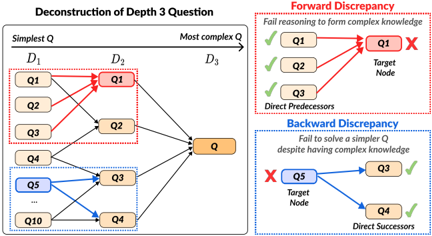
The image presents a diagram illustrating the deconstruction of a "Depth 3 Question" and concepts of "Forward Discrepancy" and "Backward Discrepancy." It uses nodes labeled with "Q" followed by a number to represent questions of varying complexity, arranged along a spectrum from "Simplest Q" to "Most complex Q." Arrows indicate relationships between questions, and colored boxes highlight specific discrepancies.
### Components/Axes
* **Title:** Deconstruction of Depth 3 Question
* **Horizontal Axis:** Represents question complexity, ranging from "Simplest Q" on the left to "Most complex Q" on the right.
* **Complexity Levels:** D1, D2, and D3, representing increasing levels of complexity.
* **Nodes:** Represented by rounded rectangles, labeled with "Q" followed by a number (e.g., Q1, Q2, Q3).
* **Arrows:** Indicate relationships or dependencies between questions.
* **Forward Discrepancy Box:** Located in the top-right corner, illustrating a scenario where reasoning fails to form complex knowledge.
* **Backward Discrepancy Box:** Located in the bottom-right corner, illustrating a scenario where one fails to solve a simpler question despite having complex knowledge.
### Detailed Analysis
**Main Diagram (Left Side):**
* **D1 Box (Red Dotted Border):** Contains nodes Q1, Q2, Q3, and Q4.
* Q1 in D1 has a red arrow pointing to Q1 in D2.
* Q2 in D1 has a red arrow pointing to Q1 in D2.
* Q3 in D1 has a black arrow pointing to Q.
* Q4 in D1 has a black arrow pointing to Q.
* **D2 Box (Red Dotted Border):** Contains nodes Q1 and Q2.
* Q1 in D2 is colored in a light red.
* Q2 in D2 has a black arrow pointing to Q.
* **D3:** Contains only the node Q.
* **Bottom Box (Blue Dotted Border):** Contains nodes Q5, Q10, Q3, and Q4.
* Q5 has a blue arrow pointing to Q3.
* Q5 has a blue arrow pointing to Q4.
* Q10 has a blue arrow pointing to Q4.
**Forward Discrepancy (Top-Right):**
* **Text:** "Forward Discrepancy" and "Fail reasoning to form complex knowledge"
* **Nodes:** Q1 (green checkmark), Q2 (green checkmark), Q3 (green checkmark), and Q1 (red X).
* **Arrows:** Red arrows point from Q1, Q2, and Q3 to Q1 (red X).
* **Labels:** "Target Node" (pointing to Q1 with red X), "Direct Predecessors" (pointing to Q1, Q2, and Q3 with green checkmarks).
**Backward Discrepancy (Bottom-Right):**
* **Text:** "Backward Discrepancy" and "Fail to solve a simpler Q despite having complex knowledge"
* **Nodes:** Q5 (red X), Q3 (green checkmark), and Q4 (green checkmark).
* **Arrows:** Blue arrows point from Q5 (red X) to Q3 and Q4 (green checkmarks).
* **Labels:** "Target Node" (pointing to Q5 with red X), "Direct Successors" (pointing to Q3 and Q4 with green checkmarks).
### Key Observations
* The main diagram illustrates a progression of questions from simpler to more complex.
* Forward Discrepancy shows a scenario where simpler questions (Q1, Q2, Q3) are answered correctly, but a more complex question (Q1) is answered incorrectly.
* Backward Discrepancy shows a scenario where more complex questions (Q3, Q4) are answered correctly, but a simpler question (Q5) is answered incorrectly.
### Interpretation
The diagram illustrates a hierarchical structure of questions and highlights potential discrepancies in a learner's understanding. The "Forward Discrepancy" suggests a gap in the ability to synthesize knowledge from simpler concepts to more complex ones. The "Backward Discrepancy" suggests a potential rote memorization of complex concepts without a solid foundation in simpler, prerequisite knowledge. The diagram emphasizes the importance of a coherent and progressive understanding of concepts, where mastery of simpler questions leads to the ability to answer more complex ones. The red arrows and X marks indicate failures in reasoning or knowledge application, while the green checkmarks indicate successful understanding.