## Diagram: Deconstruction of Depth 3 Question
### Overview
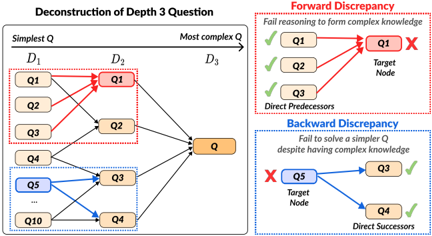
The image is a technical diagram illustrating the conceptual breakdown of a complex question ("Q") into simpler sub-questions across three hierarchical depths (D1, D2, D3). It also defines and visualizes two types of reasoning failures: "Forward Discrepancy" and "Backward Discrepancy." The diagram uses a flowchart structure with nodes, directional arrows, color-coding, and symbolic markers (checkmarks, X's) to convey relationships and outcomes.
### Components/Axes
**Main Diagram (Left Panel):**
* **Title:** "Deconstruction of Depth 3 Question"
* **Horizontal Axis/Scale:** An arrow labeled from "Simplest Q" on the left to "Most complex Q" on the right.
* **Depth Labels:** Three vertical columns labeled D1, D2, and D3 from left to right, corresponding to the complexity scale.
* **Nodes (Questions):** Rectangular boxes containing question identifiers.
* **D1 Column (Simplest):** Q1, Q2, Q3, Q4, Q5, Q10.
* **D2 Column (Intermediate):** Q1, Q2, Q3, Q4.
* **D3 Column (Most Complex):** A single node labeled "Q".
* **Groupings:**
* A red dashed box encloses nodes Q1, Q2, Q3 in D1 and Q1 in D2.
* A blue dashed box encloses nodes Q5, Q10 in D1 and Q3, Q4 in D2.
* **Connections (Arrows):** Black arrows show dependencies, flowing from left (simpler) to right (more complex). For example, arrows from Q1, Q2, Q3 in D1 point to Q1 in D2.
**Side Panel 1 (Top Right): Forward Discrepancy**
* **Title:** "Forward Discrepancy"
* **Subtitle:** "Fail reasoning to form complex knowledge"
* **Diagram:** A target node "Q1" (with a red X) is connected by red arrows from three "Direct Predecessors": Q1, Q2, Q3 (each with a green checkmark).
**Side Panel 2 (Bottom Right): Backward Discrepancy**
* **Title:** "Backward Discrepancy"
* **Subtitle:** "Fail to solve a simpler Q despite having complex knowledge"
* **Diagram:** A target node "Q5" (with a red X) is connected by blue arrows to two "Direct Successors": Q3 and Q4 (each with a green checkmark).
### Detailed Analysis
**Main Flowchart Structure:**
The diagram maps a dependency tree for a complex question "Q".
1. **Depth 1 (D1):** Contains the simplest, foundational questions: Q1, Q2, Q3, Q4, Q5, Q10.
2. **Depth 2 (D2):** Contains intermediate questions synthesized from D1.
* Q1 (D2) is formed from Q1, Q2, Q3 (D1).
* Q2 (D2) is formed from Q1, Q3 (D1).
* Q3 (D2) is formed from Q4, Q5 (D1).
* Q4 (D2) is formed from Q5, Q10 (D1).
3. **Depth 3 (D3):** The final complex question "Q" is formed from Q1, Q2, Q3, Q4 in D2.
**Discrepancy Definitions:**
* **Forward Discrepancy:** Illustrated with Q1 as the target. The scenario shows that even if all direct predecessor questions (Q1, Q2, Q3) are solved (green checkmarks), reasoning can still fail (red X) to correctly form the more complex target knowledge (Q1). This represents a failure in synthesis or upward reasoning.
* **Backward Discrepancy:** Illustrated with Q5 as the target. The scenario shows that even if complex knowledge exists (solved direct successors Q3 and Q4 have green checkmarks), one can still fail (red X) to solve a simpler, foundational question (Q5). This represents a failure in analysis or downward reasoning.
### Key Observations
1. **Non-Linear Dependencies:** The connections are not strictly hierarchical; nodes in D1 feed into multiple nodes in D2 (e.g., Q3(D1) feeds into both Q1(D2) and Q2(D2)).
2. **Color-Coded Groupings:** The red and blue dashed boxes highlight specific clusters of questions involved in the discrepancy examples. The red box corresponds to the Forward Discrepancy example (Q1 chain), and the blue box corresponds to the Backward Discrepancy example (Q5 chain).
3. **Symbolic Logic:** Green checkmarks universally indicate "solved" or "correct," while red X's indicate "failed" or "incorrect." Red arrows are used in the Forward Discrepancy diagram, and blue arrows in the Backward Discrepancy diagram, matching their respective box colors in the main chart.
4. **Spatial Grounding:** The legend/title for each discrepancy panel is placed directly above its corresponding illustrative diagram. The main chart's complexity axis is positioned at the very top, spanning the entire width.
### Interpretation
This diagram presents a model for analyzing the structure of complex reasoning tasks. It suggests that complex knowledge ("Q") is built upon layers of simpler questions. The core insight is that reasoning can fail in two distinct, non-obvious ways:
1. **Forward Discrepancy (Synthesis Failure):** Possessing all the necessary foundational facts (solved simple Qs) does not guarantee the ability to correctly combine them into a higher-order conclusion. This highlights the challenge of integration and logical synthesis.
2. **Backward Discrepancy (Analysis Failure):** Possessing advanced, complex knowledge does not guarantee the ability to deconstruct it back to its fundamental components or explain the basics. This underscores the difference between applied knowledge and foundational understanding.
The diagram implies that robust reasoning requires bidirectional competence: the ability to build up from simple parts *and* break down complex wholes. The specific question labels (Q1, Q2, etc.) are placeholders, indicating this is a general framework applicable to any domain where knowledge is hierarchically structured, such as mathematics, science, or law. The "Depth 3" in the title suggests this is an example of a specific complexity level within this framework.