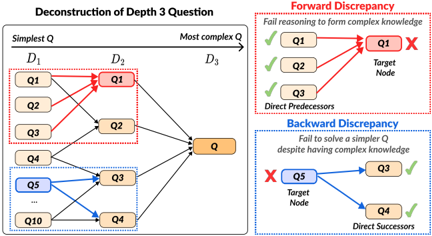
## Diagram: Deconstruction of Depth 3 Question
### Overview
The diagram illustrates a hierarchical structure of questions (Q1–Q10) organized by complexity (D1–D3) and their relationships to a central question (Q). It contrasts **Forward Discrepancy** (failure to form complex knowledge) and **Backward Discrepancy** (failure to solve simpler questions despite complex knowledge).
### Components/Axes
- **Nodes**:
- **Q1–Q10**: Labeled questions, color-coded by discrepancy type.
- **Q**: Central question (orange).
- **Arrows**:
- **Red arrows**: Forward Discrepancy (failures in forming complex knowledge).
- **Blue arrows**: Backward Discrepancy (failures in solving simpler questions).
- **Sections**:
- **Forward Discrepancy**: Highlighted in red, with a target node (Q1) and direct predecessors (Q1, Q2, Q3).
- **Backward Discrepancy**: Highlighted in blue, with a target node (Q5) and direct successors (Q3, Q4).
- **Legend**:
- Red = Forward Discrepancy (failures in forming complex knowledge).
- Blue = Backward Discrepancy (failures in solving simpler questions).
### Detailed Analysis
- **Main Diagram (Left)**:
- Questions are arranged in three complexity tiers (D1–D3).
- Arrows connect questions to the central Q, indicating dependencies.
- **Q1–Q3** (red) form a cluster in D1–D2, feeding into Q.
- **Q4–Q10** (blue) extend into D3, with Q10 linking to Q4.
- **Forward Discrepancy (Top Right)**:
- **Target Node**: Q1 (red X).
- **Direct Predecessors**: Q1, Q2, Q3 (green checks).
- Text: "Fail reasoning to form complex knowledge."
- **Backward Discrepancy (Bottom Right)**:
- **Target Node**: Q5 (blue X).
- **Direct Successors**: Q3 (green check), Q4 (green check).
- Text: "Fail to solve a simpler Q despite having complex knowledge."
### Key Observations
1. **Forward Discrepancy**:
- Q1, Q2, Q3 (simpler questions) are prerequisites for forming complex knowledge (Q), but Q1 fails (red X).
- Suggests foundational reasoning gaps in early-stage questions.
2. **Backward Discrepancy**:
- Q5 (complex knowledge) fails to solve Q3/Q4 (simpler questions), despite having advanced understanding.
- Indicates a disconnect between knowledge retention and application.
3. **Hierarchy**:
- D1–D2 focus on foundational questions (Q1–Q3), while D3 emphasizes complexity (Q4–Q10).
- Q acts as a convergence point for all tiers.
### Interpretation
- The diagram highlights **asymmetry in knowledge gaps**:
- **Forward**: Struggles to build complexity from simpler components.
- **Backward**: Inability to apply complex knowledge to simpler tasks.
- **Q1** (Forward) and **Q5** (Backward) represent critical failure points, suggesting targeted interventions are needed at these nodes.
- The structure implies that depth-3 questions (D3) require both foundational reasoning (D1–D2) and the ability to integrate knowledge across tiers.
**Note**: No numerical data or trends are present; the diagram focuses on conceptual relationships and failure modes.