\n
## Diagram: Model Ablation Study
### Overview
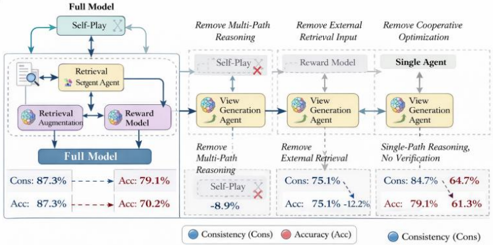
The image presents a diagram illustrating an ablation study of a complex model, likely a reinforcement learning or game-playing agent. The diagram compares the performance of the "Full Model" against variations where specific components have been removed ("Remove Multi-Path Reasoning", "Remove External Retrieval Input", "Remove Cooperative Optimization"). Performance is measured by Consistency (Cons) and Accuracy (Acc).
### Components/Axes
The diagram is structured into four main sections, arranged horizontally:
1. **Full Model:** Depicts the complete model architecture.
2. **Remove Multi-Path Reasoning:** Shows the model with the multi-path reasoning component removed.
3. **Remove External Retrieval Input:** Shows the model with the external retrieval input component removed.
4. **Remove Cooperative Optimization:** Shows the model with the cooperative optimization component removed.
Each section includes a visual representation of the model architecture and performance metrics. The diagram also includes the following elements:
* **Components:** Retrieval Agent, Retrieval Augmentation, Reward Model, View Generation Agent, Self-Play.
* **Metrics:** Consistency (Cons), Accuracy (Acc).
* **Legend:**
* Blue: Consistency (Cons)
* Red: Accuracy (Acc)
* **Arrows:** Indicate the direction of information flow and the impact of component removal on performance.
* **Percentage Changes:** Displayed below each ablation, indicating the performance drop compared to the Full Model.
### Detailed Analysis or Content Details
**Full Model:**
* Consistency (Cons): 87.3% (Blue)
* Accuracy (Acc): 79.1% (Red)
* Consistency (Acc): 87.3% (Red)
* Accuracy (Acc): 70.2% (Red)
**Remove Multi-Path Reasoning:**
* Self-Play is marked with a red "X", indicating its removal.
* Consistency (Cons): 78.4% (Blue) - a drop of -8.9% compared to the Full Model.
* Accuracy (Acc): 75.1% (Red) - a drop of -12.2% compared to the Full Model.
**Remove External Retrieval Input:**
* Consistency (Cons): 75.1% (Blue)
* Accuracy (Acc): 75.1% (Red)
**Remove Cooperative Optimization:**
* The model is simplified to a "Single Agent".
* Consistency (Cons): 84.7% (Blue)
* Accuracy (Acc): 64.7% (Red)
### Key Observations
* Removing "Multi-Path Reasoning" has the most significant negative impact on Accuracy (-12.2%).
* Removing "Multi-Path Reasoning" also significantly impacts Consistency (-8.9%).
* Removing "External Retrieval Input" results in a moderate decrease in both Consistency and Accuracy.
* Removing "Cooperative Optimization" leads to a slight increase in Consistency but a substantial decrease in Accuracy.
* The "Full Model" exhibits the highest Consistency and a relatively high Accuracy.
### Interpretation
This diagram demonstrates the importance of each component within the "Full Model". The ablation study reveals that "Multi-Path Reasoning" is crucial for maintaining high Accuracy, while "Cooperative Optimization" appears to contribute more to Consistency than Accuracy. The removal of "External Retrieval Input" has a moderate impact on both metrics, suggesting it plays a supporting role.
The diagram suggests a trade-off between Consistency and Accuracy. Removing "Cooperative Optimization" increases Consistency but significantly reduces Accuracy, indicating that this component is essential for achieving high performance on the accuracy metric. The "Full Model" represents a balance between these two metrics, leveraging all components to achieve optimal results.
The use of arrows and percentage changes effectively communicates the impact of each ablation on performance, allowing for a clear understanding of the relative importance of each component. The diagram is a valuable tool for understanding the model's architecture and identifying areas for potential improvement. The diagram is a visual representation of a quantitative experiment, and the data suggests that the full model is the most effective configuration.