## Diagram: Model Configuration Comparison
### Overview
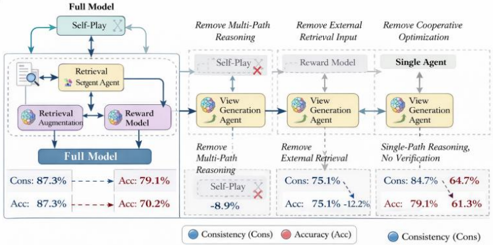
The diagram illustrates a comparative analysis of different model configurations derived from a "Full Model" framework. It evaluates the impact of removing specific components (e.g., Multi-Path Reasoning, External Retrieval Input, Cooperative Optimization) on two performance metrics: **Consistency (Cons)** and **Accuracy (Acc)**. The configurations are visualized as interconnected components with labeled metrics.
---
### Components/Axes
- **Legend**:
- Blue circles represent **Consistency (Cons)**.
- Red circles represent **Accuracy (Acc)**.
- **Main Configurations**:
1. **Full Model**: Includes all components (Self-Play, Retrieval, Reward Model, View Generation Agent).
2. **Self-Play**: Removes Multi-Path Reasoning.
3. **Reward Model**: Removes External Retrieval Input.
4. **Single Agent**: Removes Cooperative Optimization.
- **Key Components**:
- Self-Play
- Retrieval Augmentation
- Reward Model
- View Generation Agent
- Single-Path Reasoning
- Verification
---
### Detailed Analysis
#### Full Model
- **Consistency (Cons)**: 87.3% (blue dot).
- **Accuracy (Acc)**: 79.1% (red dot).
#### Self-Play (Remove Multi-Path Reasoning)
- **Consistency (Cons)**: 75.1% (blue dot).
- **Accuracy (Acc)**: 70.2% (red dot).
- **Trend**: Both metrics decline compared to the Full Model, with a sharper drop in accuracy (-8.9%).
#### Reward Model (Remove External Retrieval Input)
- **Consistency (Cons)**: 84.7% (blue dot).
- **Accuracy (Acc)**: 61.3% (red dot).
- **Trend**: Consistency remains high, but accuracy drops significantly (-17.8%).
#### Single Agent (Remove Cooperative Optimization)
- **Consistency (Cons)**: 84.7% (blue dot).
- **Accuracy (Acc)**: 64.7% (red dot).
- **Trend**: Consistency matches the Reward Model, but accuracy is slightly higher than the Reward Model (-14.4%).
---
### Key Observations
1. **Multi-Path Reasoning Impact**: Removing it (Self-Play) causes the largest accuracy drop (-8.9%), suggesting it is critical for precise predictions.
2. **External Retrieval Importance**: Removing it (Reward Model) preserves consistency but severely harms accuracy (-17.8%), indicating its role in data quality.
3. **Cooperative Optimization Trade-off**: Removing it (Single Agent) balances consistency (84.7%) and accuracy (64.7%), though both metrics lag behind the Full Model.
4. **Full Model Dominance**: Achieves the highest accuracy (79.1%) but has lower consistency (87.3%) compared to some simplified configurations.
---
### Interpretation
The diagram highlights trade-offs between model complexity and performance:
- **Accuracy vs. Consistency**: The Full Model prioritizes accuracy but sacrifices some consistency. Simplified models (e.g., Reward Model) retain consistency at the cost of accuracy.
- **Component Criticality**: Multi-Path Reasoning and External Retrieval are pivotal for accuracy and consistency, respectively. Their removal disproportionately impacts performance.
- **Practical Implications**: The Single Agent configuration offers a middle ground, potentially useful in resource-constrained scenarios where both metrics need balancing.
This analysis underscores the importance of component-specific contributions in model design, guiding decisions on which elements to retain or optimize based on application needs.