## Diagram Type: Mathematical Commutative Diagram
### Overview
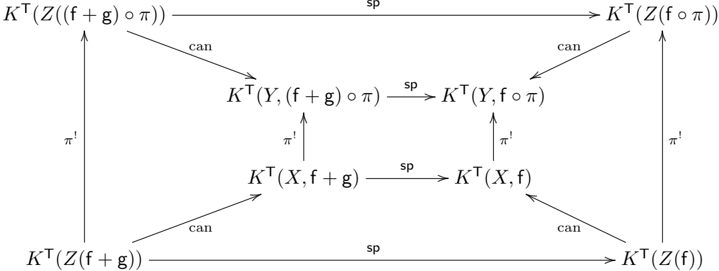
This image presents a complex mathematical commutative diagram, likely from the field of algebraic topology or algebraic geometry, specifically involving K-theory (`K^T`). The diagram has a three-dimensional, cube-like or prism-like structure, showing relationships between various K-theory groups. The nodes are mathematical expressions, and the directed edges (arrows) represent maps or homomorphisms between these groups.
### Components
**Nodes (Vertices):**
The diagram consists of eight nodes, which are K-theory groups. They are arranged in two layers, a "front" layer and a "back" layer, each forming a square.
* **Back Layer (Top and Bottom):**
* Top-Left: `K^T(Z((f + g) ∘ π))`
* Top-Right: `K^T(Z(f ∘ π))`
* Bottom-Left: `K^T(Z(f + g))`
* Bottom-Right: `K^T(Z(f))`
* **Front Layer (Middle):**
* Upper-Left: `K^T(Y, (f + g) ∘ π)`
* Upper-Right: `K^T(Y, f ∘ π)`
* Lower-Left: `K^T(X, f + g)`
* Lower-Right: `K^T(X, f)`
**Edges (Arrows) and Labels:**
The arrows represent maps between the nodes. They are labeled with specific symbols indicating the type of map.
* **Horizontal Arrows (labeled 'sp'):** These arrows connect the left side of the diagram to the right side.
* Top (Back): `K^T(Z((f + g) ∘ π)) —sp→ K^T(Z(f ∘ π))`
* Upper (Front): `K^T(Y, (f + g) ∘ π) —sp→ K^T(Y, f ∘ π)`
* Lower (Front): `K^T(X, f + g) —sp→ K^T(X, f)`
* Bottom (Back): `K^T(Z(f + g)) —sp→ K^T(Z(f))`
* **Vertical Arrows (labeled 'π!'):** These arrows connect the bottom nodes to the top nodes within the back layer, and the lower nodes to the upper nodes within the front layer.
* Left (Back): `K^T(Z(f + g)) —π!→ K^T(Z((f + g) ∘ π))`
* Right (Back): `K^T(Z(f)) —π!→ K^T(Z(f ∘ π))`
* Left (Front): `K^T(X, f + g) —π!→ K^T(Y, (f + g) ∘ π)`
* Right (Front): `K^T(X, f)` —π!→ `K^T(Y, f ∘ π)`
* **Diagonal Arrows (labeled 'can'):** These arrows connect the back layer to the front layer.
* Top-Left (Back to Front): `K^T(Z((f + g) ∘ π)) —can→ K^T(Y, (f + g) ∘ π)`
* Top-Right (Back to Front): `K^T(Z(f ∘ π)) —can→ K^T(Y, f ∘ π)`
* Bottom-Left (Back to Front): `K^T(Z(f + g)) —can→ K^T(X, f + g)`
* Bottom-Right (Back to Front): `K^T(Z(f))` —can→ `K^T(X, f)`
### Detailed Analysis of Commutative Squares
The diagram is composed of several commuting squares, which is the defining property of a commutative diagram. This means that any two paths between the same start and end nodes yield the same composition of maps.
1. **Top Face (Back and Front Upper nodes):**
* Path 1: `K^T(Z((f + g) ∘ π)) —sp→ K^T(Z(f ∘ π)) —can→ K^T(Y, f ∘ π)`
* Path 2: `K^T(Z((f + g) ∘ π)) —can→ K^T(Y, (f + g) ∘ π) —sp→ K^T(Y, f ∘ π)`
* Commutativity: `can ∘ sp = sp ∘ can`
2. **Bottom Face (Back and Front Lower nodes):**
* Path 1: `K^T(Z(f + g)) —sp→ K^T(Z(f)) —can→ K^T(X, f)`
* Path 2: `K^T(Z(f + g)) —can→ K^T(X, f + g) —sp→ K^T(X, f)`
* Commutativity: `can ∘ sp = sp ∘ can`
3. **Left Face (Back and Front Left nodes):**
* Path 1: `K^T(Z(f + g)) —π!→ K^T(Z((f + g) ∘ π)) —can→ K^T(Y, (f + g) ∘ π)`
* Path 2: `K^T(Z(f + g)) —can→ K^T(X, f + g) —π!→ K^T(Y, (f + g) ∘ π)`
* Commutativity: `can ∘ π! = π! ∘ can`
4. **Right Face (Back and Front Right nodes):**
* Path 1: `K^T(Z(f)) —π!→ K^T(Z(f ∘ π)) —can→ K^T(Y, f ∘ π)`
* Path 2: `K^T(Z(f)) —can→ K^T(X, f) —π!→ K^T(Y, f ∘ π)`
* Commutativity: `can ∘ π! = π! ∘ can`
5. **Back Face:**
* Path 1: `K^T(Z(f + g)) —π!→ K^T(Z((f + g) ∘ π)) —sp→ K^T(Z(f ∘ π))`
* Path 2: `K^T(Z(f + g)) —sp→ K^T(Z(f)) —π!→ K^T(Z(f ∘ π))`
* Commutativity: `sp ∘ π! = π! ∘ sp`
6. **Front Face:**
* Path 1: `K^T(X, f + g) —π!→ K^T(Y, (f + g) ∘ π) —sp→ K^T(Y, f ∘ π)`
* Path 2: `K^T(X, f + g) —sp→ K^T(X, f) —π!→ K^T(Y, f ∘ π)`
* Commutativity: `sp ∘ π! = π! ∘ sp`
### Key Observations
* The diagram is highly symmetrical.
* Parallel arrows always carry the same label (`sp`, `π!`, or `can`).
* The structure suggests a compatibility between three types of operations: specialization (`sp`), pushforward/Gysin map (`π!`), and a canonical map (`can`).
### Interpretation
This diagram illustrates the compatibility of different maps in K-theory.
* `K^T(...)` likely denotes the K-theory of a space or a pair of spaces, possibly equivariant K-theory given the `T` superscript (often used for a torus action).
* The arguments `X`, `Y`, `Z` are likely spaces or schemes.
* `f` and `g` are likely functions or sections of bundles over these spaces.
* `π` is likely a map between spaces, e.g., `π: Y → X` or `π: Z → something`. The presence of `π!` suggests it's a proper map or one for which a Gysin map is defined.
* `∘` denotes the composition of functions.
* `sp` likely stands for a "specialization" map, possibly related to deformation to the normal cone or a similar construction.
* `π!` is a pushforward or Gysin map induced by `π`.
* `can` represents a "canonical" map, which could be a restriction map, an inclusion, or another natural transformation between the K-theory groups.
The overall diagram asserts that these three types of maps—specialization, pushforward, and the canonical map—commute with each other in the given context. This is a powerful statement about the naturality and consistency of these constructions in K-theory.