## Commutative Diagram: Category Theory
### Overview
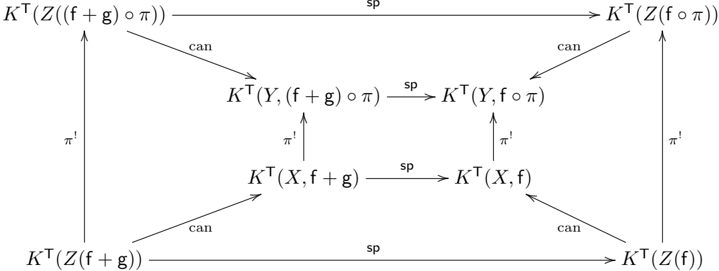
The image is a commutative diagram, likely representing a relationship between objects and morphisms in category theory. It shows various objects labeled with K^T and expressions involving functions f, g, and π, connected by arrows labeled "sp", "can", and "π!". The diagram illustrates how different compositions of functions and transformations relate to each other.
### Components/Axes
* **Objects:** The objects in the diagram are represented by expressions of the form K^T(…), where the content inside the parentheses varies. These include:
* K^T(Z((f+g) o π)) (top-left)
* K^T(Z(f o π)) (top-right)
* K^T(Z(f+g)) (bottom-left)
* K^T(Z(f)) (bottom-right)
* K^T(Y, (f+g) o π) (middle-left, top)
* K^T(Y, f o π) (middle-right, top)
* K^T(X, f+g) (middle-left, bottom)
* K^T(X, f) (middle-right, bottom)
* **Morphisms (Arrows):** The arrows represent morphisms (transformations) between the objects. The arrows are labeled as follows:
* "sp": Represents a specific transformation, appearing horizontally at the top, middle, and bottom of the diagram.
* "can": Represents a canonical transformation, appearing diagonally from the top-left to middle-right, top; top-left to bottom-right; bottom-left to middle-right, bottom; and bottom-left to top-right.
* "π!": Represents a transformation related to π, appearing vertically on the left and right sides of the diagram.
### Detailed Analysis
* **Top Row:** The top row shows a transformation from K^T(Z((f+g) o π)) to K^T(Z(f o π)) via the morphism "sp". There is also a diagonal arrow labeled "can" from K^T(Z((f+g) o π)) to K^T(Y, f o π).
* **Middle Rows:** The middle rows show transformations from K^T(Y, (f+g) o π) to K^T(Y, f o π) and from K^T(X, f+g) to K^T(X, f), both via the morphism "sp". There are also vertical arrows labeled "π!" from K^T(X, f+g) to K^T(Y, (f+g) o π) and from K^T(X, f) to K^T(Y, f o π).
* **Bottom Row:** The bottom row shows a transformation from K^T(Z(f+g)) to K^T(Z(f)) via the morphism "sp". There is also a diagonal arrow labeled "can" from K^T(Z(f+g)) to K^T(X, f).
* **Vertical Transformations:** The vertical transformations labeled "π!" connect K^T(Z((f+g) o π)) to K^T(Z(f+g)) on the left and K^T(Z(f o π)) to K^T(Z(f)) on the right.
### Key Observations
* The diagram is structured in a rectangular grid, with transformations occurring horizontally, vertically, and diagonally.
* The "sp" morphisms seem to simplify the expressions inside the K^T(…) by removing the "+g" component.
* The "can" morphisms appear to be canonical mappings between different objects.
* The "π!" morphisms connect objects with and without the Z prefix.
### Interpretation
The diagram likely represents a commutative relationship in category theory. The commutativity implies that following different paths between two objects in the diagram results in the same transformation. The diagram seems to illustrate how the functions f, g, and π interact within the context of the K^T functor. The "sp" morphisms might represent a specialization or simplification process, while the "can" morphisms represent canonical mappings. The "π!" morphisms likely relate to a projection or pullback operation involving π. The diagram's structure suggests a careful arrangement of objects and morphisms to demonstrate a specific property or theorem within the category.