## Diagram: Function Composition and Transformation Flow
### Overview
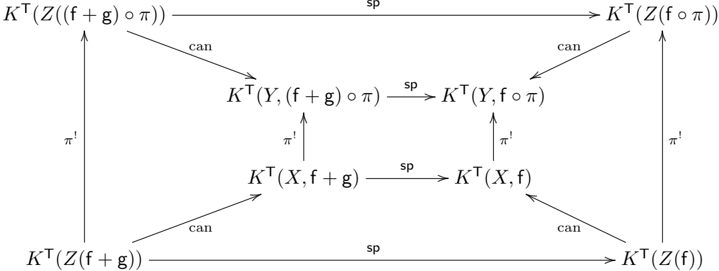
The diagram illustrates a structured flow of function transformations and compositions, represented by nodes labeled with mathematical expressions involving `K^T` (likely a transformation or kernel function) and arrows labeled "can" (capability) and "sp" (specialization). The structure suggests dependencies or possible paths between transformed states of functions `f`, `g`, and `π` across variables `X`, `Y`, `Z`.
### Components/Axes
- **Nodes**:
- `K^T(Z(f + g)∘π)` (top-left)
- `K^T(Y, f∘π)` (top-right)
- `K^T(X, f + g)` (middle-left)
- `K^T(X, f)` (middle-right)
- `K^T(Z(f + g))` (bottom-left)
- `K^T(Z(f))` (bottom-right)
- **Arrows**:
- Vertical arrows labeled `π'` (prime symbol) connect nodes across rows.
- Horizontal arrows labeled "sp" or "can" connect nodes within rows.
- **Labels**:
- `π'` appears on vertical arrows, suggesting a derivative or transformed version of `π`.
- `sp` and "can" likely denote operational relationships (e.g., specialization, capability).
### Detailed Analysis
1. **Top Row**:
- `K^T(Z(f + g)∘π)` → `K^T(Y, f∘π)` via "sp" (specialization).
- `K^T(Z(f + g)∘π)` → `K^T(Z(f∘π))` via "can" (capability).
2. **Middle Row**:
- `K^T(X, f + g)` → `K^T(X, f)` via "sp".
- `K^T(Y, f∘π)` → `K^T(Z(f∘π))` via "can".
3. **Bottom Row**:
- `K^T(Z(f + g))` → `K^T(Z(f))` via "sp".
4. **Vertical Connections**:
- All nodes in a column are connected by `π'` arrows, implying a shared transformation axis.
### Key Observations
- **Specialization ("sp")**: Used for horizontal transitions, possibly indicating refinement or narrowing of function scope (e.g., `f + g` → `f`).
- **Capability ("can")**: Used for vertical transitions, suggesting broader applicability or existence of paths (e.g., `Z(f + g)∘π` → `Z(f∘π)`).
- **Prime Symbol (`π'`)**: Indicates a transformed or derived version of `π`, possibly a derivative or adjusted parameter.
- **Function Composition**: The `∘` operator denotes function composition (e.g., `f∘π` means `f` applied after `π`).
### Interpretation
The diagram likely models a system where functions `f`, `g`, and `π` undergo transformations across variables `X`, `Y`, `Z`. The "sp" and "can" labels suggest a framework for reasoning about possible transformations (e.g., in category theory, functional programming, or optimization). For example:
- **Specialization** (`sp`) may represent deterministic or constrained transformations (e.g., simplifying `f + g` to `f`).
- **Capability** (`can`) may indicate non-deterministic or optional paths (e.g., adapting `Z(f + g)∘π` to `Z(f∘π)`).
- The vertical `π'` connections imply a shared transformation layer across all nodes, possibly a global parameter or constraint.
This structure could represent a proof system, computational graph, or theoretical model for function behavior under composition and transformation.